Audio Interview Wendy Kowalik Part II – On Insurance And Getting Rich Slowly

Please see related discussion with Wendy Kowalik in Part One on investment advisory fees.

Michael:          Hi, my name is Michael and I used to be a banker.

Wendy:            Hi, Michael. Wendy Kowalik, I founded Predico Partners. We’re a financial consulting firm. I started my career with an insurance company and sold insurance for the same 17 years that  we managed money.

Try to save your money from all these nice folks

On Insurance

Michael:          That is my pet peeve, insurance. I think too many people who are engaging with insurance as if insurance was a form of investing make a deep error. I find when people buy insurance they’re being told that it’s some kind of good investment. You and I previously spoke about this guy Dave Ramsey, who for all his flaws, has told me the number one thing I need to know about insurance, which is: figure out what the risk transfer is. And that’s what insurance is for. It’s not for mixing with investments. I deeply believe that.

You came from a firm that did quite a bit of insurance. As we’ve spoken in the past, that’s not always how insurance is sold. Probably the majority of the time it is some kind of weird blend between a supposed investment in addition to a risk transfer. You’ve done it. I haven’t sold insurance or been involved in that, but what do you think about my ideas?

Wendy:            “It depends,” is the worst answer, but globally you’re on the right track. You’re exactly right. And what I’ll tell you is if someone is walking through the door saying you should use it as an investment vehicle, you’re probably on the wrong track.

predico_partners
Interview with Wendy Kowalik of Predico Partners

Very seldom will you find that working well. The insurance industry’s argument on that side of it is it’s disciplined savings. It grows tax deferred. Well, so does your 401(k). Make sure you’re making that out first. That’s the first place you need to be saving, on that side.

The other argument is you can go in and take a loan out tax-free. Very true statement except for the fact that if the policy doesn’t last for the long term, then you pay taxes on every dollar you took out. That’s where it’s all the details within the insurance that many times make them not work as they were originally sold.

Yes, for globally, I would tell everybody that there’s only two reasons to purchase insurance.

  1. To protect an income source if you’ve got a spouse that’s working and you need their income to make your monthly budget. You need to protect that.


  1. The second side of the table is if you have estate taxes. You can use insurance to basically pay a lower dollar amount for you estate taxes. Outside of those two pieces of the puzzle, I don’t really see a huge need for life insurance.

Michael:          The second part, the estate taxes, is going to be much more of a high net-worth problem than an ordinary investor problem. We’re talking up at the top 5%, 1% or .01%. It gets more plausible that they’re going to be able to have a tax savings and estate planning through insurance, right?

Wendy:            Right, sitting here today, an estate over 10-million dollars for a married couple and an estate over 5-million dollars for a single individual.


Michael:          What I tell people, and most of my ordinary acquaintances are not in that category, I just say “You need to focus on self-insuring” through trying to invest your money so that when it comes time where you can no longer work, or you choose to not work, you’re not worried about an income stream, and you’ve self-insured though actual investments, rather than this expensive version, which is paying an insurance company to be this mix of asset protection, asset building, and income replacement.

Wendy:            That’s exactly right. You should have two different pieces of the puzzle. You should have term insurance if you’re protecting an income stream for a period of time. And use your savings separate from that.

Michael:          Right. I just don’t trust that most insurance sales people in the industry is parsing that out for people to say “If you’re got a risk of loss of income, you need term for the period of time in which you’re worried about that, and then use the savings to put that in the market.”

This is what I always tell people — without knowing — having not worked in the insurance industry that just seems to be the right thing.

Wendy:            Right.

Michael:          For most people, with obvious exceptions. If you’ve got a ten-million-dollar estate it’s a whole different situation and you probably need different set of advice, which I’m not qualified to give. We’ve got term insurance in my family related to how old my kids are, when they are going to be no longer under my protection, and can fend for themselves in a sense. But it’s super-duper cheap to get that, for a certain number of years, and a certain amount of money, not a huge amount, but sufficient to not leave them in a lurch.

Wendy:            That’s the biggest struggle on the insurance side, is figuring out what that number is.

Michael:          Tight.Certainly back to your two reasons to have insurance. One is replacing income stream, and the second is estate planning and possible tax reduction. The folks for whom that second part is relevant, estate planning — the first part seems to me to be totally irrelevant. You’re either in one or the other. You’re probably not in both because if you have ten million somewhere in assets, you don’t really need to ensure further a loss of income stream. You’re probably going to be able to feed and clothe yourself now. Or am I not thinking about that right?

Wendy:            Yes, no you’re right. Could they self-insure? Absolutely. What you’ll find a lot of times, though, is you’ve got people in that situation that have purchased property or they’ve got a family-owned business that makes that up. Then it becomes a liquidity event. Do I really want to unload Pepsi to pay the estate taxes? Or do I want to have to sell at that point or do I want to buy some time? It still may not be this massive convoluted structure, but I may be that I want to purchase an amount to give me time to figure out what I want to do with the asset.


On Budgeting, and Getting Rich Slow

Michael:          So, any other topics you think we should get onto the podcast?

Wendy:            The other thing you put on there was budgeting. How do people come up with a budget.

Michael:          Oh yeah, let’s talk about that.

Wendy:            I do think that is a big piece of the puzzle. The number-one side we run through is no matter how much money you have, you’ve got to understand how much you spend that’s fixed expenses and will not change, no matter what you do right now, unless you actually make radical lifestyle changes, such as selling your home, changing your cars, that type of thing.  Or is it just discretionary, and to me that is such a big piece of the puzzle, is understanding exactly what you’ve got that’s fixed, what you’ve got that’s discretionary, because that’s the only way you can determine can I really cut back and make some changes, and start saving more, because we don’t need to eat out as much or go do this as much. Or is it that we’ve extended beyond what we can truly afford either in a home, or cars, or things such as that, and we need to change lifestyles more dramatically than just not going out to eat on Friday nights.
money_problems

Michael:          I’ve taken to saying to people, my friends, or peers, or people that ask my advice that nobody has any extra money at the end of the month. Whether you make 350,000 bucks a year or you make  35,000 bucks a year. There’s no extra money. Your lifestyle builds to whatever you’ve gotten comfortable with, and I tell people you basically have to trick yourself into creating little streams of savings and investments. This isn’t true for everybody and to bring up my nine-year-old daughter, she’s basically a hoarder. Her babysitter basically said early on she’s going to be on the hoarder TV show. She never throws anything away, so if you give her some money — there’s a few people like that, who save all their pennies, nuts, and squirrel them away.

But for most people there is no money. There’s no salary that’s enough to make sure you have extra money. If you move up from the Honda to the Audi, then you have to get the Jaguar. You’re still just buying a car, but somehow if you make 350,000 dollars. It’s not hard to go bankrupt on 400,000 dollars a year. Mike Tyson went bankrupt after earning 300-million dollars in his life. There isn’t any real money…[that’s sufficient.] You have to figure out tricks and ways to get the excesses.

Then you have these weird stories of the person who never made more than 40,000 dollars in their life, and they have huge investment accounts, relatively speaking, at the end of their life. They were able to do it.

Wendy:            My favorite was we had a client referred to us in my former firm. That was exactly it. He had been a civil service employee, never made over 40,000 dollars for many years, and finally topped out at 65,000 dollars. She was in her early 80s, late 70s, and her investment account was worth 15 million dollars. She purchased with every extra few dollars, at the end of the month, she’d say this is what we’re going to set aside for savings. He would purchase bank stocks because he decided that it paid a little bit in dividends, and that was what he followed. He did financial stocks and he purchased six stocks, followed them. He never once sold a dollar of them. He never cashed them in for anything, and just added to those same six. That’s what it grew to. It was absolutely incredible.
stocks_v_bond
Stocks for the long run

Michael:          That is incredible. If you have 60 years of doing that, there’s the compound returns of equity exposure to a couple of good stocks or six different bank stocks over a certain period of time. That’s incredible, yet mathematically very plausible when you look at it, how much you could put away, and if you let it ride for 40 to 60 years. It’s totally doable. It doesn’t feel like that until holy cow, 30 years later suddenly it’s grown.

Wendy:            Right.

Michael:          I feel like that message doesn’t get out to enough people or it gets out when you turn 62 and you’re like huh, so I should have been starting 40 years ago? Now you tell me?

Wendy:            That’s right. And I think it’s hard to withstand, and I think what many people strive for is they keep trying to find a better way to get to the investment returns. They’re looking for that — there’s some trick to get there. A lot of it is just hard work and discipline.

Michael:          I think automatic deductions from paychecks or your checking account, so you never see it — just like investment advisors are going to secretly, stealthily take out 1% or 1.5% per year. If you can get your 401(k) and then your brokerage account to sneakily take out a few hundred and then a few thousand dollars per pay period, it works out in the long run.

Wendy:            Exactly. You’re right.

Michael:          It’s hard to make the affirmative choice to do it, but if just sneakily happens by default you can build up wealth, I think.

Wendy:            I completely agree. We tell everybody if you take it and send it to a brokerage account that’s not in your bank, leave it in cash for 90 days, that way you know can you really make it without that money, without having to go back and take it back. You normally won’t call the brokerage account and ask them to send you a check. You really do need it if you’re doing that. So then at the end of 90 days put it to work. See if you can increase it and put away more in the next pay period.

Michael:          I think that method works. GET RICH SLOW. It’s hard to get rich quick.

Wendy:            Very true.

Michael:          Thank you for discussing all these things. I think there’s lots of interesting ideas here that people should be paying attention to.

wendy kowalik pic 2
Wendy Kowalik, President of Predico Partners


Please see related posts:

Interview with Mint.com – I give ALL the answers

On Insurance – Use for Risk Transfer Only

On Insurance as an Investment

401Ks are awesome but should be simpler

Guest Post from Lars Kroijer: Don’t buy too much insurance

On Longevity Insurance: Do You Feel Lucky?

Audio Interview Part I with Wendy Kowalik – On Fees


Post read (1034) times.

Interview with Mint.com – I Give ALL The Answers

Finance website Mint.com asked me some good questions for their blog. You can visit them there or enjoy the repost below.
Interview_mint_Bankers_anonymous
As a former Wall Street insider, what do you think is the average person’s largest misconception about investing?

The average person thinks that what Wall Street does is so complex that it requires extremely bright specialists to handle the complex needs of individuals. And the average person thinks implicitly that complexity and special skills naturally justify high fees.

And while it is true that many to most people on Wall Street are bright and there are complex things happening there, all that intellect and complexity is irrelevant for the vast majority of individuals. For most Americans, including high net worth individuals, a very simple and inexpensive approach will serve them best.

If you had the ability to get every person in the United States to adhere to three financial principles, what would those be? Why?

Great question. More than principles, I would go with three financial attitudes. Those would be:

a) Optimism – You kind of have to trust that markets are going to work out fine in the long run, even when the short run and medium run look extremely frightening.

b) Skepticism – Most financial solutions you get pitched with constantly are irrelevant or overly costly.

c) Modesty – Be realistic and modest about your own ability to ‘beat the pros,’ and realistic and modest about the ability of professionals you hire to ‘beat the pros.’ Also, modesty about attributing one’s investment success can avoid mistakes due to excessive confidence.

How does life change when one has more financial literacy? What does it take to be financially literate? How illiterate are most people?

Financial literacy is a process that most people need to engage in, but a process for which there are too few guides. Most of our parents don’t know how to help. Certainly our teachers and professors are mostly unhelpful guides. Most of the ‘experts’ in the media are in fact salespeople in one form or another, so while they can tell you the positive features of what they sell, most are unhelpful in helping us sort out our different options in a suitably skeptical way.

Most well-educated people that I know are very uncertain what to do when it comes to financial decisions. Or worse, they have high certainty, but wrong ideas. Both versions of financial illiteracy can be very costly.

Financial literacy obtained in one’s early twenties, I think, would make the average, middle-class person $1 million richer at the end of their life. That’s the premise of my book. (More on that later, see below, the end of this post.)1

For higher earners, the benefits of financial literacy will be many multiples of that.

Investment is something that many people want to do, but don’t seem to fully take advantage of. What are some of the best practices one can employ to become better at investing?

The four biggest determinant of investment results are:

  • Time (longer is better)
  • Asset allocation (risky is better, and for non-experts/non-insiders, diversified is better)
  • Costs (lower is better)
  • Tax advantages (zero, low, or deferred taxes are better)

A powerful way to combine those four advantages – one that anyone can do but not enough of us do – would be to fund your (tax advantaged) retirement accounts (like an IRA or 401(k)), and purchase risky (100% equity) low-cost (probably index) mutual funds while still in your twenties.

A 22 year-old who does that for the next ten years is guaranteed wealth in his or her old age. In fact, it is impossible not to end up wealthy if a 22 year-old does that for ten years in a row.

If you’re not 22 right now, you won’t have as much time – which is a shame – but it’s probably still worth doing all the steps that I described above at any age.

The absence of 50 years of investment growth makes a wealthy old age still likely, but just less guaranteed.

Another important best practice is to employ automatic deduction as your main weapon to fund retirement and investment accounts. By that I mean you have to set up a system with your brokerage firm that automatically transfers money from your paycheck or your checking account every month (or every two weeks, or whatever) into your retirement and investment accounts.

The weird secret is that basically nobody has enough money left over at the end of the month or year for investing. But if we take that money out in small increments through automatic deductions, somehow we find we do have the money. This is one of those weird psychological tricks that make the difference between being wealthy or not being wealthy in our old age.

There seems to be a battle among many individuals who struggle with paying down debt and trying to save. What kind of advice can you give them?

If we have trouble paying down debt and saving, then we have to employ a series of Jedi mind tricks to get it done. Those Jedi mind tricks could involve three methods: a) automatic deduction b) budgeting, and c) radical transparency.

a) Automatic deduction, which I mentioned above, is probably the most powerful of these. You have to figure out a way to get your money out-of-sight, out-of-mind before you spend it. If you’re in debt, that means setting up automatic payments toward your high interest debt. If you’re trying to save or invest, that means setting up automatic payments out of your checking account and into a hard-to-reach savings vehicle or brokerage account.

b) Budgeting, which I hate to do – along with 99% of the rest of the planet – is not for me a long-term sustainable solution in itself. But over the short-term, it can actually help you alter your behavior when you start to write down every single freaking, nitpicky little transaction. The act of recording all transactions – even just for a couple of weeks or a month – I believe could change your behavior. That’s because you realize just how many non-essentials you purchase. It gets annoying writing down that packet of tic-tacs, and the latte, and the iTunes download, but then you realize you made $173.52 in non-essential purchases last month. And if you could dedicate the $173 extra to debt payments per month, you might actually be able to get rid your debt in this lifetime.

c) Radical transparency means announcing to your group of friends, or a single friend, or a debt-counseling group, your intention to get debt free in a set amount of time. Then you commit to regular (daily?) updates to your support person. The publically-stated intention, along with the support you will get from the group, may be the Jedi mind trick you need to actually kill your debt. There’s something powerful that AA members have figured out, which is that if you admit your powerlessness, and then you ask for help from an understanding group, you may be able to achieve the previously impossible-seeming task.

What do you think are some of the biggest challenges regarding debt (getting out of it, staying out of it, paying it off, etc)?

Debt exists in that psychological area of shame in which, like a cat with a broken leg, we want to hide our injury from others. We don’t want to admit our debts to others, and we don’t want to ask for help. We may even engage in self-destructive behavior – “Hey, let me buy this lunch for everyone!” – in order to hide our shame.

People stuck with excessive debt probably also have a fatalistic approach; they may believe that it’s not possible to reduce or manage their debt, so why even try? For people for whom this sounds familiar, I’d recommend a classic from the 1930s called The Richest Man in Babylon.

It may seem cheesy at first to the modern reader, but I think it effectively captures the psychology of a debtor’s resistance to getting out of debt. The book also has extremely practical steps toward becoming debt-free and then building wealth.

You say on your site that politicians are able to take advantage of citizens because those citizens are not as aware of financial matters as they should be. Please provide an example of this and how financial literacy can help fix this problem.

‘Taking advantage of’ is too strong a phrase. But I think citizens cannot properly police their officials if they don’t understand concepts like compound interest, which affects the future growth of government debt, public pension obligations, and Medicare and Social Security obligations.

Young people entering the professional world oftentimes come into adulthood with debt from student loans. What advice would you offer to these individuals?

The best situation would be to minimize student loan debt up front, but I suppose that line of thinking would get us talking about unlocked barn doors and horses that have already left the premises. It’s at least worth mentioning, however, that borrowing big sums of money to get a name-brand educational degree may not make as much financial sense as loading up on credits on the cheaper side (e.g. two years of community college, then transfer) before purchasing an expensive educational certificate.

Once you have a pile of student loan debt, I think the situation has to be tackled with optimism (student debt can be paid off) but realism (you may not be able to pursue your artist’s dream right now).

Stealing a page from the aforementioned The Richest Man in Babylon, I would suggest students do NOT forget to start an investment account. The author of that book has an interesting formula that, while it may not work for everyone, at least has the virtue of simplicity.

It goes like this:

1. Arrange your lifestyle such that you can live off of 70% of your take-home pay on a monthly basis. (I know, I know, this seems impossible. But still, it’s probably your only chance ever of making it all work out in the long run. Basically, yes, we’re talking about rice & beans, a subpar vehicle, and an apartment in a rougher neighborhood than you would prefer.)

2. Dedicate the next 20% of your take-home pay to paying off your debts.

3. Dedicate the final 10% of your take home pay to investments. In the beginning, this should to be channeled to an Individual IRA or 401(k).

When indebted, it seems like step #3 is an impossible kick-in-the-pants suggestion, because there’s no extra money to make this happen. The problem with skipping step #3, however, is that a student-loan-burdened individual will never get around to starting investing, until age 40. By then, it’s almost twenty years too late to get started.

So as impossible as it may seem, my advice for the student-loan-indebted recent graduate is to follow all three of the steps above. 70% for living expenses, 20% for debts, 10% for investments. Wash, rinse, repeat, every month. Rice and beans will suck for a while. But wealth will follow.

What are your thoughts on retirement and preparing for retirement? What about those who have already retired and are scared of outliving their money?

For people who are already putting away money in their tax-advantaged retirement accounts (IRAs and 401(k)s), the most important decision is probably their allocation to risky assets (like stocks) vs. non-risky assets (like bonds). The mistake most people make, in my opinion, is to dedicate too much money to the non-risky category.

This mistake is exacerbated by 98.75% of all investment advisors who tell their clients to invest in a mix of 60% stocks and 40% bonds. This piece of advice – which I strongly disagree with – serves the investment advisor well because you will not panic when the market crashes, and therefore you are less likely to fire your investment advisor for losing you money.

I think this advice serves the individual less well, since most people would end up far wealthier in the long run if they invested a higher percentage of their assets in the risky category.

My further thought process, which owes a heavy debt to the amazing book Simple Wealth, Inevitable Wealth by Nick Murray, goes like this:
a) Retirement accounts, by definition, are long-term investments. Even if you’re already retired, you need retirement money to last many years – often a few decades.


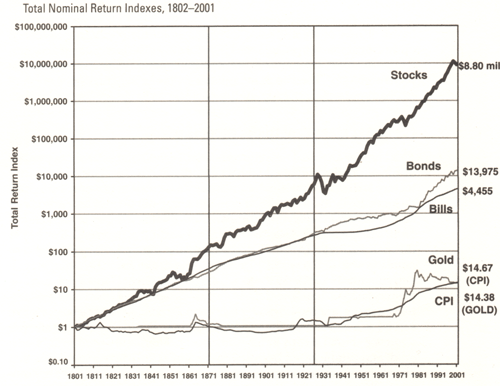
b) The longer your time horizon, the higher the probability that risky (like stocks) beats non-risky (like bonds).

c) Using the historical experience of the last 100 years, we can say the following: with a five-year horizon, stocks beat bonds 70% of the time. With a 10-year horizon, stocks beat bonds 80% of the time. With a 15-year horizon, stocks beat bonds 90% of the time. With a 20-year horizon, stocks beat bonds 99+% of the time.

d) Because most retirement money is invested for the longest time period, by allocating your retirement money to bonds you are basically saying that you believe that history is no guide at all, “it’s different this time,” and that odds-be-damned, you want to make a very low probability bet. That’s fine, and that’s what 98.75% of investment advisors tell you to do, but personally I think that’s a crying shame and a terrible choice, as well as a way to reduce your wealth in your retirement.

e) Although risky assets (like stocks) are extremely volatile in the short and medium run, a longer investment time horizon (plus automatic deduction dollar-cost averaging!) makes equity volatility less of a risk and more of an opportunity.

f) The real risk of investing your retirement money is actually with bonds, an allocation to which – for many people – will cause them to outlive their retirement funds. After taxes and inflation, bonds lose purchasing power. I understand this is contrary to conventional wisdom and contrary to what 98.75% of all investment advisors say, but that doesn’t make it any less true. Again, for a more articulate presentation of these ideas a) through f), I highly recommend Nick Murray’s Simple Wealth, Inevitable Wealth.

By the way, I’m not an investment advisor, so I suffer exactly zero consequences for people taking my advice on this topic or not. And that’s precisely why I have credibility on the issue. I’m not worried about being fired as somebody’s investment advisor when the market crashes.

And by the way, the market will definitely crash. I don’t know when, or by how much, but it will crash multiple times over the course of your investing lifetime. The key, however, is to not panic, and instead keep on doing what you were doing. Ideally, this means automatic deduction investing, so that you can dollar-cost average your stock investments at more advantageous prices when the market crashes.

Please share anything additional that you would like individuals to know about Bankers Anonymous.

I’m passionate about teaching finance. I’m on a mission!

My book The Financial Rules For New College Graduates: Invest Before Paying Off Debt And Other Tips Your Professors Didn’t Teach You is for the smart  college graduate just starting out trying to navigate the highly consequential financial choices regarding car loans, debt, savings, home-ownership v. renting, insurance, entrepreneurship … even philanthropy and retirement planning.


Please see related posts:

Book Review: The Richest Man In Babylon, by George Clason

Book Review: Simple Wealth, Inevitable Wealth by Nick Murray

Book Review: The Automatic Millionaire by David Bach

How To Be A Money Saving Jedi

Stocks vs. Bonds: The Probabilistic Answer


Post read (3271) times.

  1. When this post first came out in 2015 I hadn’t written my book, but I very much wanted to. The book came out in 2018, and if you liked this post you should, well, buy it!

Do You Need An Investment Advisor? And Why?

nest_egg

A version of this post previously appeared in the San Antonio Express News.

Some friends of mine recently opened up investment accounts with a guy who is a salesman at a national insurance company. My friends also hired a “fiduciary” to review their investment plans. Finally, they consulted me, for free, on what to do with their investments because I’m a friend.

They seek answers to something nobody ever bothers to teach. They need financial advice. Who doesn’t?
Among the three sources they recently contacted, they will certainly hear quite a bit of possibly contradictory advice. In the long run, I got to thinking, do they also need to hire an investment advisor?
“Do you need an investment advisor?” is one of those evergreen questions for people who have managed to accumulate some investments.

The short, albeit possibly contradictory answer — given that I do not have an investment advisor myself — is: “Yes, probably.”
Following on the heels of that question, if the answer to the first question is yes, is: “What do I need an investment advisor for?”

I’m so glad you asked. And you’re not going to believe this, but I have very strong opinions on this question.
A good investment advisor should do two — and only two — things, and then stop.

Number one thing: Set up an investment plan for the client that has a reasonable chance for success at meeting the client’s goals, taking into account the client’s ability to save and invest. The plan should be so simple that all parts can be understood clearly by the client. The plan should run on auto-pilot (probably involving automatic paycheck or bank account deductions), and should rebalance on a low-frequency cycle (probably through new purchases, rather than sales).
All of this should be accomplished within two visits with the investment advisor.

Number two thing: When the market crashes — by the way, the only 100-percent guaranty in an investing life is that the market will crash, probably more than once, in a client’s 30-year investment cycle — the investment advisor is there to prevent the client from selling after the crash. Because when things get cheap you’re supposed to buy more, not sell.
Psychologically speaking, few of us can stomach the nausea of actually buying after the crash.

Ahem. Now, would all those reading this who made stock purchases in March 2009 please raise your hand?
Oh, really? All of you with your hands up are liars.
While we rarely have the sense to buy at the lowest point in the market, realistically a good investment advisor reminds us at least not to sell after the crash happens. The good advisor reminds us that we knew a crash would happen a couple of times in our 30-year investment cycle.
After the crash comes you don’t sell — you just keep on doing what you’re doing. If the advisor can prevent the panicked sale after the crash, the advisor is worth all the money paid to her over the years.

And that’s it. Anything else that an investment advisor does is probably too much, and the client may suffer as a result.

“But, but, but…..” I can already hear all of the investment advisors out there protesting.

But what about tax planning? And estate planning?
What about insurance products? Have you considered whole life versus term life insurance. Or can I interest you in a variable annuity?
But shouldn’t an advisor pre-screen some hedge funds and venture capital funds?
Want to hear about oil & gas leases? Master limited partnerships?
I’m pretty sure there’s real estate and mortgage refinancing to be done, no?
What about picking great stocks for a client?

financial_advisor
If your financial advisor was a stock-photo robot, he should look like this

But what should I know about precious metals, agricultural commodity futures, and that new project finance deal in Ghana?
I also once read something about sector rotation? And then there’s value vs. growth? And biotech, and countercyclical consumer products!
What about anticipating the Fed, trading ahead of new data releases, getting in early on the next hot trend, or black-box trading and currency hedging?
Look, I agree — finance can be endlessly fun and interesting, and these are all great areas for a broker or investment advisor to get into because they produce wonderful opportunities for additional fees, commissions, portfolio churn and opacity. In most cases, however, they just don’t happen to produce wonderful results for clients.
If you need insurance or tax planning, by all means hire an expert. But a good investment advisor does not necessarily serve her client by brokering all these products.

To sum up:
Do you know how to set up what I describe above as “the number one thing” all on your own? If not, you probably need an investment advisor.
Second, do you know — beyond a shadow of a doubt — what you will do when the market crashes? Are you sure? If not, you probably need an investment advisor to hold your hand — that itchy-to-sell trigger-finger hand — to prevent you from selling.


Please see related posts: Book Review of Simple Wealth Inevitable Wealth by Nick Murray
financial_advice

Post read (3110) times.

Book Review: How To Avoid Financial Tangles


If you ever read any novels by Jane Austen, Anthony Trollope, or Charles Dickens you quickly realize that the most important goal of 19th Century English life was securing – through a fortunate birth or a strategic marriage – a steady income based on the rents of private property.

The plots of all their novels hinge on this uncertain quest. All of their protagonists seek to navigate the twists and turns of what may euphemistically be termed ‘financial tangles.’

Popular culture – at least in the US – no longer focuses quite so much on this singular struggle, as our movies tend to teach either one of two lessons. It’s either ‘true love overcomes all obstacles’ or ‘underdogs can overcome powerful antagonists through pluck and an intriguing bromance.’[1]

Despite the shift in popular culture, however, I would argue that avoiding financial tangles remains the central struggle of real life in the 21 Century.

I mention this because I wandered into a used bookstore recently, found myself at the finance section, and a book named How To Avoid Financial Tanglesby The American Institute For Economic Research fell into my hands. [2]

financial_tangles

Financial tangles? That sounded interesting, as did the fact that the AIER is in Great Barrington Massachusetts. Massachusetts! My people! This should be good, I thought.

I noticed the first edition of the book was published in 1938 (a good year for financial tangles) and has been updated periodically since then. I also noticed 1938 represents a sort of halfway point in time between the Dickens & Trollope era and our own day, although my copy from the bookstore was published in 1995.

I’ve been reading through it slowly since.

What many of us need to know about financial tangles goes beyond what can be gleaned for free from a finance blog. On the other hand, we do not want to start incurring lawyers’ and accountants’ fees whenever we might step into a tangle.

We often need something relatively sophisticated, but at the same time not overly technical.

This book offers a kind of half-way technical approach. You will not find clever Clint Eastwood references to explain insurance concepts, or clever Sci-Fi analogies for quantitative trading, but you will get a starter briefing on important issues of real estate, trusts, wills and estates, insurance and contracts – basically all of the stuff of 19th Century English novels.

Do you know the difference between joint tenancy and tenancy by the entirety? You better believe Lizzy Bennet knew. Are you familiar with Trusts for Minors? The lawyers in Jarndyce & Jarndyce were. Do you know the most important principles for designing a Will? The residents of Barsetshire did.

Do you have a will? Do you know why you should have one? Do you know why people – even relatively non-wealthy people – create trusts?

How To Avoid Financial Tangles can help you self-educate, most likely in advance of speaking with an attorney or some other specialist.

I’m not saying you will love reading this as much as you do reading Trollope, Dickens and Austen, but this is a solid place to start the modern process of avoiding financial tangles.

Please see post: All Bankers Anonymous reviews in one place!


financial_tangles


[1] I defy you to come up with a major Hollywood movie that doesn’t follow one of these two patterns. See? You can’t do it.

[2] For those of you under age 40, “books” used to come in a paper, glue, ink, and cardboard format that could be physically held. This brought tremendous obvious disadvantages to people who read “books” this way. You couldn’t create an infinite number of copies at the press of a button. You could not Google search for key words, or check your precise % already read. You could not even cut and paste favorite passages to your Twitter account, without doing irreversible damage to the original book with scissors. Anyway, for this old style of book, believe it or not but there are still actual buildings where “physical book” fetishists still lurk, touching and handling the old-style paper and ink things. Used bookstores – and physical bookstores for that matter – now exist only outside of the “real economy” and may be safely ignored by all of you under age 40.


Post read (4963) times.

Rapunzel and Compound Interest

Rapunzel
Trapped in the tower for the Summer, learning Compound Interest

“Daddy,” began the little princess plaintively, “I’m bored.” The poor thing is trapped in her tower for the Summer months. Wizarding school ended the first week of June, and will not start again until next Fall.

Also, it’s a Sunday and her 4-year old sister, the other little princess trapped in the tower, naps deeply on the couch.

“Oh is that so?” replied the wizard, looking up from his desktop computer, the glass desk table strewn with envelopes with coffee mug circles, and toast crumbs.

“Yeah, there’s nothing to do.”

“Huh. Sounds like we need to do some math magic. Would you like to do that?”

“Ok!” she brightens.

“Can I show you how to spin ordinary straw into gold, so you can be very rich 50 years from now?

“Daddy…” she gives the wizard her stop-pulling-my-leg look.

“What?” the wizard looks back innocently, eyebrows raised.

“Ok fine, show me.”

It turns out the sweet thing will do anything to escape the existential prison-tower called Summer. The wizard cackled silently to himself.


Calculating Annual Returns

“Let’s take this magical spell step by step. We have to build up the magic in small pieces to be able to do all of it.

Do you remember last Fall, when you invested $500 in shares of Kellogg?”

“Yes, you took all my savings and risked them in the market,” The princess looked up reprovingly.

“That’s right. Well, I’m sure that must have been magical money – received over eight years from Godparents, Santa Claus, and the Tooth Fairy – because look what’s happened to your $500.”

With that, the wizard took out his magical iPhone and pressed the ‘Stocks’ App, which showed a closing price of 68.91 for ticker symbol K.

“The stock is up 11% since September last year,” pointed out the wizard. And since it’s been less than one year, so far you’ve grown your money at an annual rate of 15%.”

“But that might not last, right? Because you said it could always go down?”

“That’s true. It still might, and it probably will go down at some point. But in the long run, it probably continues to go up. And since you don’t need the money for a long time, you can think about what’s going to happen in the long run.”

“Ok.”


Calculating one year’s annual growth

“The magic spell I want to show you – how to spin ordinary straw into pure gold – happens over a long time. In fifty years, when I’m over ninety, and a very old wrinkled wizard, you will be a very rich princess. But first, let’s talk about how to figure out the growth of your money in one year

Do you remember how we talked about percents?

To figure out how your money can grow over one year, you have to multiply your original amount by the percent growth, and then add it to the original amount.

So to do the first part of this spell, you need to calculate 15% of $500, and then add that to $500. Let’s see how much money you could have after one year.”

With that, the princess took her blue-ink wand in hand and scratched out the runes on a paper notepad. After a half-minute of spell-casting, she looked up.

“$75 more. So after one year I would have $575 if it grows by 15%.”


Calculating Compound Returns in multiple years

“Very well done. Now I’ve got two more intermediate steps that you will find too hard, but after you try it and can’t do it, I’ll help you through the magic.

Tell me how much you would have after 2 years and 3 years, if you start with $500, and achieve 15% growth each year, for 2 years, and then for 3 years.

The princess began to puzzle over this. Her magic didn’t seem to be working. She wrote some runes, and then some more runes, and then scratched them out. Some heavy sighing followed. She held her golden head in her left hand, while working magic with her right. Finally, with a little prompting, she came up with $150 in extra money, over two years.

“$650 after two years?” she looked up hopefully.

“Close, but not quite,” replied the wizard. “The difference is that when you compound growth at 15% for two years in a row, you have to start the second year’s growth from the previous year’s ending point. With this, the wizard quickly showed how the magic spell gets cast.

“One year’s growth gets you to $575, and then the second year’s growth will be 15% of the $575, or $86.25. When you add that to $575, you end up with $661.25.”

The princess looked up, a little unsure where this was going, or why the difference mattered much.

The wizard plowed ahead anyway.

“Can you show me how you’d get to the third year?” asked the wizard.

This time, the young princess had the right insight.

“Multiply the $661.25 times 15%, and then add that to $661.25?”

“Exactly!” The wizard pulled out his magical iPhone, pressed the calculator App, performing a mystical ritual involving intricate numerical symbols.

“Accio Numericus!” he exclaimed as he pressed the “=” on his calculator with a flourish.

“Daddy.” eye-rolled the princess. The wizard turned the magical iPhone face toward her so she could read it.

“760.44,” she read.

“That’s not the real trick though,” warned the wizard.


Do you want to see something really magical?

“Ok,” said the wizard conspiratorily, lowering his voice a little bit. “Do you want to see the whole magic spell? We had to learn the basic magic before you could handle this.”

“What if you could keep compounding your 15% return over the next 50 years? When I’m a wrinkled old wizard, that $500 of straw you invested could become gold. But how much gold? This magical spell tells you.”

Calculating long-term compound growth of an existing investment

The wizard added to the tension in the room by slowly checking over his right shoulder, then over his left. Seeing no prying eyes of elves, orcs, or bad wizards, he returned to the pad of paper in front of them.

There, he wrote a mysterious series of letters:

FV = PV * (1+Y)^N

The wizard looked up, wide-eyed, expectant.

Here, finally, some powerful magic to impart to the young magi princess.

The princess giggled.

The wizard frowned.

“That is totally confusing!” she exclaimed. “Why are there so many letters?”

“No, no, no, you can understand all of this math. Let me just tell you what everything means and you’ll see.

Writing “FV” on the pad, he said “FV just means “Future Value,” which is what our magic is going to calculate. That’s our magical answer – what we’re working towards, how much gold you’ll have in fifty years.”

And now writing “PV” on the paper, the wizard continued, “PV is just Present Value, which is the amount we started with. For you, that’s the $500 you invested in Kellogg.”

“The magic symbol ‘Y’ in this spell,” the wizard went on, is the annual return that we’re working with. Since we’re trying to figure out the answer to a problem with a 15% annual return, we can use 15% for Y in this formula. Since 15% can also be written as a decimal 0.15, we’ll end up turning (1+Y) in the formula into 1.15 for our magical calculation.

“But Daddy you’ve never told me anything about an N. N doesn’t make any sense to me.”

“N is just the number of years. And it has the little carot symbol to show that it means ‘raised to the power of,’ do you remember that?”

“I think so.”

“Right, so when we did 3 raised to the power of 2, we wrote it 3 times 3. And 5 raised to the power of 4 we wrote it 5 times 5 times 5 times 5. In this magical spell, we’re going to have 1.15 times 1.15 times 1.15, but multiplied by itself for a total of 50 times. Which we’re not going to do in our heads, but rather with the magical and mystical iPhone calculator App.”

“Ok,” came the princess’ reply, a little skeptically.

“Are you ready for the magic?” intoned the wizard, upping the drama once again. “First, I want you to guess how big your $500 straw can grow into spun gold in 50 years, when I’m an old wrinkled wizard.”

“I don’t know.”

“Just guess. Something big.”

“I don’t know, maybe $2,700.”

“No, bigger. I said you’d be rich.”

“Ok. How about $9,000.”

“Let’s see what the magical iPhone calculator app tells us. First, we turn it horizontally to be able to see additional calculator functions, in particular the ‘X raised to the power of Y’ button. Now, remember to always say ‘Accio Powerzoom Numericus’ when you input numbers like this.”

Sigh from the Princess. Half an eye-roll.

“No, you have to say it. Say it with me.”

“Accio Powerzoom Numericus!”

The wizard theatrically pressed buttons while describing his process.

“First, enter 1.15, then the ‘X^Y ’ button, and then 50, for the number of years, and then hit the “=” sign.

Now multiply that result by our original PV of $500.

There’s your answer: $541,828.72”

“That’s a lot of money, Daddy.”

“Yes, and do you know what you have to do to make that gold come to you?”

“What?”

“Nothing. Absolutely nothing. Just never sell. The people who work for Kellogg do all the hard work. They sell cereal and whatever else and keep growing their business. You do no more work than you ever did to put that $500 into that stock.”

“Whoa. That’s cool. But what if it only goes up by 10%?”

“It might. So we can use the same magic formula to see what happens then. We can make Y just 10%, so then our “(1+Y)” is 1.1 instead. We raise that to the power of the same N, 50. Then we multiply it by our original present value amount of $500.

And don’t forget:

“Accio Powerzoom Numericus!”

“Boom! At 10% annual return you’d only have $58,695.43.

Which, for not doing any work for the next 50 years, would also be a lot. Most people I know would like to have an extra $58 thousand dollars right now.”

“Yeah, that’s still a lot. Daddy, can my sister and I go outside to play on the porch now?”

“Sure kiddo. Great work there.”

Boom! Mischief managed.

mischief_managed
Mischief Managed!

The front door banged closed, and the wizard cackled quietly to himself.

Once she was out of earshot he rehearsed the following under his breath:

“I don’t mind if you go out to the porch this time, but just promise me one thing, my sweet girl?” in his gentlest wizard tone.

“Sure, anything, what do you need, Daddy?” he answered quietly to himself, in a little princess falsetto.

“NEVER ASK. TO LEAVE THIS TOWER. AGAIN.”


Please also see related posts:

Compound Interest and Wealth

Book Review: Make Your Kid a Millionaire

Daddy I need an Allowance – Teaching Compound Interest

The Allowance Experiment gets even better

Post read (24664) times.

Book Review: Think and Grow Rich by Napoleon Hill

EDITOR’S NOTE: I wrote the below review in 2014, after reading the book because it makes many Top 10 lists of favorite or best business books of all time. I still stand by my review, BUT was fascinated to read a long piece of research in December 2016 on Napoleon Hill’s life career. Hill was, it turns out, a complete con artist. Passing bad checks, setting up fake charities and pocketing the money, engaging in securities fraud and fake stock issuances, marrying five times and leaving each of his wives and children in the lurch, and running from the law throughout his life. It’s a fascinating account, and changes the context of this book. In all likelihood, he completely invented the “Andrew Carnegie personally asked me to research this” justification in his book. He made up his connections to famous people, including Presidents Wilson and Roosevelt. He serially lied and cheated his way through life. In that light, the purported ‘effectiveness’ of his advice is a complete fabrication of his imagination. But hey, who am I to say what works?]
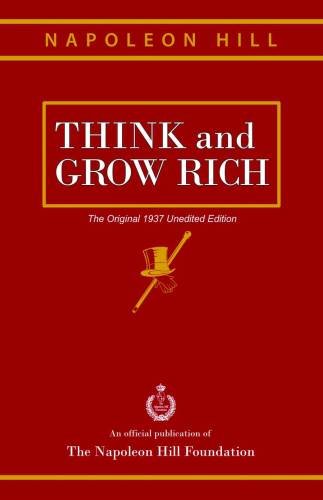
Can you simultaneously find something personally un-appealing, yet respect its effectiveness, when considered on its own terms?  Of course you can. For example that’s my summary view of Miley Cyrus’ amazing career so far.

 I did not enjoy reading Napoleon’s Hill’s Think and Grow Rich – indeed some parts are pretty darn annoying – but I’m intrigued that wholeheartedly embracing the book could help you grow rich.  I’ll explain why I didn’t like it, but if some eager-to-get-rich kid asked me for a short-list of book recommendations for that purpose, I’d include this one.

 I’m not alone in thinking this one deserves to be ranked at the top of the genre-.  I’m making my way through the most highly recommended personal finance books of all time; Think and Grow Rich cracks the Top 10 of most lists.

 Napoleon Hill wrote his motivational book in the 1930s, after interviewing hundreds of successful men of business that he met under the imprimatur of Andrew Carnegie.[1] Written in the depths of the Depression, and published in its final period (1937), the book proved a popular tonic to what must have been the gloomy national mood regarding wealth and opportunity.

 Think and Grow Rich launched both the self-help and the get-rich book genres and Hill became a pioneer of the motivational-speaker-circuit.  Hill’s book is credited as the intellectual predecessor to self-help gurus such as Dale Carnegie (How to Win Friends and Influence People) and Tony Robbins (Awaken the Giant Within) as well as get-wealthy gurus such as Dave Ramsey (The Total Money Makeover), and Robert Kiyosaki (Rich Dad, Poor Dad).

 The self-help-and-get-rich progeny of Think and Grow Rich might be reason enough for me to trash this book, as I have a severe allergic reaction to finance gurus.[2] I could not stand reading Secrets of the Millionaire Mind by T. Harv Eker for example, as, stylistically, his book oozes snake-oil, alongside some reasonable ideas.

 What else did I not like?

 A lack of doubt

 Unlike 21st Century probabilistic thinkers – Nate Silver is my paragon here – Hill does not admit any doubt in his thought process.

In fact, his “Think and Grow Rich” method requires the suspension of disbelief. He writes in the first chapter that if you doubt his wisdom, his wisdom cannot work for you.

 A friend of mine, who recently attended a Tony Robbins “Business Mastery” seminar, told me that this faith component forms a key starting point for Robbins’ classes as well.

“Look,” Robbins explained at the outset of his weekend seminar, “You can decide this is all bullshit.  And maybe it is, and maybe it isn’t. But for it to work for you at all, you have to suspend disbelief and embrace this. Otherwise you should just go home now.”  My friend stayed, and found Robbins utterly compelling.

(I probably would have walked out then. In a related news item, I skipped Catholic mass this past weekend.)

 While I find Robbins’ moxy impressive, intellectually I rebel.  I remember a lesson from my academic advisor in college about thought-systems that cannot be criticized from within, such as Marxism or Freudianism, without the critic immediately facing intellectual exile from the system – as a member of the bourgeoisie in the former example, or utterly repressed, in the latter.

 If you can’t question it, how do you test its reliability?  Intellectually, I’m more of a test-your-assumptions kind of guy.

 Questionable science

 Hill – like his self-help progeny – combines utter certainty in his methods with an early 20th-Century “scientific” style. His style reminds me – and not in a good way – of a more confident age in which “science” and “progress” promised to unlock human motivation, imagination, and self-confidence.

 Here’s a sample of Hill’s prose, in which he references his ‘research.’

 “From my research, I have concluded that the subconscious mind is the connecting link between the finite mind of man and infinite intelligence. It is the intermediary through which you may draw upon the forces of infinite intelligence. Only the subconscious mind contains the process by which mental impulses (thoughts) are modified and changed into the spiritual (energy) equivalent. It alone is the medium through which prayer (desire) may be transmitted to the source capable of answering prayer (infinite intelligence).”

 I mean, read that over again.  What can we do with this? This falls somewhere between “certain” science and mystical gobbledygook.

 As you can see from that sample, the problem is not just his early 20th Century mode of thought, but also his clunky writing. This gets tedious after a while.

 But can this book help you get rich?

 Tony Robbins would say that question is far more important than my distaste for pseudo science, unearned certitude, and semi-mystical psychological jargon.

 Getting rich is not easy. To go from not-wealthy to wealthy does not happen by accident.  Most of us find the process mysterious, the road uncertain, even our own personal agency in the process unknown.

Can we make it happen ourselves? Or is it all mostly luck?

If Hill has a method that helps, who am I to carp?

 Here’s why I suspect Hill’s book can help.

 His step by step approach, which I’ll outline below, seems to set the right mental conditions for an individual dedicated to pursuing wealth. And if you adopt the attitudes and activities that he warns against, achieving wealth is probably impossible.

 He presupposes no particular level of education, or any special leg up in the world for his readers.

Interestingly, for his particular moment in time – and our own moment in time for that matter – Hill sees no structural barriers to wealth creation. 

He admits to no insurmountable economic conditions, no vast inequality gaps, no barriers of gender, race, and class standing in the way of an individual getting ahead in the world.

While his disregard of barriers seems naïve – many people do have a much easier starting point and journey than others – the mental attitude of “no barriers” probably is the right one. Even though these barriers exist, a modern Napoleon Hill would probably urge his readers to reset their mental compass and ignore the barriers.

Said another way, few people who self-conceive as victims of a rigged game have the right starting mind-set for pursuing wealth, the way Hill recommends doing it.

 It’s all in the mind

 Interestingly, Hill specifically declines to spell out in his book what the ‘Secret’ of getting wealthy is, claiming that readers need to open their mind to an unstated, read-between-the-lines message woven throughout his chapters and anecdotes. He claims that readers should, upon finishing his book or upon re-reading it, experience a flash of intuition that will guide them in their journey to great riches.  Maybe I’m too prosaic for hidden secrets, but I found his lessons not hidden secrets at all.  They are, in fact, easy to summarize, for your benefit.

 Hill’s steps to wealth – or any other difficult-to-achieve success.

 1.      Mastery over your own mind is a key – no, the key – to success. Fears, doubts, procrastination, negativity, defeatism – all of these must be conquered.

2.      If you want to get wealthy – or achieve other difficult-to-achieve non-monetary goals – you need to set extremely specific goals: How much money you will obtain down to the precise dollar amount, by what precise date, and through what process.  Write it all down, say it out loud, commit it to memory, and post it in a place where you can see it every day.

3.      Decide, very specifically, what you are willing to sacrifice in order to achieve your goal – since nothing in life comes for free.

4.      Repeat out loud to yourself the goal from step #2 as a mantra, upon waking up in the morning, and upon going to sleep at night, and then probably in the middle of the day as well, until you lather yourself into a white-hot obsessed state of mind, focused intensely on your goal.

5.      Seek out and attract a team of experts who know more than you, or have complementary skills to you. Hill calls this team your personal ‘Master Mind,’ – a kind of board of directors willing to work with you toward your set goal. Figure out a way to compensate your Master Mind team, as nobody works for very long without some benefit.

6.      Acquire, by your own efforts and the inputs of your Master Mind team, the specialized knowledge you’ll need to succeed.

7.      When failure and setbacks thwart you – and they will – understand that failure is just an intermediate step toward ultimate achievement of your goal.

8.      Commit to a continuous program of clearheaded self-analysis and self-improvement. To lead your team most effectively you will need to adopt and embody traits that make you deserving to lead.

 I may be doubtful about some of Hill’s style, but I don’t doubt that these instructions – more fully explained in the book’s few hundred pages – would help anyone on their road to either riches, or some other large ambition.

 Can anyone get wealthy just reading Think and Grow Rich? Well, the book sold 60 million copies and something tells me that not everyone has made it. On the other hand, not everyone has committed as fully – without any lingering doubts – as Hill urges.  Including me.

 But I wrote down my own mantra. I posted it on my bulletin board. I’m saying it out loud to myself. I’m working on it.

Please see related book reviews

 Nate Silver’s The Signal and the Noise

 T. Harv Eker’s Secrets of the Millionaire Mind


think-and-grow-rich-napoleon-hill


[1] There’s no evidence whatsoever he interviewed any women.

[2] I spontaneously break out in hives around my chest, neck, thigh and back area if I walk too close to that section of the bookstore.

Post read (41069) times.