I’ve long nurtured a plan to do an interview style podcast for people in business. Its finally happening with the good folks of Texas Public Radio.
It will be on all the usual podcast channels. Here’s a link to the page on Texas Public Radio‘s website, but again, you can go to Apple Podcast or Stitcher or whatever and smash that “subscribe” button.
My hope is that these characters will be interesting to people who wouldn’t normally flip through the business section of the newspaper.
I’m not interested in a “Here’s my success, try to emulate me!” type of conversation. I’m interested in talking about surprising origin-stories, near-death-of-business stories, and just unexpected wisdom in common hours.
By the way, if you’re in Texas and I should be interviewing you for this show, please drop me a line!
Over and over again this year I found myself describing developments in financial markets that seem, frankly, nuts. All I’ve done this year, it seems, is write about wacky finance trends.
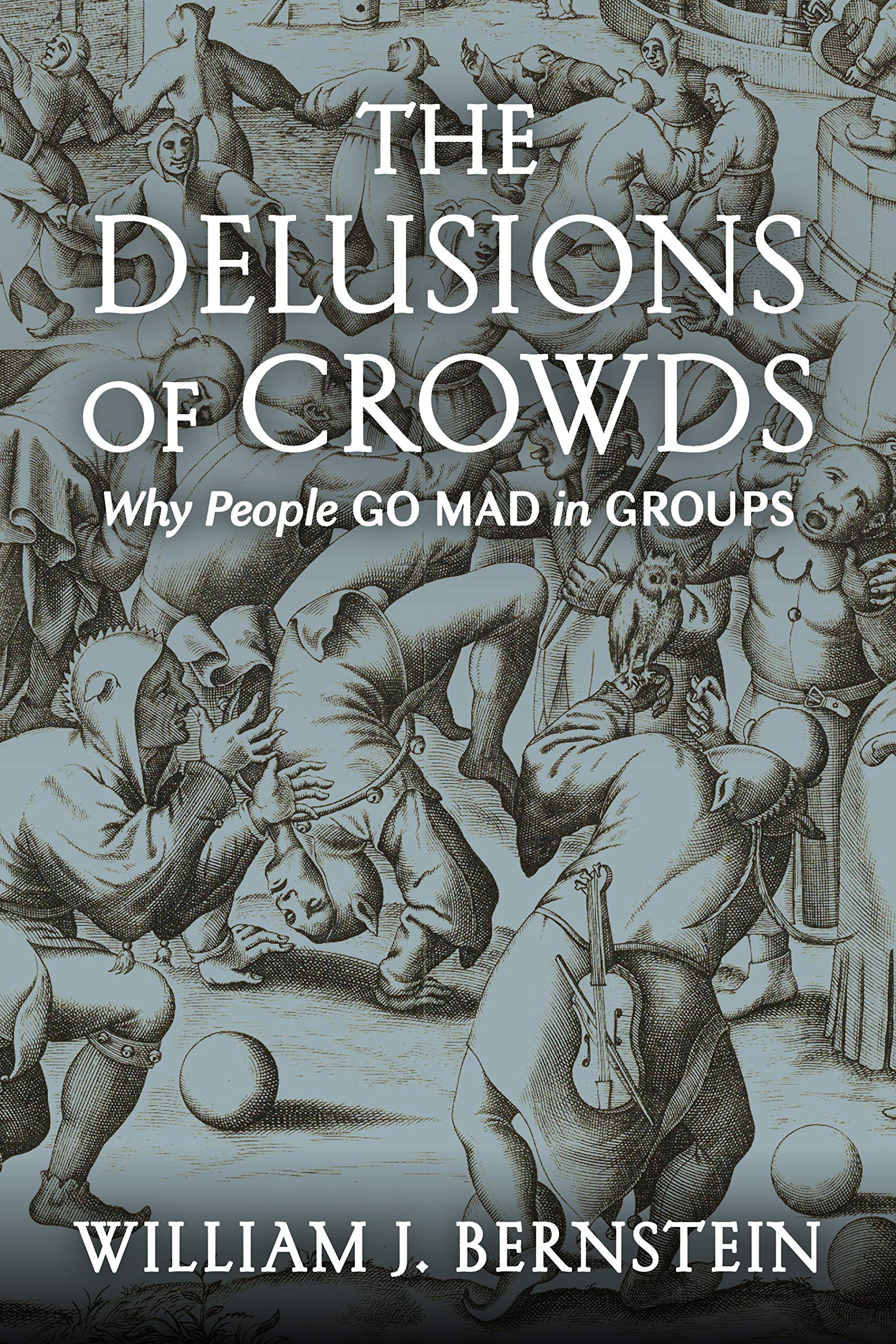
In The Delusions of Crowds, Bernstein toggles between stories of financial delusions and religious delusions. Both types of madness depend on two common human frailties. One he describes as the “Asch Effect,” based on a social psychological experiment which showed how humans can be convinced of obviously wrong things by the social pressure to conform to the opinions of others. When the religious leader or the financial whiz says something is true, and enough people around us agree, we tend to agree, despite evidence to the contrary.
Another common thread is our ability as humans, in the face of contradictory evidence, to completely discount one set of facts if they conflict with our pre-existing beliefs. When the apocalypse does not arrive on the prophesized date, Bernstein notes, true believers do not necessarily reject the prophet. Insteaed, we listen eagerly for the prophet’s update on the next plausible date for the End of Times, rather than settle our cognitive dissonance through doubt or disbelief. Contradictory evidence is merely an opportunity to double-down on our fervent faith, not change our beliefs. The South Sea bubble, railroad stocks in 1840 Britain, the stock pools of 1929. The Fifth Monarchy of 1666, the seventh-day adventism of 1843, the Y2K mania. Bernstein does not mention the QAnon phenomenon, but clearly this recent movement falls within Bernstein’s historical pattern.
For those looking for a pure financial wisdom book, I should warn that Bernstein spends considerable time on non-financial matters. Specifically, he digs deep into the clear connection between “End Times” prophecies from past centuries and powerful Evangelical movements today. Bible-inspired numerology and prophecy has entranced people for a millennium. Bernstein makes the case that this madness not only follows historic patterns but also represents a current threat. Apocalyptic beliefs linked to what he terms dispensationalist Protestantism infuses our current politics.
Personally, I am somewhat immune to the Asch Effect. On the other hand, I tend to redouble my strongest views in the face of contrary evidence, often to my embarrassment. Which I will now demonstrate for you, in the course of reviewing the goofiest financial trends of 2021. Those trends, with caveats.
Meme Stocks
The Robinhood app and Reddit-Bro inspired investing in “Meme Stocks” like Hertz, GameStop and AMC kicked off in January 2021 with a bang. We should have known then that the entire year would be an unending string of delusions and madness. Most of these rockets have yet to fall to earth as the year ends, again not what I would have expected.
Stop The Game. Stop.
Caveat: Spotting undervalued companies unloved by institutional investors was the original plausible investment thesis behind some of these meme stocks. That’s cool but only accounted for the earliest movements toward stock appreciation, before the madness took over.
Cryptocurrency
These are closer to religion than financial bets or investments. The fundamental correct price of Bitcoin remains zero. That’s the same fundamental price as with all the other crypto currencies I’ve ever heard of. Anyway, hundreds of billions of smart investment capital disagree with me. Since approximately 2013, every time I talk to an audience of folks about investing the first question is always “should I/how can I invest in crypto?” My answer is always the same. Something to the effect of I would sooner recommend lighting one’s paper money on fire flying down the highway at 90 miles an hour. But again, I am clearly the idiot in the room. Up until now I have been wrong, wrong, and then wrong again about Bitcoin.
Kevin Roose thought he was joking at first
Caveat: I (kind of) understand blockchain technology might be the coolest tech since the invention of the selfie-stick. But cryptocurrencies are not the same as blockchain, and I will continue to disparage the former while being open to the future awesomeness of the latter.
SPACs
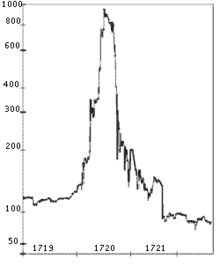
Shall we all invest in an enterprise best described as “an undertaking of great advantage, but nobody to know what it is?” That was the infamous published description of a speculative business advertised around the time of the South Sea Bubble of 1720, a phrase which equally applies to the Special Purpose Acquisition Companies (SPACs) that hit maximum popularity in early 2021.
Picture of South Sea Bubble or really any SPAC you’d like it to be
You put your money into an empty vessel and hope that the named backer finds a private company to take public through purchase. Why wouldn’t you want to put your money into an unknown business that has A-Rod, Sammy Hagar, or Kevin Durant as its backer? Note: That’s both a rhetorical and a sarcastic question.
Caveat: SPAC investors typically get an option to request their money back once an acquisition target gets announced. So, it’s a bit like a free option for the original SPAC backers.
NFTs
Have people entirely lost their minds? You bought a digital thing and you value it highly because there can only be one copy (or a limited number of copies) of the digital thing? And this is worth $1 thousand or $1 million, or $50 million to you?
Caveat: Art collecting is always insane when viewed from a finance perspective. Probably best to just leave it to aesthetics and the phrase “There is no accounting for taste.”
Tesla
There are only so many times I can point out how stupid this stock has been in the past, is now in the present, and always will be in the future, for ever and ever, amen. And at each point in time, I have not only been proven wrong, but proven colossally wrong. Like, it’s the wrongest stock-picking call anyone has ever made in the history of making wrong market calls. I feel really great as Tesla shares have zoomed from a ridiculous $100 billion valuation to a ludicrous-mode $1 trillion market capitalization in less than 2 years. But still: Y’all are crazy. I feel extraordinary conviction on this.
Caveat: I understand the cars are great. I have no problem with the cars. Just the stock, and its price. And it’s bizarre owner, Elon Musk. Him I have a problem with. But again, I’m the idiot, I admit that.
The most common ending to human delusions, financial and religious, is heartbreak. In finance, however, some bubbles serve the purpose of creating the conditions for future economic innovation. After the wreckage of a burst bubble, we can often see in retrospect how the creative destruction was necessary, or at least that it seeded new growth. This will be useful to remember, when the current crazy ends in tears.
My question begins from a personal financial setback.
My 16 year-old got her driver’s license in August, which I just learned will double our household automobile insurance premiums. We previously paid $678 every six months but will now pay $1,276 every six months.
Yay.
Now I know where I’ll spend the automatic child tax credit that I was so happy about recently.
This new, egregious, pricing is typical for youthful drivers, who are guilty until proven innocent, from the perspective of insurance companies.
Another guilty until proven innocent factor used by auto insurance coverage is credit scores. The worse or thinner your credit, the more you pay for auto insurance. This feels unintuitive. Why should a person with a flawless driving record pay more for insurance if they were late on their credit card bill, or don’t have a credit record? Driving and using credit responsibly are clearly separate skills.
Using credit scoring in insurance products and pricing is an active debate at the federal and state level. New Jersey Senator Cory Booker has proposed banning credit scoring as a factor in auto insurance. Michigan Congresswoman Rashida Tlaib has done the same in the House.
The insurance industry maintains that the historic correlation between lower credit scores and a higher number of claims and a higher dollar value of damage claims justifies the use of credit scoring in pricing.
In June of this year entrepreneur Nestor Hugo Solari moved his startup auto-insurance company Sigo Seguros to Austin and launched a new program in the state, targeting the state’s Spanish-speaking population.
One of Sigo Seguros’ selling points is that they do not consider personal credit scores when underwriting auto insurance. They consider credit-scoring discriminatory, especially against Spanish-speaking Texans. To further appeal to his target audience, the company will not require a traditional state driver’s license either. Customers can provide a foreign driver’s license and still receive coverage from Sigo Seguros, without any surcharge.
The most typical customer for Sigo Seguros, according to Solari, seeks liability-only coverage, and may forgo collision coverage because they drive an older, less-valuable car.
I’ve previously written about this, but from a personal-finance perspective, I favor this flavor of auto insurance. We need solid protection against catastrophic liability. But we don’t need protection against car damage because, for personal finance reasons, people shouldn’t drive valuable cars. Especially, I hasten to add, with a new 16 year-old driver behind the wheel. I decline to insure against damage to my 2009 Hyundai, which has a trade-in value of maybe 2 thousand dollars. At that kind of value, what’s the point of damage insurance? The thing is nearly worthless, on purpose, just the way I like it. So I save a little by declining collision coverage, as do many Sigo Seguros customers.
I asked Solari what his issue was with credit scores. Solari pointed out to me that the Spanish-speaking Texans his company seeks to serve may have thin or no credit files because of recent immigration status or because the community is relatively under-banked, compared to native English-speakers in the state.
I confirmed with my own auto insurance company that they do consider personal credit as one of the factors determining my premiums. Texas insurance rules allow credit scoring as a factor for pricing, in a regulated way, and as long as it’s not the only factor considered. Some states, including California and Massachusetts, have banned personal credit as a factor because of their potentially discriminatory effects.
Other factors also always matter, such as miles driven, car-density as measured by zip code, and of course past driving record.
Nestor Solari
In theory, what is a fairer method for pricing auto insurance?
Critics of the use of credit scoring argue that observed driving behavior and driving record is what should count most. They have a point as well.
In recent years auto insurance companies have experimented with telematics, which provide data directly to the companies on your particular driving style, based on a mobile phone app that tracks everything from acceleration and hard-braking to late-night driving and texting-while-driving.
Sigo Seguros offers a discount for customers who sign up to its mobile-phone based telematic system, as a better way to measure driving risk.
I was interested to learn this because I had previously enrolled about a year ago in an app that offers me a discount for letting my insurer track my driving experience. My insurance company’s app even reports to me about my sudden braking as well as my phone use while driving. It’s probably tracking overall miles driven as well.
This kind of driving data strikes me as quite fair, since it measures factors that could increase the likelihood of auto accidents which credit scores, for example, do not. This is the ultimate goal – fairness in auto insurance – based on observed risky behaviors. And fairness is good.
The downside of telematics is that Big Brother – in the form of my auto insurance company – is totally watching me drive around everywhere.
This makes me paranoid about my ability to get away with doing crimes in the future, which is a real negative. On the plus side, I get 3 percent annual savings on my auto insurance premiums!
We are now paying through the nose because of my teen driver. Eventually I will need to rob banks just to pay for the auto insurance, but the auto insurance telematics will increase my likelihood of getting caught for this behavior. A classic Catch-22.1
Speaking of Big Brother watching, and as a total aside, I have really enjoyed the idea that Bill Gates can track my every move, ever since I got the Pfizer vaccine against COVID. You know what’s nuts about that worry in particular? We all carry smartphones everywhere! That is the actual tracking device recording all of our movements, people! It’s not the vaccine. Please, for the love of McKenzie Scott and all that is beautiful in this world, get vaccinated if you haven’t already. ↩
Note: I’m months late in posting this review, which was actually Summer Reading this year. A version of this post previously ran in the San Antonio Express News.
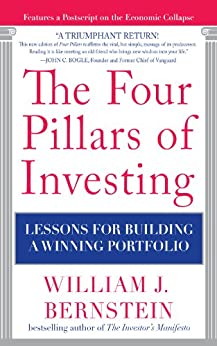
Bernstein, a trained neurologist-turned-investment-writer-and-advisor, originally published The Four Pillars in 2002 and then updated it in 2010.
Although I had never read Bernstein’s Four Pillars before this week, I can honestly say that I have, over the years, 100 percent absorbed his philosophical approach to personal investing. There is almost no daylight between what he thinks we should do and what I think we should do. I guess that means I have read many of the other books or papers that underpin his approach. Or that I’ve been reading people influenced by Bernstein. Or maybe just that there is a single objectively best way to go about personal investing and we have independently arrived at the same place. (Honestly I’m sure it’s the first two options, not the third). So, if you were a blank slate and wondering what philosophical approach you should bring to investing – and you really trusted my judgment – then I would posit that you could read Bernstein and therefore know just what I would endorse.
The four pillars of Bernstein’s title are the theory, history, psychology, and business of investing. Bernstein offers a lightning round – a mere 200 pages – describing what you need to know about these four topics. In his fifth and final section he brings together a practical “how to” based on the earlier chapters. Spoiler alert: The “how to” is diversified index funds.
The prose is relatively easy – except maybe parts of the early chapters on investing theory – in which a bit of math could bog down casual readers.
On investing theory, Bernstein says you must expose yourself to risk in order to receive a positive return, markets are more efficient than you think, and that fundamental investing derives from valuing future cashflows with a mathematical calculation that tells you what those cash flows are worth today. All very solid stuff.
Knowing investment history is the key next step. I learned plenty about the development of mutual funds and the origin-stories of firms like Merrill Lynch, Fidelity, and Vanguard, plus deeper histories – always useful – about up-market manias and down-market busts. His history of Vanguard and its role in pioneering low-cost mutual funds is worth the price of admission.
I believe that understanding investing psychology – the problems coming from inside our own brain – is the key to succeeding as an individual investor. Berstein explains the pitfalls of misunderstanding risk, the classic errors of confusing luck and skill, being overinfluenced by the recent past, and finding patterns where there are none.
Finally, understanding the business of investing – the real way in which investment firms earn a living from us – is essential.
There are investment companies and there are marketing companies disguised as investment companies. Bernstein posits that ninety percent are really marketing companies while only 10 percent are investment companies. The majority of investment professionals are focused on sales, not investing. One way you can spot the marketing companies is because they sell high-fee mutual funds, load funds, variable annuities, and other insurance products.
Is The Four Pillars perfect? No.
Many of his stories read like they came from the early 2000s, in the sense of salient anecdotes from the financial world and references to events in the 80s and 90s that only older folks will remember vividly.
One area I disagree with Bernstein is on workplace retirement accounts like 401(k) plans, which he warns are disasters. In contrast I think they are quite beautiful and important.
He writes,
“The ascent of self-directed, defined-contribution plans – of which the 401(k) is the most common type – is a national catastrophe waiting to happen. The average employee, who is not familiar with the market basics outlined in this book, is no more able to competently direct his own investments than he is to remove his child’s appendix or build his own car.”
I worry that people reading his view that they are a disaster would then not take advantage of their tax-deferred workplace investment programs.
The author, William Bernstein
But I take his point that few people are prepared to maximize their opportunity or to efficiently manage their own investing. Reading one or two classic personal investing books – like his – would go a long way toward correcting this problem.1
Bernstein’s section on investment fees seems outdated to me, in that he’s referencing 2 percent investment advisor fees and the prevalence of front-loaded mutual funds. Don’t get me wrong, these still exist and Bernstein’s main point still stands, which is that traditionally the money management industry charges ridiculously high fees and delivers mediocre results. The trends have improved over the past 20 years and fees, thankfully, have been coming down in some – but not all! – areas of investing.
You could accurately call The Four Pillars a slightly dated book. In an important sense, however, a bit of mustiness enhances the credibility of a personal finance book, to me. It means the book has stood the test of time. It means something timeless and true is being taught, rather than timely but ephemeral.
You will gain more from reading one of those books than you possibly could learn in hundreds of hours watching videos, browsing online, or even – gasp! – reading this blog. Bernstein in The Four Pillars makes the correct observation that investment journalism has an inherent problem in that the correct thing to advocate – always and only invest in terribly boring index funds – is the dullest possible story. How can we write headlines with that message day after day? So instead we write endlessly about the improbable and the sensational – the cryptocurrencies and the billionaires. It’s much more interesting to write headlines about Dogecoin and GameStop, despite the fact that these are, or should be, deeply irrelevant to our lives.
I enjoy learning about other finance books I have yet to read, so please feel free to send me your top recommendation – something that improved your relationship with money and investing. Thanks!
Book Review: The Delusions of Crowds, by William Bernstein (pending)
Post read (417) times.
I have one other mild critique: I don’t love the way Bernstein explains the math of discounting cashflows. That happens to be an obsession of mine, so I may be overly critical, but nevertheless I didn’t think his math explanations were as clear as they could have been. ↩
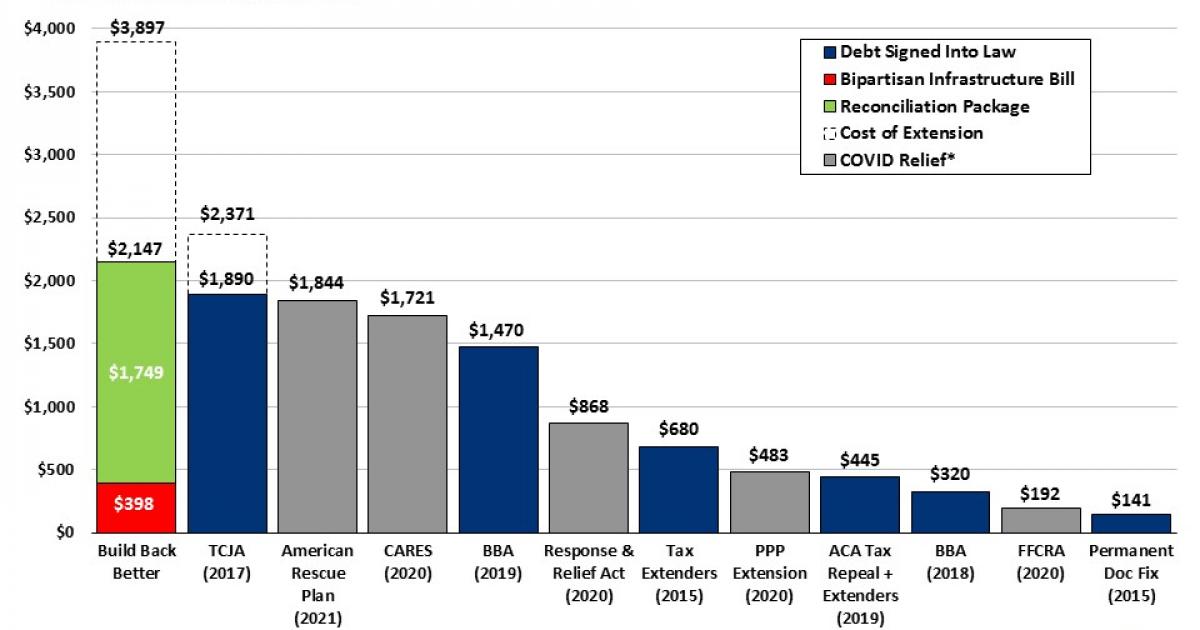
The Build Back Better Act pushed by the Biden administration and passed by the House last week contains a provision to raise the SALT cap from $10 thousand to $80 thousand.
That’s how ironic it is
This, for me, is peak irony. Like, Alanis Morissette should henceforth substitute her “It’s like a black fly in your Chardonnay” lyric to instead croon “It’s like SAaaaaaaaLT in Biden’s BBB!” That’s the level of high irony we’re talking about here.
First, some explanation of the SALT cap, which stands for State And Local Taxes deductions cap. Before Trump’s 2017 Tax Cuts and Jobs Act, which is understood correctly as a tremendous tax cut for the wealthy, taxpayers could itemize state and local taxes that they had already paid, and have them deducted from their federal income.
One of the only tax hikes of the 2017 reform was a cap on SALT deductions at $10,000. Before the cap, for example, if a taxpayer had already paid $30,000 in a combination of property and state income taxes, then their federal income would be considered $30,000 lower, for tax purposes. Limiting the SALT deduction at $10,000 would effectively mean that taxpayer owed taxes on $20,000 more dollars. The difference between $30,000 and the $10,000 cap.
Owning the Libs
This was widely perceived at the time as a fiendishly clever way to both raise revenue while simultaneously owning the libs. The libs, the thinking went, pay high property taxes and high state and local income taxes in places like California, New York, New Jersey, and Connecticut. This cap on tax exemptions seemed highly targeted to blue states. Many people’s taxes – particularly affluent libs who pay alot of state and local income tax and property taxes – went up by a lot, starting in 2018.
Now that Democrats run the House, Senate, and White House, they get to write tax policy in 2021. And while the BBB is described as a social spending bill, it is primarily a tax policy document.
The BBB seeks anti-poverty, equality, and climate goals largely through tax policy. Spending on climate is largely through tax breaks for clean energy. Spending on reducing child poverty is through an expansion and changed criteria of the earned income tax credit and the child tax credit. A drive for equality comes through expanding taxes on upper 1 percent and 0.1 percent earners. It’s a tax law through and through.
Not surprisingly, one of the key priorities for Democratic representatives from California, New York, New Jersey, and Connecticut was repealing the SALT cap. It’s not a thing they shouted from the rooftops. But certain key constituents made it clear this needed to get done. Now that BBB passed the House, Republican representatives are shouting it from the rooftops, and they will continue to do so.
This all matters – as most tax issues do – more to higher income and higher wealth people.
If the SALT deduction is lifted from $10 thousand to $80 thousand in the final BBB legislation (all of this is pending a Senate vote) blue-state Congresspeople are happy because every single donor who matters will be affected. They will have delivered for their people.
But we can see a few ironies piling up about the SALT Cap hike.
The bottom line of repealing the SALT cap is that it would be a very big benefit to the wealthy. Substantively, it will cost $85 billion a year in tax revenue. The top 1 percent of taxpayers will get about half this benefit, while the next ten percent will enjoy 35 percent of the benefit. This is all extremely off-brand for the Democratic Party in 2021. It makes an easy attack line for Republicans. Texas Representative Kevin Brady – the ranking Republican on the House Ways and Means Committee and therefore GOP point person for tax policy – immediately began hammering BBB for the SALT cap benefits to the wealthy.
But in Red States Like Texas…
Let’s go further, however, into the ironies. Unmentioned in the critiques of the SALT cap boost are how this will affect Texans for example.
Texas is a very high property-tax rate state, because of the absence of state income tax. In my county, for example, I pay 2.7 percent of market value for my home every year. That means anyone who owns a home worth more than $370 thousand has filled their SALT exemption on property taxes alone. With median home prices now above $300 thousand in my not-particularly-wealthy county, the SALT cap hits a lot of people. A lot of Texas homeowners. While there is not a majority of homeowners who are affected, there will be a large plurality.
Texans pay high property taxes too!
All of this is to say that every Texas donor of means to Kevin Brady is also massively affected by the SALT cap. They are in that sense hoist upon their own petard. You just won’t hear Brady talking about it.
The SALT cap jockeying lays bare an uncomfortable fact of democracy. Namely, there’s a wide gulf between the “voter class” and the “donor class.” Lower income people, even in blue states, are not much affected by SALT caps. Higher income people and people who own valuable property, even in red states, are very affected by SALT.
For my part – my own valuable house and my hefty 2.7 percent property tax rate means I’m very affected. Even though the SALT cap hike is in that sense “fair to me” personally, I still think House Democrats should not have given me this tax break in the BBB.
Even if you revel in the “owning the libs” aspect of the SALT cap, there are further nuances at play. Namely, federalism.
Federalism
In the abstract, Republicans profess to believe more strongly in devolving power to states, versus Democrats who often seek to strengthen the central government at the expense of “states’ rights.” State and local taxation, however, is a key way in which citizens of a state exercise choice, engaging in the “50 laboratories of democracy” aspect of our federal system. When citizens of a state (small d) democratically choose higher taxes in order to, for example, improve health care access, that’s a valid choice. In the broadest sense, the SALT deduction serves as a mechanism for shifting spending and taxation power down to the state level. This again puts Democrats and Republicans in this SALT fight on the opposite side of where they usually land.
It’s just another ironic twist in the upside-down roles of SALT caps.
What happens next? A couple of Senators, Bernie Sanders (VT) and Robert Menendez (NJ), do not like the wealthy skew of the House SALT cap increase, and have plans to limit the benefits to those making less than $400,000 per year. I’m hoping Bernie saves the day.
From the distance of the future, we will remember 2021 as the year the metaverse began to take shape. As the building blocks of this new world come into focus let’s begin with the obvious and timely.
The ultimate Web 2.0 company, Facebook, rebranded itself as Meta this past month to signal that it intends to lead the charge into Web 3.0, aka the metaverse. Meta owns not only Facebook, Instagram, and WhatsApp, but also importantly virtual reality firm Oculus. So they’ve got a nice head start on building this around us.
One the one hand, the metaverse still feels quite science fiction-y. Science fiction writer Neal Stephenson, author of the 1992 novel Snow Crash (which I have not yet read) gets credit for inventing the word.
For a glimpse at this future, who among us did not love the movies Tron and The Matrix? And the books Neuromancer by William Gibson, or more recently Ready Player One by Ernest Cline? Sure, there were a few teensy-tiny issues in these fictional metaverses, but surely Zuckerberg will solve these problems on our behalf.
From the perspective of metaverse dwellers, what we might call “in real life” or “IRL,” this “flesh and blood” existence has a name. Our corporeal world, as distinguished from the metaverse, shall henceforth be known as the “meatverse.” Is this not perfect? Please, please, can we make the meatverse a thing?
If the virtual world will be called the #Metaverse will the real world be called the #Meatverse?
The key transformation from meatverse to metaverse (besides the movement of 1 letter) can be captured by the concept of dematerialization. Future production of goods and services need not be physical or material. They will be digital. We will mostly and increasingly live our whole lives in this digital world.
Long before renaming his company Meta, Zuckerberg was already on an acquisition tear to build our metaverse. He’s got not only a head start, but maybe has built a near-monopoly already. In 2021, Facebook/Meta bought virtual-reality game-maker BigBox VR, and game platform Unit 2 Games, which resembles the Roblox platform, a competing metaverse builder.
In 2019 Facebook bought Beat Games, the maker of the most popular virtual reality game on Oculus. In 2020 they bought Giphy, thought to be useful for building digital advertising. The company also acquired two other virtual reality game-makers Sanzaru Games and Ready at Dawn.
It’s not just the roll-up of VR businesses, but also the deepening and adoption of new technology in 2021 that mark the trend toward the metaverse.
Semi-buried beneath the 2021 hype about cryptocurrencies (which I hate) is the more significant application of blockchain technology (which I acknowledge is probably important.) Blockchains may be crucial infrastructure powering the coming metaverse.
Non-fungible tokens, better known as NFTs and based on crypto and blockchain technology, allow for permanent, private ownership of digital assets in the metaverse. This already means metaverse-ready artwork, which exploded in popularity and prices this past Spring.
All of the hype around extraordinary prices paid for digital NFT artwork indicate that the very real human need for social status and social connection will likely drive construction of the metaverse.
Status acquisition in the metaverse feels poised to only grow exponentially from here. For example, paying $4,000 for a digital (not physical) Gucci bag in the game Roblox isn’t cool, because it can’t be taken out of that single game. But maybe getting an NFT of a Gucci bag in the metaverse will be cool, because it’s transferable across platforms and can be permanently owned for life?
A Gucci bag in Roblox resold for 350,000 Robux or roughly $4,115. The same purse IRL costs $3,400.
Remember: this Roblox purse is not an NFT and thus has no value/use/transferability outside the Roblox world-yet it's worth more than the physical one.
To your question, apparently yes, somebody did pay more for a digital Gucci bag in the Roblox game than the cost of a real-life Gucci bag. This is only the beginning of the fun we’re going to have in the metaverse.
This will soon mean metaverse real estate. Will I be able to purchase the coolest meta-mansion and host the coolest meta-parties at an extraordinarily high cost in crypto? Undoubtedly, soon, yes.
But also, do I get to explore Mordor with the realest orcs and achieve my dream of climbing Mount Doom, all while laying safely on my couch? You’re darn right I’m going to do that on a Saturday night surrounded by all of my favorite hobbits. I’ll probably pay a lot in cryptocurrency for a live elven guide too. In a related story, a videogame company just bought Peter Jackson’s visual effects studio for $1.6 billion last week, explicitly to facilitate the building of the metaverse with Lord of the Rings nerds like me in mind.
As you read this, are you under the mistaken impression that none of this applies to you?
Once you understand the narrative and the trend, you will recognize more key elements of the metaverse are assembling before our very eyes. This past year in particular.
The metaverse took a great leap forward in 2021 because COVID forced everyone to interact virtually for months at a time. You wanted to see your friend? You needed to collaborate with your colleague? You had a therapy appointment? Everything we needed to do in person we realized we could do through our screens, virtually. And we have all adapted more or less quickly to it.
I bought a new car in September, a 2022 model Hyundai Elantra. It’s not even close to a high-end car, but the self-driving proto-metaverse features are actually amazing. Automatic steering-wheel nudges when I drift out of my lane. Automatic braking if I come up to close to the car ahead. Immersive sound. I play podcasts that take me anywhere in the outer world. That outer world is represented by a constantly changing 3-D street map on my screen. It’s just a whole different driving feel than my 2009 car of the same make and model. It is not a far leap to think that automated driving or semi-automated driving is just around the corner, extending the metaverse from my computer screen to my windshield.
Soon I will hardly need to interact with the meatverse at all.