
USAA Wobbles

Tell me: do you want the good news first, or the bad news? Fine, we’ll start with the bad news. 

In 2022, USAA reported its first yearly “net income” loss since 1923 – the first loss in one hundred years! – of $1.3 billion. 

Next, the CFO reported that the company’s own measure of its “net worth,” the difference basically between what it owns and what it owes, dropped dramatically from $40.1 billion to $27.4 billion from 2021 to 2022. 

That’s a $12.7 billion drop in net worth, or a 31.6 percent drop year-over-year. Not great.

USAA

Finally, USAA had reported a line in its consolidated statements called “Other comprehensive income (loss), net of tax,” a loss of $10.5 billion. Since that was 8 times bigger than its “net income” loss, and roughly the size of its reported drop in “net worth” over the year, I reached out to the company to tell me what the heck “other comprehensive income (loss), net of tax” actually means. It’s not an accounting term with which I was previously familiar.

Brett Seybold, Corporate Treasurer, responded to my query. “The ‘other comprehensive income loss’ was due to unrealized losses in our investment portfolio across all lines of business, about half of which is in our bank. This is the result of lower market valuations from rising interest rates, which impacted the full financial services industry last year. It’s important to note that this accounting value change is temporary and has already improved in 2023 – and any undervalued securities can simply be held to maturity.”

This makes sense (in fact this was my best guess before Seybold confirmed it). It is also worth contextualizing his response with what’s happened lately with other banks.

The larger US banking context

The recent failure and seizures of First Republic Bank, SVB, and Signature Bank by the FDIC (the 2nd, 3rd, and 4th largest bank failures in US history, respectively) have bank customers (and regulators!) on edge a bit these days. 

Listed as the largest Texas-headquartered bank by both assets and deposits, USAA carries a sort of flag for the industry in the state. 

Unlike past eras of finance wobble, recent bank failures haven’t happened because of crazy risk-taking or irregular accounting or any number of traditionally morally questionable actions for which we might judge bank executives harshly. 

Instead, a simple and simplified model of recent bank failures is this. 

bank_failure

Step one is that banks like SVB held lots of super-safe assets like US Treasurys which lost their current market value when interest rates rose rapidly throughout 2022. Fixed income assets – the finance term for bonds and similar investments – drop in price as interest rates go up. As long as a bank still holds these super-safe assets and doesn’t sell them, the losses aren’t necessarily locked in. That’s what USAA’s Seybold confirmed made up what happened at USAA with the $10.5 billion loss under the line item “other comprehensive income (loss).” Roughly half the number for the bank portfolio, and half for the insurance portfolio.

The not-necessarily-market-value generally is not a problem because depositors don’t all ask for their money at once. These super-safe bonds will all pay out in full eventually. Regulators are cool with it too. Usually.

Step two with SVB, Signature, and First Republic Banks, however, was that they catered to customers who held large deposits, with a (now we understand to be an overly) large proportion above the FDIC-guaranteed $250 thousand threshold. Those large and relatively sophisticated depositors moved their accounts too rapidly for the banks to sell their assets in an orderly way. Because a significant portion of bank assets were actually worth less than their value on the books of the banks, and the withdrawals happened fast, the market value of the banks – roughly their “net worth” was wiped out just as they faced a liquidity crunch. So, we got FDIC receiverships and forced sales over a weekend for the 2nd, 3rd, and 4th largest bank failures in US history.

There were things these failed banks could have and should have done better, we now know in hindsight. Financial institutions can use interest rate swaps to hedge their declining bond values. They can underwrite or hold shorter-maturity assets that allow them to pivot more nimbly when interest rates rise. They can diversify away from an over-concentration on high-deposit customers, although that last move takes time, and for bank executives is probably counter-intuitive. (Banks generally love and want to attract high-deposit value customers!)  But that’s all in hindsight for those particular banks. 

What we should concentrate on are banks today. Specifically today, what should we think about  USAA’s 2022 performance?

The Good News, or Why I’m Not Worried About USAA

Without insider insight into their fixed-income hedging strategies (although again in hindsight they maybe did not hedge rising rates enough in 2022) two things about USAA seem true, and comforting. 

First, USAA is not simply a bank but a diversified financial services company. They are foremost a property and casualty insurance company, and also a life insurance company, and then also a bank. Insurance had its own specific 2022 problems like higher loss claims due to inflation and supply-chain bottlenecks. But in general, with 77 percent of annual revenues coming from insurance premiums, they operate in a different category than traditional banks. Insurance companies always run and manage risks, but bank runs aren’t really their main worry.

More broadly, their banking customer base is not primarily high-net worth individuals, but rather active or retired military personnel and their families. As Seybond confirmed, “Our bank is consumer based, 93% of deposits are within the applicable FDIC insurance limits, and we have access to excess liquidity to serve the needs of our members.”

I’m not at all worried about USAA personally as my bank, since I (sadly for me) do not have balances larger than the FDIC-guaranteed $250 thousand. Mo’ money, mo’ problems as the saying goes, and the inverse is also true when it comes to this specific consumer-banking risk: less money, less problems. Alas for me.

Maybe I should have mentioned, I bank with USAA. My checking, savings, credit card, home mortgage accounts, plus my kids’ bank accounts, are all with the company.

I insure with USAA as well: auto insurance, home insurance, and term life insurance.

I live in the hometown of their headquarters, and have many friends and acquaintances who work for USAA. I wish the company tremendous success but also I am self-interestedly curious about their setback years as well.

People are nervous right now about financial institutions. A once-in-a-hundred-year loss naturally prompts a question of whether it is anomalous bad luck or a trend. As the largest bank headquartered in Texas, USAA enhances public trust by explaining even the bad years when they occur. And even the obscure accounting lines when asked. I appreciate their letting me dig in a bit. Ninety-nine years before hitting a loss year is a pretty good track record.

A version of this post ran in the San Antonio Express News and Houston Chronicle.

Post read (254) times.

How’s Inflation Going These Days?

How’s inflation going these days?

It was the talk of the town 6 months ago and 10 months ago. The most recently published April 2023 Consumer Price Index rise (the most commonly quoted inflation rate) was 4.9 percent annual, down from the peak 9.1 percent annual rate in June 2022. 

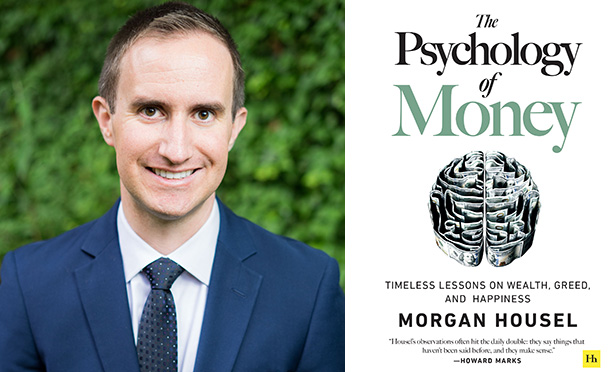
Morgan Housel

Even as the world panicked last year about rising inflation, I will now share with you a teensy confession. I didn’t really see it. Or if I did see it, it felt fine, temporary, non-threatening. I know this is heretical and borderline obnoxious to say.

This week I came across a comment on inflation from the finance writer Morgan Housel, who is one of the very best at what he does.

“What I think is really interesting is that everyone spends their money differently. So no two people have the same inflation rate,” he said in an interview in September 2022. “There is no such thing as the inflation rate. It’s just your own individual household.”

Housel’s insight explains my reaction when compared to the collective freakout I noticed elsewhere. My experience of inflation is different from yours, and yours is different from everyone else’s.

Falling Prices

Now in the latter-half of my intended century on this planet, I could settle gently into the “kids, when I was your age, that used to cost a nickel” phase of my life. But as I look around, that story isn’t particularly true in many areas.

In July 2013 I purchased an Apple Macbook Pro laptop computer for the retail price of $2,499. This past week, the monitor died and I returned to the Apple store in the North Star mall and bought another Mac Pro laptop. In my mind, 10 years for a laptop is a good run. It lived a good long life as far as electronics go and it was time to buy a new one. I paid $1,999 retail for the new one with improved graphics, larger memory and a decade worth of incremental feature improvements compared to the 2013 version.

inflation_airline

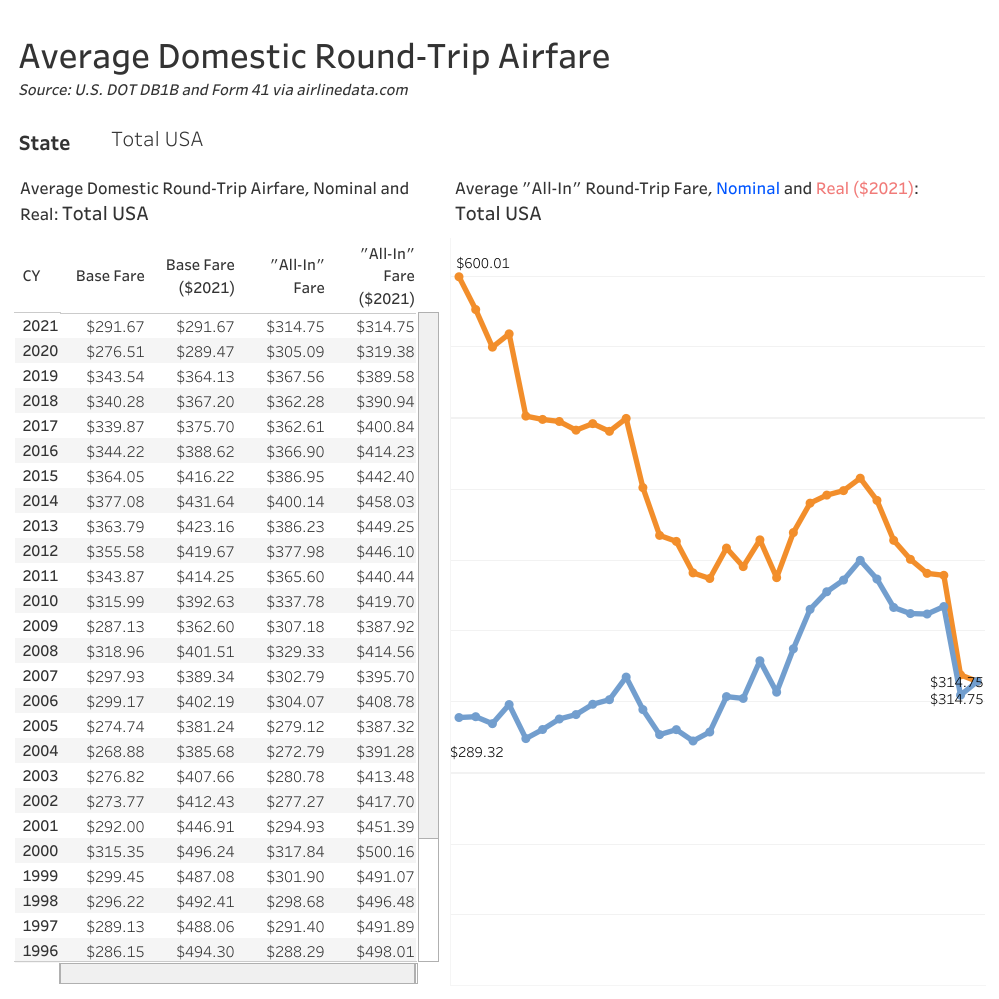
Last week I booked a round-trip flight to New York City in June for the all-in price of $517.80 (including taxes, travel booking, and airline fees). How much was this flight to New York City 33 years ago? I can’t compare the exact flight but The Department of Transportation reports that the average domestic airline fare from Texas in 1990 was $253.41. Meanwhile the average domestic round trip fare in Texas all-in was $314.75 in 2021.

Depending on the reference years, the average domestic flight costs the same, a little more, or a little less, over the past 40 years. This is actually incredible.

This past winter the internet lost its mind over the price of eggs, which had doubled. (Avian flu had wiped out the hens.) Our collective hive mind pointed to the rising cost of a carton of eggs as if that were some sign of inflation end-times. The price for a dozen large brown cage free eggs from HEB is $2.78 as I write this in mid-May 2023. Pretty much unchanged over the past decade.

I mention computers, flights, long-distance phone calls, and eggs because we notice the rise in prices but rarely their fall. So that’s one piece of the puzzle.

Inflation that we welcome

If you are a capitalist, inflation maybe hits differently. In my own capitalist way of thinking, the rise in both stock market values in my retirement portfolio over a decade and in the value of my home over that same decade are forms of inflation. Benign forms, from my perspective, but inflation nonetheless. Future purchasers of my shares or my home are negatively impacted by that inflation. Still, I’m personally glad for it.

Bloomberg News has run stories this year about companies that engage in “excuseflation.” That means firms that use bad news, like supply-chain disruptions or shortages or war – those were the top 2022 excuses – to raise prices. Companies that can raise prices and keep them high when normalcy returns – without losing market share – then have the opportunity for higher profits. 

Investors, in turn, seek to purchase shares in companies that prove they can hike prices and expand margins. This is another way in which inflation hits differently depending on who you are. For owners of capital, price hikes by companies are a sign of strength and an incentive to invest. For homeowners, price hikes are a path to long-term wealth.

MacBook
Deflationary

Inflation I don’t notice

I’m never going on a Caribbean cruise, where prices are up 14 percent since last year. I work from home, so I am not hurt much when gas prices hike the cost of a daily car commute. I don’t rent my home, so I’ve avoided one of the most brutal rises in costs in recent years.

Now, you’ve probably noticed I have conflated three ideas. First, prices are flat or falling in many areas over the past 30 years. (televisions, computers, long distance telephone calls, plain t-shirts and socks). Second, I benefit from some price hikes (my real estate, stocks in companies that have pricing power to use inflation as an excuse to hike prices and increase their margins.) Third, some price changes I don’t stress about because they hardly affect me directly (gasoline and diesel fuel, cost of caribbean cruises, home rental prices.) 

I’m not saying inflation isn’t real. I’m saying our experience of inflation is unique to each of us. There is no objective inflation since we all buy and own different stuff.

My inflation experience is about to get worse

One of the worst areas of inflation over the past 30 years has been the rising cost of higher education. Since I will be paying for this over 8 of the next 9 years for my daughters, you can expect near-constant whining in this space about tuition inflation. It’s going to be brutal. For me to experience and for you to read about.

A version of this ran in the San Antonio Express News and Houston Chronicle.

Please see related posts:

Book Review: The Psychology of Money by Morgan Housel

Post read (123) times.

Ukraine Philanthropy Part II – Using Airline Miles

I wrote recently that helping Ukrainian people survive and resist the Russian invasion is the most philanthropically worthy project I can think of right now. But a key question remains: How can I help?

I found a surprisingly easy and satisfying way last week, through an organization called Safe Passage 4 Ukraine

They accept donations of hotel miles, credit card reward points, and airline miles. If you only have a small number of saved miles, the organization can aggregate donations from many people to purchase travel or hotel stays for refugees from the war zone.

Their online form is very easy to use.

For small amounts of miles in airlines I rarely fly, I filled out their form with my pledge, then clicked a button, and the website took me to my own airline miles account. From there, once logged in, I clicked the charity to complete the transfer of miles. The charity then sent me a confirmation email, asking me to click once more to confirm the transfer. Less than 5 minutes of “work” at my desk. Easy peasy.

SP4U

JetBlue’s minimum donation is 500 miles. I really can’t use my roughly 2,000 miles with them so I donated them. United Airlines’ minimum is 1 thousand miles. I pledged the roughly 2,500 miles I had. 

The Most Satisfying Thing

Then I did an even cooler thing. Although I only had a few JetBlue and United Airline points, I travel American Airlines more frequently. I had accumulated a little over 50 thousand miles at the beginning of last week.

Shortly after I pledged to donate at least 30 thousand of those points, a travel specialist from Safe Passage 4 Ukraine requested over email for me to stand by, as he’d be sending me further details shortly.

With at least 30 thousand American Airlines to pledge I became eligible to purchase a transatlantic flight for an individual Ukrainian refugee.

Two days later, on a Friday afternoon, my assigned travel specialist sent me an individual’s profile, just as promised. It was a Ukrainian woman’s name, her birthdate, and a specific multi-city flight plan – Warsaw to London (Heathrow) to Philadelphia to Orlando, with flight numbers and times. The specialist had already worked out that this one-way transatlantic flight could be purchased with my 30,000 miles, plus $96.15 from me. Very affordable. By the time this column goes to print, she will have arrived in Orlando.

Incidentally, I don’t know about you, but whenever I try to book my own travel with my miles I find I never have quite enough. If I have 25 thousand miles, my flight requires 50 thousand. If I have 50 thousand, my flight needs 90 thousand. I feel like it costs 50 thousand miles just to go from San Antonio to Dallas and back, whenever I search for it myself. To my delight, booking this ticket for a stranger to fly out of Warsaw to Orlando actually cost exactly what the Safe Passage 4 Ukraine travel specialist told me it would cost. Somehow, they found a 4-city transatlantic flight for 30 thousand miles, plus $96.15. 

Actually, initially I had a problem when I went to book it and I found I couldn’t get the flights for less than 79 thousand miles. Then I realized that I’d mistakenly searched for a round trip ticket. I’d forgotten to book just the one-way flight. Right. The Ukrainian refugee just needs to get away right now. She isn’t looking for the round trip yet. 

So Who Gets Safe Passage?

I spoke last week with Rachel Jamison, the founder and Director of Safe Passage 4 Ukraine. Jamison says her organization has flown 505 Ukrainians overseas, fleeing the war. They have flown or housed (with hotel points) 41 injured volunteers. They have flown 39 wounded soldiers receiving prosthetics.

Rachel_Jamison
Rachel Jamison, SP4U founder

They have aggregated 17 million airline miles and approximately 2 million hotel points. Because they mostly work with points and miles, their actual financial donations have remained small, an estimated $350 thousand to date.

By day, Jamison is a law professor working for New York University based in the United Arab Emirates. We spoke by Zoom despite the 10 hour time difference. With an all-volunteer organization, she retains her full time job. “I’ve been in a lot of tough places,” she says, “but [Ukraine] is the hardest environment.”

“I come in as an atypical person, not from Ukraine. But this is what I’m most proud of, professionally. Safe Passage 4 Ukraine is also atypical, in that it involves Ukrainians working in partnership with foreigners, and military folks working with civilians. That’s very rare.”

Because they have many more people trying to flee the war than they can serve, their partners on the ground in Ukraine asses criteria for safe passage flights, which are a combination of 

1. A safe landing destination, 

2. Legality, and

3. Need

To determine a safe destination, Jamison says the “most common thing is people have family in the US or Canada, and they need to be reunited with them.” This is especially true as most people they help are women, and women with children.

Ukraine_refugees
SP4U mostly helps women and women with children

Next, their partners on the ground in Ukraine do assessment of their legal status.

“Every person we help move to the United States or Canada has a documented legal right to move, and has a sponsor when they arrive, usually a family member,” explains Jamison.

And then finally, there’s the prioritization of the most needy. “There’s an overall needs assessment that starts with: ‘if we don’t help this person, what will happen?’ All of them have been through things that you and I have never experienced,” Jamison continued. “So we are drawing the line at who really needs our help.” 

That often means the recipients of the flights are ill and in need of treatment, or they are people traumatized by bombing or Russian occupation. In the next phase of the war – which may mean towns newly liberated from the Russian army – Jamison expects a huge uptick in people desperate for help. 

“Right after Kharkiv was liberated [in September 2022] there were suddenly many people with serious needs. We are going to need everything we can get.”

An SP4U volunteer

Chris Schools is an ex-marine with operations experience who lives north of Dallas (Celina, TX). He has known Jamison from before she went to law school. Schools deployed to Afghanistan 2010-2011 with the marines as an ordinance specialist but has been out of the military since 2011. When Russia invaded Ukraine, he knew he wanted to help, but asked himself how? 

I asked him whether he considered going to Ukraine? “It runs through your head, but with a 6 and a 3 year-old now, my life is different. I can’t be going into combat zones.”

Instead, when he heard about what Jamison was doing, he reached out online and asked he how he could help. As he told me, “nobody is more action-oriented than Rachel, in everything she does. It was very easy for me to get bought in and know we were on a worthy mission.”

In April 2022 he volunteered to work on partnership outreach, and then extended his work to helping, along with others, to set up their financial systems, managing their PayPal account for incoming donations, as well as making disbursements for example to reimburse partners inside of Ukraine. 

As a logistics guy with a background in working in a complicated war zone, Schools was effusive in praising what Jamison created in a short time. “The organization is unique in that they found a way to give back that hadn’t been done. Anybody can say they need money, but they put together a complicated system in a manageable way, to be innovative and move quickly.”

The Appeal

This charity really appeals to me. I had an extra spare resource – airline miles – that I’ve traditionally found difficult to use. Safe Passage 4 Ukraine did the hard work to find and vet the person from a war zone who most needed them. They found the exact flight on the exact day that could serve her needs. All I had to do was book it with my miles under her name and personal information. They did the rest. 

I don’t know any of the back story of the woman whose ticket I purchased with my airline miles, only that she was from Mykolaiv, a previously Russian-occupied but now Ukrainian-liberated city. That’s all I need to know. 

Without this organization as a matchmaker, I would have virtually no way to personally help an individual in the Ukrainian war zone. I found it very emotionally satisfying doing my small part to help remove one person, desperate to get out of a war, to a safer place in the United States.

Here’s the link again to pledge miles.

A version of this post ran in the San Antonio Express News and Houston Chronicle.

Please see related post

Ukraine Philanthropy I – A Scrappy Group

Post read (102) times.

All I wanted for Christmas: A Congressional Stock-Trading Ban

All I wanted for Christmas is a ban on members of Congress trading individual stocks. 

Back in 2012 Congress passed the STOCK Act, which requires disclosure of securities trading with a 45-day time lag, with some (extremely minor) penalties for noncompliance.

Based on those disclosures and other reporting, I put together a complete spreadsheet of the Texas delegation’s trading in 2022, year to date, through September.

I’ll get into that description in a moment. 

In the meantime, it’s important  to understand for context that the correct amount of individual stock trading by members of Congress is zero. The correct way for a member of Congress to invest in markets is to put their investment in either a blind trust or a diversified portfolio of stock mutual funds, preferably not focused on any industry sector.

This is because members of Congress have access to information that the rest of us do not have. They have both public platforms and the ability to cast votes affecting industries and companies that we do not have. We should know with certainty that their support or opposition to industries, companies, and government spending and government regulation come from a sincere belief rather than personal financial self-interest. 

So here’s what the Texas delegation has been up to in 2022 so far. Eight members of Congress bought or sold individual stocks so far in 2022. A New York Times report on trades in the period 2019 to 2021 also supplements my descriptions.

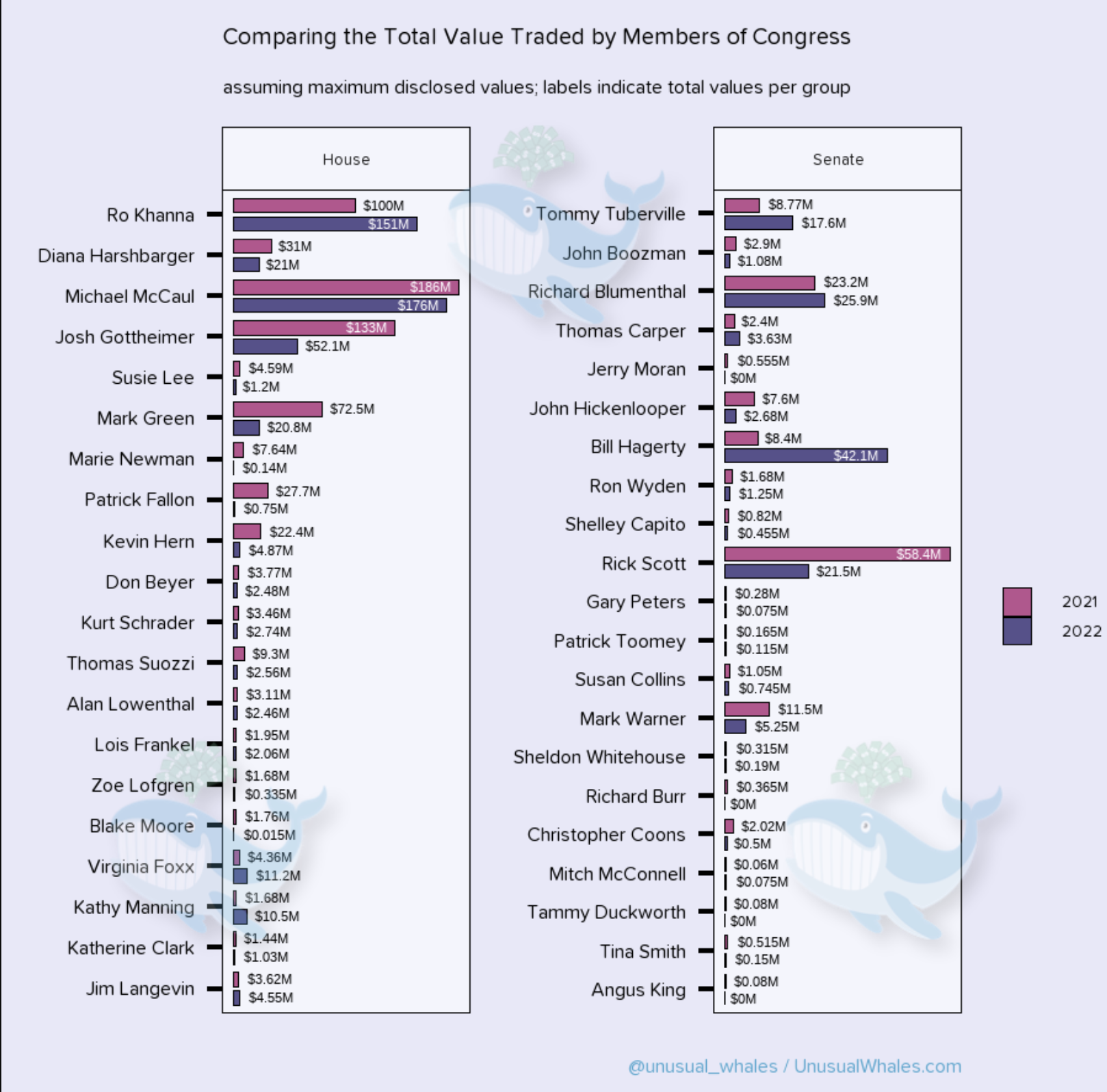
Among the Texas delegation, Michael McCaul (R, TX-10)  is by far the most active, buying and selling literally millions of dollars of shares every month, with often over hundreds of trades per month, January through September. His stock portfolio activity makes him, in industry parlance, “a whale.” McCaul is the son-in-law of the founder of Clear Channel Communications, now renamed iHeartMedia, with a net worth ten years ago of an estimated $300 million.

The New York Times reports that in 2020 to 2021 time period, McCaul family members bought and sold IBM, which has major contracts with the Department of Homeland Security, while McCaul served on the Homeland Security Committee. Family members also traded millions of dollars worth of both UPS and Meta shares, at a time when those companies were testifying before Congressional committees on which he served.

Unusual Whales
Unusual Whales has done great work on Congressional Trading

Pete Sessions (R, TX-17) was the next most active in 2022, trading 31 times year-to-date through September, in amounts ranging from $1 thousand to $50 thousand at a time, of 28 different companies. In previous years, the Times reports Sessions made trades in Bank of Nova Scotia and JPMorgan Chase after he was appointed to serve on the House Financial Services Committee.

Michael Burgess (R, TX-26) traded 22 times, on 7 securities, in increments between $1 thousand and $50 thousand. The majority of his focus was 12 trades involving Stryker Corporation, a medical device company. His preferred strategy appears to be a call-write strategy, in which he sells 1-month call options. This would mean he ended up selling shares in Stryker when the stock goes up over a short period of time. He also traded Microsoft, Disney, Amazon, Ford, Abbott Laboratories, and Berkshire Hathaway in 2022.

In previous years, the Times reported that 8 of 9 individual trades were in companies related to the House Energy and Commerce subcommittees, on which he serves.

Vicente Gonzalez (R, TX-15) purchased between $100 and $250 thousand of Tesla stock in May 2022.

Patrick Fallon (R, TX-4) purchased between $65 and $150 thousand of Twitter shares in January, and sold between $250 and $500 thousand of Verizon shares that same month. A report by Business Insider found that Fallon had 118 late disclosures in violation of the STOCK Act, making him unusually noncompliant with the 2012 law. The Times reports in previous years that Fallon bought and sold Amazon and Microsoft and Boeing, while serving as a member of the House Armed Services Committee. All three companies had important business with the Department of Defense. 

Lloyd Doggett (D, TX-35) has the most programmatic style, making purchases between $1 and $15 thousand worth of a repeating list of 6 companies every month, from February through October 2022: Proctor and Gamble, IBM, Home Depot, Coca Cola, Johnson & Johnson, and PPG Industries.

August Pfluger (R, T-11) sold Microsoft and purchased Warner Brothers and Liberty Media, in April 2022, in amounts totalling $50 thousand or less. He incurred 12 STOCK Act violations for late disclosures in past years, according to Business Insider.

And finally, Dan Crenshaw (R, TX-2) traded in January 2022 with the most apparently “cowboy” trading style. Based on sales reported in 2022, Crenshaw punted on the bankrupt meme-stock of Hertz. He bought and then sold Rivian Motors within a week, just as the shares were crashing, while also selling Tesla, Boeing, Southwest Airlines, and most interestingly a 3-times leveraged ETF on bank shares. Amounts ranged from $1 to $15 thousand. Dan, please step away from your Robinhood trading app before you do yourself any more harm. 

Crenshaw had 8 STOCK Act violations according to Business Insider. The Times reported that in previous years he sold shares in Kinder Morgan, while a member of the Energy and Commerce subcommittee on Environment and Climate Change. He had also bought shares in Boeing, as a member of the committee that oversees the Homeland Security Department.

Although she did not have 2022 stock trades and has since decided to cease individual stock trading, the Times reports in previous years that Lizzie Fletcher (D, TX-7) bought and sold stocks including in Carnival Corporation and Fedex, while a member of the Transportation and Infrastructure Committee. 

Meanwhile in the Senate, Senator John Cornyn, according to his 2022 financial disclosure statement for calendar year 2021, does not appear to own individual stocks, but rather owns diversified mutual funds – a better choice!

Senator Ted Cruz, according to his 2022 financial disclosure statement for calendar year 2021, owns individual positions in energy companies Exxon, One Gas, and EPD totalling between $165 and $400 thousand. He reported purchasing up to $50 thousand worth of a “Bitcoin Exchange Platform” in January 2022. He also owns diversified mutual funds, as well as up to $5 million in Goldman Sachs stock, where his wife has long worked.

Ok, back to the main point here, of why members of Congress should never trade individual stocks. 

It is not enough to think that 95 percent of Congressional votes are honest, or 95 percent of Congress members are honest. The existence of the bad 5 percent (I am making up this number, hopefully it is less than 1 percent) puts the entire rest of Congress into question. It should be deeply in the interest of all members of Congress to reduce financial suspicion about their and their colleagues’ motivations. They should want to ban stock trading by other Congress members to protect their own reputations.

In January 2022, bipartisan momentum seemed to be building within Congress to enact a ban on members trading individual stocks. 

The good news is that incoming House Speaker Kevin McCarthy has said that he supports a ban on individual stock trading by members of Congress. 

The issue had languished for a long time without outgoing House Speaker Nancy Pelosi’s support, which some cynically thought was because her husband Paul Pelosi (recently in the news as the victim of a home-invasion and attack by a QAnon-spouting person) was a large and active investor in individual stocks. She came around to support the issue by early 2022, but never brought a bill to a vote on a stock trading ban before the November 2022 election.

The bad news is that incoming reformers like McCarthy tend to forget about nitpicky ethics rules like stock-trading bans once they are in power. Financial ethics are not a red meat and potatoes type of issue likely to stir the Republican base.

Still, it’s my kind of issue. Texans should demand their own members of Congress not only stop trading in ways that raise red flags, but also vote to eliminate conflicts – and appearances of conflicts of interest – whenever possible.

A version of this post ran in the San Antonio Express News and Houston Chronicle in December 2022.

Post read (140) times.

Request for Your Personal Finance Questions

I’m trying a new thing with my newspaper.

Could you send me your specific personal finance questions, ideally about some decision you are trying to work through? If you need anonymity, that’s perfectly doable. A good email to send your questions to: michael@michaelthesmartmoney.com

Thank you!

personal_finance_help
Hand holding placard with help text vector illustration, person asking help

Post read (83) times.

Ukraine Philanthropy Part I – How You Can Help A Lean Scrappy Group

I wrote recently about what would be on the bottom of my list of philanthropic priorities. 

What is on the top of my list? I have only just begun to act on it, but the short answer is Ukraine, my geopolitical obsession for a little over a year.

My main honest thought in February 2022, during the first week of the invasion, is that I would have fled the fight. I fully expected Ukrainians to do the same. Their resistance to the Russian invasion, and their relative success in not being rolled over by the successor to the feared Red Army, astonishes me. 

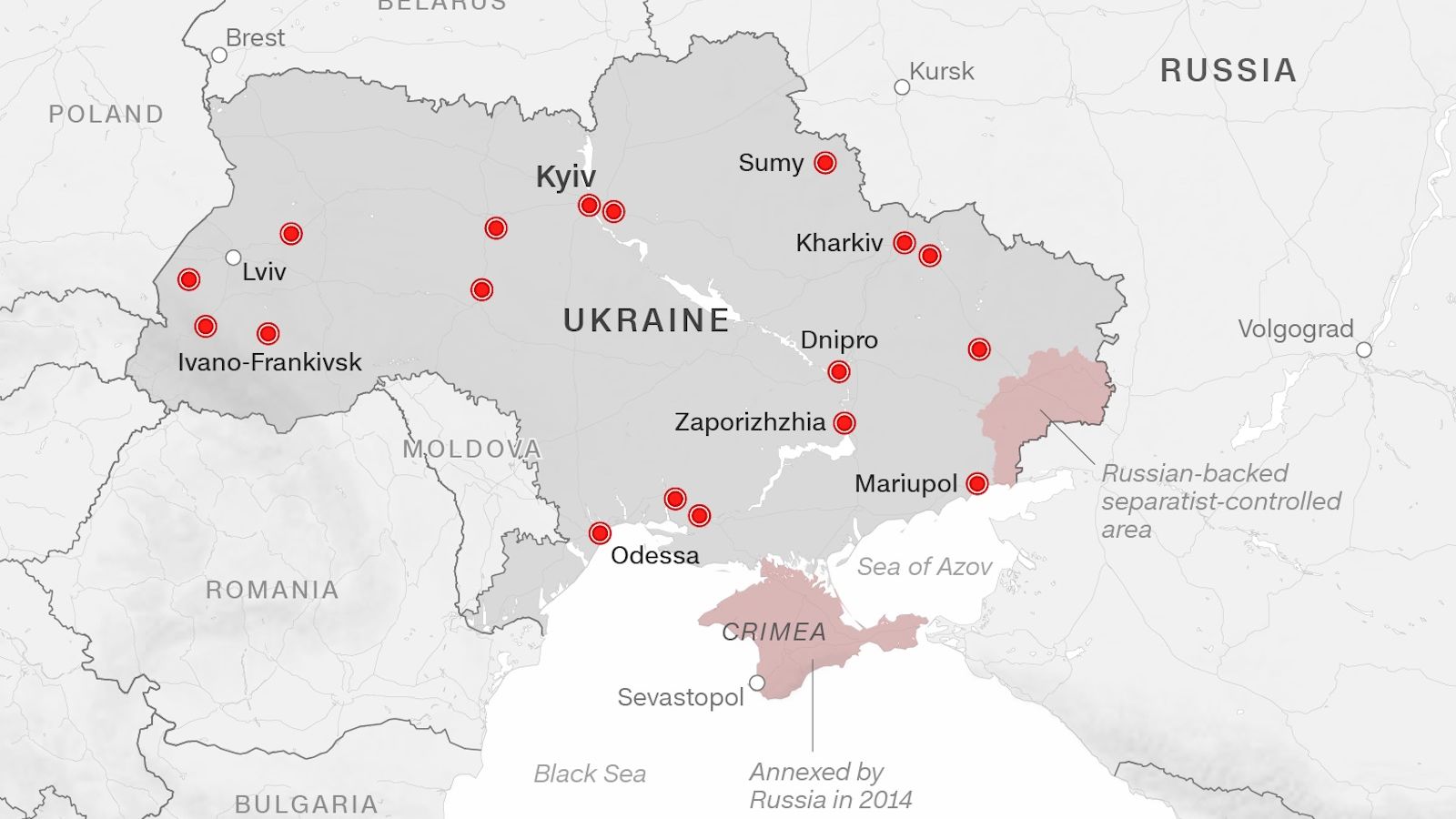
ukraine_war_map
Ukraine key locations

The conflict may last many more awful years. One of my main questions over the past year is how can I, and by extension how can Texans equally obsessed as me, support Ukraine?

Official Channels

Two official sites exist to gather international private support for Ukraine’s resistance. As a first response to my question I think people could and should consider these. 

Ukrainian President Zelensky created United24,

which solicits donations for one of three purposes: 

  1. Defense and Demining,
  2. Medical Aid, and 
  3. To Rebuild Ukraine

Mark Hamill, who portrayed rebel Luke Skywalker in the Star Wars epic about scrappy resistors fighting an evil empire against all the odds, has signed on to this official effort to support Ukraine. They accept credit and debit cards online. As of April 2023, Ukraine24 says they have raised $321 million this way.

In addition, the National Bank of Ukraine created a site for private direct donations to support the Ukrainian Armed Forces.

The National Bank of Ukraine claims that as of April 2023, it has raised the equivalent of $677 million (25 billion Ukrainian Hryvnia) through direct donations. 

Unofficial Channels

One of the unique features of this invasion is how technology – through social media, and on-the-front-lines communications for example – enables individuals to offer material support in a less official capacity. There are likely thousands of small-scale efforts that have sprung up since February 2022 to support Ukraine.

Austin-based television director Dax Martinez-Vargas met fellow advertising director Mykola while shooting television commercials in Ukraine. Following the 2014 Russian invasion of Crimea, Mykola’s television work dried up. As Martinez-Vargas tells it, Mykola over time built a discussion group on the social media platform Discord to call attention to Ukraine’s situation. When Russia invaded in February 2022, US-based members of that Discord group asked Mykola how they could help get supplies to where they were needed most. The discussion widened to others interested in Ukraine’s plight on the social media platform Reddit, where Mykola continues to build his international audience using the alias “JesterBoyd.”

jester_boyd
JesterBoyd

Dallas-based entrepreneur Steve Watford joined with Martinez-Vargas and a Nevada-based entrepreneur Anders Boyd to found Ukraine Front Line, Inc. 

Their original common bond was Mykola’s Discord group, and a desire to help as directly as possible. Boyd built the group’s website. Watford became President and got the organization recognized by the IRS as a 501(c)(3) charity, eligible for tax-advantaged giving from US citizens. 

Since then, Watford reports, about $50 thousand from 200 individuals and two trusts have been sent to support Mykola’s efforts to deliver needed supplies to the soldiers and medical personnel at the front. As their man on the ground in Ukraine, Mykola arranges purchase and pickup of materials, often in Poland, and sees their delivery by himself, or via couriers. They’ve purchased and delivered supplies such as combat medical supplies, cold weather uniforms, and reconnaissance drones.

It’s all very scrappy, lean, unofficial, and grass-roots. Watford, Martinez-Vargasa, and a third board member Robin Rohrback with whom I spoke, all prefer the efficiency of direct support to Ukrainians over more official charities or big established international charities. 

Compared to larger organizations, the material delivered by Ukraine Front Lines, Inc is tiny. But as the volunteers see it, with no overhead and volunteers who cover their own administrative costs, 100 percent of donations go to where it’s most needed in Ukraine.

The risks

The New York Times reported last month on Ukraine charities that have popped up since the invasion began 14 months ago that have raised eyebrows.

Accusations include lying about the biographies of key members, claiming official registration or pending registrations as an official charity when that wasn’t true, or exaggerating accomplishments or deliveries of supplies. A year ago I sent a small amount of money via PayPal to a Ukraine-based American with an active Twitter presence who represented just such a grassroots organization. He was mentioned as a controversial figure in that recent New York Times article, and he has since gone dark on Twitter. For small organizations, one should always maintain some level of skepticism. 

For what it’s worth, Ukraine Front Lines is a registered 501(c)(3) organization. Mykola and his in-country couriers do an admirable job of photographing and documenting their deliveries, posting on the Ukraine Front Lines blog and Reddit. 

One upside of supporting small organizations is efficiency. Another is that supporting small increases the chance of engaging in a philanthropy that is emotionally satisfying, through a narrative and personal connection. 

My donations

I am of the opinion that the US government and our NATO should support Ukraine generously with government funds. As of this writing, official US government support is above $75 billion, a combination of military, financial, and humanitarian aid. But I also hope and think Americans – who give close to $500 billion dollars in philanthropy per year – could make a difference as well.

Last week, I was successfully able to donate a small amount of money to Zelensky’s United24 for “defense and demining” through my credit card. 

Then I tried to donate a small amount using my credit card to the National Bank of Ukraine, but the payments didn’t go through. After three failures I tried to communicate via online chat, but the site’s chat function was in Ukrainian, so I was not able to complete that donation. 

Zelenskyy
Zelenskyy as civilian leader and leader of a country at war

Finally, I gave a small amount to Ukraine Front Line, Inc after speaking directly with three of their members, and after viewing Mykola’s very specific communications online. 

As we grind into the second year of a brutal invasion and defense, I hope and think the philanthropic power of Americans should and could be a force multiplier. 

Watford brings a very Texas attitude toward his support for Ukraine through Ukraine Front Line, Inc.

“We [Texans] bleed freedom, that’s our nature, and God help anyone that threatens it,” says Watford. “This same trait has been heroically demonstrated by the people of Ukraine. They were backed into a corner staring straight down the barrel of a loaded gun and said, ‘do it.’ They have and will continue to fight to preserve their freedom, and they’ll die before they give it up. That’s about as Texan as it gets.”

A version of this post ran in the San Antonio Express News and Houston Chronicle.

Please see related post: Ukraine Philanthropy II – Using Miles for Refugees

Post read (110) times.