
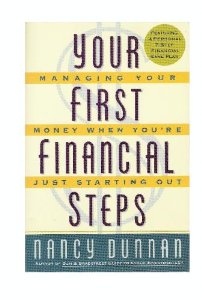
Book Review: Your First Financial Steps – Managing Your Money When You’re Just Starting Out

Your first financial stepsYou know what’s funny?

Your First Financial Steps/Managing Your Money When You’re Just Starting Out, by Nancy Dunnan is funny.

I graduated from college in 1995, the same year Your First Financial Steps came out, so in a sense I am precisely the demographic who was supposed to buy this book, at that time.  I knew nothing about the topic of finance as a college senior, and I still recall the conversation in which a family member explained to me the difference between a stock and a bond, and the difference between the terms “fixed income” and “equity.[1]

I’m interested now, in 2013, because I’m attempting to write a book for exactly the same purpose, for college graduates in 2014 and 2015.

Good advice on personal finance doesn’t change much from year to year, or decade to decade, and some financial writing from 1875 and 1949 still holds up well.[2]

But this book did not age well and ends up being kind of funny.

It’s not wrong, exactly, it’s just a time capsule of the way things were when I graduated from college.  Nobody would dream of buying, or reading, a personal finance book like this now.

A few choice features that made me chuckle.

1.       Dunnan frequently recommends readers photocopy pages of formatted tables from her book.  The reader can then use this newly photocopied page to fill in a set of information such as the anticipated costs of personal life goals or accumulated debts.  Something tells me nobody is going to photocopy tables from a book these days.  Not to mention the more important fact that if you’re writing down numbers that need summation or manipulation in some way, and that’s not in a spreadsheet, you’re doing it wrong.

2.       All of the useful sources of government or commercial information she references – from the IRS to credit bureaus to low-cost campgrounds for affordable vacations – come with an address and telephone number.  No websites, obviously, since in 1995 the World Wide Web was only on the verge of launch.  My God how did we know anything back then?

3.       Some of the advice seems to come from an earlier Norman Rockwell age, before the Federal Reserve was identified as the Star Chamber of the Trilateral Commission, controlling everything from global equity prices to ushering in a New World Order of black helicopters and United Nations control.  In 1995, however, a college student like me might have seen the Fed as another aspect – along with George Bailey’s Bailey Building and Loan Association – of the local banking scene.  In the chapter on banking, Dunnan lists the cities with regional Federal Reserve banks and advises the just starting-out student: “Call the one nearest you to find out about a tour.”  I don’t know why that made me laugh.  Does she want her readers to be disappeared forever?[3]

 4.       On getting a job, on page 63, Dunnan includes a special box entitled “Looking for a Job by Computer.”  This edgy piece of advice includes the name of a software program called “Jobhunt” that lists “the names, addresses, and info on 600+ employers, arranged by job type and geographic region.”  Send away for that program on diskette and start your job hunt today!

 Anyway, in sum, I’m enjoying the “literature review” of personal finance books – so I thought I’d share some of my pleasure with Bankers-Anonymous readers.  Please send me a telegram (or whatever) if you recommend a book on personal finance I should read or review in the course of my research.

 Amazon link to: Your First Financial Steps/Managing Your Money When You’re Just Starting Out

Please see related post: All Bankers Anonymous Book Reviews in one place.


[1] If you don’t know the difference, we’re both in luck!  I have a book you need to read.  Just give me about a year to get an agent, a publisher, and get this thing on the shelves.  You’re going to love it.

[2] On 1875 finance, I recommend Anthony Trollope’s The Way We Live Now, which I plan to review some time.  It’s so good, and all about Bernie Madoff, before Bernie Madoff’s grandfather was even born.  For the key book on investing from 1949 I’m referring of course to Benjamin Graham’s The Intelligent Investor.

[3] I kid, I kid. It’s a joke.

Post read (10467) times.

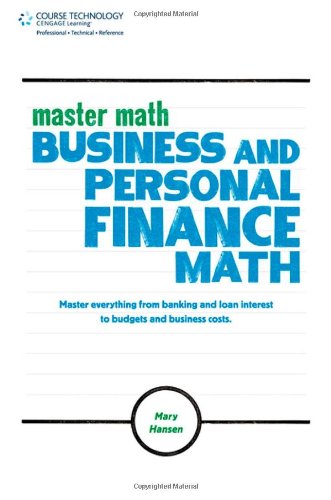
Book Review: Master Math; Business and Personal Finance Math

I’m finishing up teaching an undergraduate course on Personal Finance this month, for which I find the assigned textbook totally useless, so I am on a quest to come up with a useful book to recommend for students as well as Bankers Anonymous readers.
What’s useful

The most impressive strength of Master Math: Business and Personal Finance Math by Mary Hansen is that it cuts out all the (mostly) banal ‘advice’ of a personal finance book, and concentrates instead on how to do the calculations.  The math level never rises beyond algebra, which frankly is all anyone needs to know, in order to competently manage their personal or small business finances.

I find this a useful guide for a ‘Do-It-Yourselfer,’ or a person intent on learning exactly how car loan companies calculate APR vs. APY, or insurance companies quote term life insurance.  A CFO for a small business or non-profit would also likely benefit from this useful introductory reference.

I’ve frequently paid but never personally calculated FICA taxes, for example, and it’s somewhat satisfying to learn how straightforward the math is.  I have personally prepared business balance sheets and budgets, debt to equity ratios, and tracked profitability, but the straightforward presentation would be useful to others who have not done so before, but who need to learn.

What’s missing

Missing from Master Math, however, is my personal pet project: Understanding discounted cashflows and compound interest – the keys to good personal finance decisions.  While the author presents a ‘compound interest’ table and defines the term (in contradistinction to simple interest), a table does not really cut it.

The limitations of print media for personal finance math

Reading the book this week has inspired a new thought, however, of which I’m increasingly convinced.

Personal finance and small business math, while not complicated, requires fluency with a spreadsheet program like Excel.

Master Math offers good, but somewhat convoluted algebraic formulas to calculate answers.  In print, the author cannot show the dynamic changes in personal finance outcomes from changes in variables.

Properly set up in a spreadsheet like Excel, by contrast, a change in loan interest rate, for example, alters every monthly payment as well as the total cost of a loan.  A small change in automatic monthly withholding, for example, changes everything when it comes to long-term retirement savings.  Only by seeing the dynamic effects, I think, can we understand what control we can have over personal financial decisions and outcomes.

What is the right media?

I know Khan Academy has changed everything when it comes to math pedagogy.  Although I enjoyed Master Math, I’m also sure personal and small business math has to be taught, and learned, through a combination of video, practice problem sets, and acquired fluency with Excel.  Static text on a page isn’t enough.

This is something I’d like to work on over the next few years.

Please see related post: All Bankers Anonymous Book Reviews in one place.

Master Math Business and Personal Finance Math


Post read (5622) times.

Personal Budgets and Quantum Physics

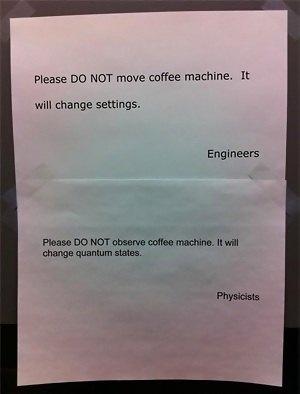
Observer effect coffee machineI hate personal budgets.

Even so, I made my students in my Personal Finance course keep track of their expenses for three weeks.  Not necessarily to torture them, but because they might need it later on.

I don’t keep one, so I’m not about to suggest that that everyone else needs to start writing down all their purchases, packing those little flimsy receipts into their wallets and stressing until every last purchase gets recorded into their personal accounting software.

Since I don’t keep one myself, I hesitate to suggest it for others.

And yet, if debt is a problem, you might need it.

The Observer Effect

The “Observer Effect” from physics explains is why you should budget expenses every month if you’re having trouble getting out of debt.

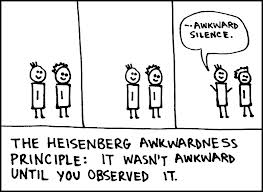
The Observer Effect is often described in shorthand as the Heisenberg Uncertainty Principal,[1] although I recently learned these are different, frequently conflated, phenomena.

Quantum theory posits that the act of observation influences electrons in spatial relationship with other particles.

In other words, to look at an electron is to alter either its position or its momentum.  Which kind of leads to messed up science.

Messed-up Science

But messed-up science can be our friend in personal finance.

To take a more common personal situation than quantum physics, doctors who study effective weight-loss techniques struggle with the basic scientific problem of Observer Effect.  Essentially, when you enroll people in a study to observe weight loss effectiveness, you more often than not change the behavior of the people in the study.

Consciously or not, study subjects begin to consider more carefully their behavior and its effect on their weight.  Whether you’re enrolled in the ‘control’ or the ‘study’ group, you no longer act or think precisely the way you did before enrollment.

Personal budgeting is a way to take advantage of this observer effect, if you have trouble coving your costs on a monthly basis.

We can use the observer effect to our advantage, altering our behavior in the act of observing it.

How I use the Observer Effect in my own life

I don’t carry monthly credit card debt, which is my primary excuse for not doing personal budgeting.[2]  Frankly, my behavior when it comes to monthly expenses is fine already.  Because I’m cheap.

But I periodically struggle with two other problems: time management – and keeping to a regular exercise schedule.  I already know the ‘right answers’ when it comes to these behaviors, but knowing the right answers is not the same thing as doing the right thing on a monthly basis

Hence, the observer effect.

When I get really stuck, I’ve learned I can track either of these behaviors in a spreadsheet.    Do I think I run four times a week but really I only run twice a week?  Do I think I go the local gym twice a week but really it’s twice a month?

Am I wasting two hours a day surfing Facebook, clicking ‘like’ on Gawker articles?  When I track every half hour of my day, I can begin to see that a scheduled twenty minute conference call actually eats up an hour and a half, between preparation time, and follow up emails, and daydreaming about what I should have said during the call.[3]

This tracking inevitably changes my exercise and time management behavior, subtly altering it for the better.

Look, I know it’s not a permanent change, and it’s not a cure-all.  But it’s a start – and better than doing nothing.

A very successful business leader once told me the hardest part of his business is enacting adult behavior change.

I’ve learned over time that personal habits – especially personal habits we’re not proud of – rarely survive wholly intact after exposure to close observation.

All of which is to say if you have a hard time covering your expenses on a month-to-month basis – try budgeting.

Heisenberg Uncertainty


[1] Apparently the ‘Uncertainty Principal’ describes the difficulty of simultaneously measuring paired properties in particles like electrons – such as location and momentum.  The ‘Observer Effect’ with which it is often confused describes the problem of observing certain phenomena without changing the measured phenomena in the act of observation.

[2] My secondary excuse? Laziness.

[3] Here’s the best time-management book I’ve ever read, 168 hours: You Have More Time Than You Think by Laura Vanderkam.  Also, she provides a handy spreadsheet that you can use to track your time.

Post read (4988) times.