
Natural Gas Revolution Part I – Mad Max Bizarro World

There’s a Mad Max quality to the back roads and blue highways of South Texas these days. I’d been hearing about this strange phenomenon almost since I arrived in Texas 3 years ago, but only recently did I get an invitation to see it for myself.

I hopped in a car with a Texas State Representative this month to tour a drilling site with an independent oil and gas company in the Eagle Ford shale in South Texas.

As the State Rep and I zoom past empty acreage – not unlike Mel Gibson’s Australian outback – we spy on the horizon a small caravan of specialized tricked-out trucks approaching menacingly.  As they roar past us, we observe flatbeds full of monstrous piping overflowing with weaponized-looking plumbing on their backs.  Ironically these Mad Max vehicles forecast not the last known energy reserves on the planet, but rather the opposite – nearly a century worth of abundant, cheap, domestic energy.

As a relative newcomer to Texas I carry all my prejudices and misconceptions about oil and gas drilling with me.  Most of what I knew before my Eagle Ford visit I learned from Hollywood, via Giant and There Will Be Blood.

I found crucial differences between my preconceptions and what we saw there.

Foremost in my mind is that most people I speak with in San Antonio, not to mention the rest of the country, do not understand just how big the Eagle Ford operations are.

If my estimates of investment are anywhere near correct – something on the order of $100 Billion – the Eagle Ford dwarfs USAA, HEB, or Rackspace[1] as an economic driver of the South Texas region.

Second, the scale of financial investment forces a corporate, risk-mitigating approach to operations down there, which is a good thing when it comes to environmental risks, a major concern about Eagle Ford.

Third, the employment boom in the South Texas region is palpable.  They need more people than they have right now.


What is fracking and what is the Eagle Ford Shale play?

So here is as good a time as any to explain what I’ve learned about how the Eagle Ford shale ‘play’[2] works, as opposed to oil and gas operations in other times and other regions of the world.

Historically, exploiting oil and gas reserves in many places on the earth has required sophisticated geological and engineering search techniques, seeking large hidden pools of hydrocarbons that can be extracted from a vertical drill in the ground.

A ‘shale’ play like the Eagle Ford, however, is the kind of seemingly un-exploitable geological formation that oil engineers and geologists skipped over for the past century, in their search for large underground pools.  Oil and gas trapped in small bubbles between tightly packed shale rock could not be released using traditional techniques until the last decade or so.[3]

A combination of two techniques changed all that: horizontal drilling and hydraulic fracturing (fracking).[4]  The horizontal drilling allows above-ground rigs to exploit a much broader underground area from which to extract hydrocarbons, and the fracking involves the use of underground explosive charges to blast open tight rock formations, followed by high pressure water, sand, guar[5], and chemical combinations to keep rock formations open long enough for oil and gas to flow and eventually to be extracted by the horizontal pipe.

Suddenly – and by suddenly I mean in the last 10-15 years – exploitation of shale oil and gas deposits trapped in shale formations has become economically viable.  And by “economically viable” I mean the oil and gas industry has suddenly found 15 years’ worth of profitable drilling in South Texas and maybe 90 years’ worth of U.S. domestic energy underground in the Bakken, Marcellus, and other major shale regions.  Horizontal drilling and fracking has caused an oil and gas revolution.

This revolution is what the State Rep and I have come to see in Bee County, Texas.


Up Next Part II – No Dry Wells in the Eagle Ford

Part III – The Scene at Drilling and Fracking Sites

Part V – The labor market in the Eagle Ford

[1] To name a few overly-referenced economic engines of South Texas.

[2] ‘Play’ in this context is what oil and gas folks call it.  Also, I’ve learned that if you’re a Yank and not from around these here parts, Eagle Ford is pronounced as one word: “Eagleferd.”

[3] A little online research reveals that fracking techniques were known and used in the oil industry as early as the late 1940s, with additional advances in the technology in the 1970s, but commercially successful exploitation of shale-trapped gas, using the sand and chemical mix, dates only to 1997.

[4] I only got through one season of the Battlestar Galactica redo that came out a few years back.  I think it’s important to acknowledge the rise of their particular Galactica method of swearing (“Frack!”) and the concurrently perfected process of releasing hydrocarbons from closed shale rock.  For linguists, this may represent an important example of “multiple independent discovery” in the development of the English language.

[5] I hadn’t heard of guar either, but it’s a common cheese and ice cream-additive, derived from beans in India and Pakistan, lately applied to the fracking process.

Post read (3799) times.

One More On Nate Silver

I don’t read Paul Krugman much because his column falls in the category of people-whose-politics-are-entirely-too-predictable, when it comes to financial or political analysis.  I have this weird aversion to reading (or listening to, for that matter) the thoughts of people about whom I can predict their stance even before the conversation begins.[1]

However, occasionally Krugman reminds me why he’s wicked smaht[2] and says what I was thinking before I even thought it (if that makes sense, which I’ll admit, it doesn’t.)

Krugman points to a National Review piece attacking Nate Silver – of Five-Thirty-Eight.com fame – for his bias toward Obama.  The gist of the National Review piece is that Silver’s methodology is flawed, intentionally, to support Silver’s Democratic agenda.

Krugman’s point, and I whole-heartedly agree, is that when good statistical analysis like Silver’s – and science for that matter – is attacked for political reasons, we lose something important.

Clearly, I’m a Nate Silver fan, because he’s cutting through the distracting media infotainment industry better than anyone right now.  So Krugman’s larger point resonates with me – that if you can discredit and reduce good data-driven analysis to a base level with the rest of the noise, you’ve given ignorance a fresh start.


[1] Diane Rehm is guilty of this.  I hated on Joseph Stiglitz’ book recently for that reason.  I can barely read Nicholas Kristoff’s poltical columns as a result.  While their Op-Eds can be useful, nearly every editorial in the Wall Street Journal is unreadable.  Unless they are unintentionally comedic, like this one.

[2] As we say in my hometown.

Post read (2117) times.

Texas Senate Candidate Sadler: Honey I Shrunk The Texas

Paul, can we talk about your yard signs?

What is the deal with your horrible logo and signage?

You placed a little teeny tiny Texas in the middle, surrounded by a red circle, just below your giant-font name.

Look, I’m new to Texas.  But even I know that you’re not supposed to lead with the message that “Everything Is Tinier In Texas!”

If you’re elected, do you promise to “Shrink Texas Down to Miniature?”

How about “Remember, Sadler Is Bigger Than Little Texas?”

Do you have a little red circle around Texas because “Texas Is Better When It’s Completely Circumscribed?”[1]

When I walk around my Democratic-leaning neighborhood and see your yard signs I picture you as that character in Kids in the Hall who viewed the heads of undesirables through outstretched thumb and forefinger to visualize “crushing their little heads.”  Only in your case, Paul, I read your logo’s plan as “If elected, I will crush your tiny little Texas,” with that character’s strained accent.  I like to hold my fingers up to your sign, squint at it, and squeeze my thumb and forefingers together aggressively.

Look, I understand you don’t really expect to win your Senate race in Texas, because you’re a Democrat running for statewide office, and Texas turned Republican in the years between Barry Goldwater and Ann Richards.  So you kind of know that Ted Cruz is going to crush your campaign and your teeny tiny Texas even without this yard sign problem.

But for your next campaign?  Find out whose brilliant logo idea that was and fire that person.


[1] Huh-huh, he said “circumscribed.”  Shut up, Beevis.

Post read (5138) times.

It’s Nate Silver’s World, And We Just Live In It

With less than two weeks to go in the election, that Jay-Z song has been running through my head, because indeed, “Who is gonna run this town tonight?”

But the answer I keep coming back to isn’t Mitt or Barack, but rather Nate Silver and his Five Thirty Eight site.  Everyone I know is absolutely addicted to his analysis and will be until November 6th.

Silver is the true thug, the mack-daddy, the baddest brother up from the housing projects of the statistics profession.  He runs this town tonight, and for the future.

Silver interprets polls and statistics unlike any other writer out there.

Traditional journalists on television, radio, and print have a need to hype as much as to inform.  Columnist Peggy Noonan absolutely predicted the future when she wrote – before the first Presidential debate – that Romney would be declared the winner, if only because the media needs a horse race.  Traditional media has advertising space to sell, which means emphasizing outlier polls showing a tight race.  Or it means national polls – which are largely meaningless in an electoral college world – get hyped beyond their true meaning.

But Silver consistently brings a probabilistic, nuanced, and data-oriented approach to predicting the Presidential outcome, and why it may hinge on Ohio.  He incorporates the information from political betting markets in a sophisticated way.

His writing reminds me of working with the brightest traders in the bond markets, sifting through data and models to come up with probabilistic scenarios.

What’s so amazing about Silver is how rare he is in journalism.  He relies not on anecdote but on data.  He’s willing to debunk myths and de-hype a situation, if the data warrants it.  Why can’t we get more of this?

It’s a Nate Silver world now, and we just live in it.

Post read (3529) times.

Ask an Ex-Banker: Home Loans and Home Equity Lines of Credit

Q. Dear Banker, My wife and I are planning an addition to our house. We need the additional space, but I do not want this project to stretch our overall budget. Since I have a specific idea of how much I want to pay, a rise in interest rates would cause us to make different decisions on the project details. Unfortunately, we need to make those decisions now but will not need the money for another 8-12 months. I don’t care if interest rates go down, I like where they are now, but borrowing money before you need it sounds foolish. How does your average Main Streeter hedge against interest rate swings?

Bradley T., San Antonio TX

 A. I understand your question to be whether you should borrow money now, before you need it, because rates are ‘low enough,’ and because you worry rates will not be this low in another 9 months when you actually need the money for the home renovation.

My short answer is: “Maybe, although I personally would not” as to whether you should borrow now and lock in today’s low fixed rates, in anticipation of needing money 9 months from now.  I’ll explain what I mean by that in a moment.  The longer answer, which I’ll detail more fully below that, is that you really need a home equity line of credit, not a fixed-rate home equity loan.

The Short Answer                                      

Should you lock in a loan 9 months early because rates are ‘low enough?’  I’ll make a bunch of assumptions to be able to answer the question specifically, and I hope you can adjust the answer to your own particular situation.

I’ll assume you can get a Prime[1] rate home equity loan for a pretty major $100,000 home renovation at 5%.  That means you’ll pay $5,000 per year in interest, or an extra $3,700 for borrowing 9 months early.

$3,700 is not the end of the world for peace of mind, and so I’ll answer “maybe” borrow this way to lock in an attractive low rate like 5% today.

There are a few reasons, however, why I would not borrow money early myself.  Foremost, we really have no idea which way interest rates will go in the future.

As a former bond guy,[2] I pay quite a bit of attention to interest rates.  Had you asked me at almost any time in the last 10 years whether interest rates were likely to go higher or lower in the next 18 months, I would have said ‘higher’ approximately nine out of ten years, and I would have been wrong approximately nine out of ten years.  That’s not because I’m ill-informed, it’s just because it’s much harder to forecast the future direction of interest rates than it seems.

Because of my own deep uncertainty about the future direction of interest rates, I would argue your choice to borrow 9 months early ‘locks-in’ a loan interest ‘loss’ of $3,700, whereas the rate available to you has a 50-50 chance of being higher or lower 9 months from now.  If you accept my view, then your interest cost for the next 9 months, by not borrowing, is $0, which is much more attractive than losing a guaranteed $3,700.

But what if, 9 months from now, your fixed rate jumps to 7% from today’s 5%, and you’re locking in a 10 year $100,000 loan at $7,000 a year, rather than the more attractive $5,000 a year interest cost?  Well, in that case, if you carry the full sized loan for 10 years, you’ll pay a total of $20,000 more in interest over the life of the loan.  In that stark (probably-worst-case-scenario) example you will have lost out, and you will curse my advice, as well as my children’s children.[3]

Given that the starting position of borrowing early is that you’re $3,700 poorer, however, I see many more scenarios in which you come out ahead by not borrowing early.

If you plan to pay down the loan principal faster than 10 years, for example, or rates shoot up less than 2% over 9 months, or rates stay the same, or rates go down even further, you will have broken even or ended up better off by not borrowing early.  So that’s why I wouldn’t take today’s rates.

The Longer Answer

Instead of a home equity loan locking in today’s good fixed rates, what you actually need is a home equity line of credit (HELOC) from which you can borrow money and pay down at any time.[4],[5]

When I started a business in 2004, I met with an elderly entrepreneur who gave me great advice: Obtain the largest possible home equity line I could, not because I needed it now, but, because as an entrepreneur I needed to be ready to take advantage of opportunities whenever and wherever they might arise.

He was right.  In fact, any person who is both a home owner and a business owner, needs to stop everything right now and start applying for a home equity line of credit.  Why are you still reading this blog post?  Go, do it, now.  I’ll wait.

Ok good, you’re back.  You’re welcome.

In your case, Bradley, the potentially higher rates one year from now will be more than made up by the fact that you can borrow only the amount you need, as you need it, for your home renovation.  The slower drawdown of debt principal and the faster payoff of principal via a home equity line of credit is virtually certain to save you interest costs in the long run.

I believe the fact that HELOC rates are floating – they may go up or they may go down over time – are more than made up for by the variable amount of principal you can take out only as and when you need it.  Over the course of your planned home improvement project, if you borrow for example $33,000 for some period of time, rather than the full $100,000 loan, you’re obviously paying 1/3 of the interest costs than you would on the full amount, during the period of the smaller borrowing.  My point is that even if you end up with the same peak amount of borrowing, $100,000, you’re likely to have paid significantly less in interest in getting to that point.  Most of the time, those savings will outweigh the probability-weighted cost of higher future interest rates.

A special note for small business owners, new and old:  If you’re just starting out, the HELOC may be your only ticket to borrowing money cheaply and flexibly.  Banks only pretend to lend to small businesses, and they certainly do not lend to new small businesses, so it’s hardly worth trying that route.  Banks do lend, however, against houses and home equity, so you’ve got a shot there.

For experienced small business owners: You still need the largest home equity line of credit possible.  You never know when the commercial property right next to your office may become available, and when having $50,000 in ready cash is the difference between acquiring the real estate of your dreams and paying more to lease office space for the next 30 years.  If you have to go to your bank to apply to get the loan to buy the property next door, you’re too late.  You need the home equity line so that you can credibly represent to the sellers your ability to close the transaction within 1 week, in ‘cash.’  That is how the pros do it.[6]


[1][1] Meaning, you have excellent credit, at least above a 720 FICO.  The FICO people sell their scores from all three major credit rating agencies here for about $35.  It’s worth it to pull your score once in a while, so you can confirm you’re eligible for the best rates and there’s no weird activity on your credit reports.  Don’t let FICO trick you into paying $14/month.  That’s stupid.

[2] No, not the Daniel Craig type of Bond guy, much to my wife’s chagrin.

[3] Which is as good a segue as I can think of for repeating Jack Handey’s Deep Thought: “I believe in making the world safe for our children, but not our children’s children, because I don’t think children should be having sex.”

[4] This entire ‘Ask an Ex-Banker’ advice column today assumes you are a responsible borrower, and that debt incurred through a home equity line of credit will go toward productive home and business improvements and not be blown on subsidizing your unsustainable consumer-driven lifestyle.  In your case, Bradley, since you live in San Antonio, that means you can’t blow the whole line of credit on Alamo Lego miniatures and bad Tex-Mex food.   But since www.bankers-anonymous.com readers are, almost by definition, extremely responsible with debt, this hardly bears mentioning.

[5] Most HELOCs give you a drawdown period of, say, 10 years, followed by a payback period of another 10 or 20 years.

[6] While I’m very much in favor of HELOCs for small business owners, I need to acknowledge in the fine print here that things can and have gone wrong for small business owners putting their houses at risk.  Of course this would be terrible.  When you get a HELOC for your small business, make sure you save it for an opportunistic can’t lose situation, not use it to keep your flailing, unsustainable, small business alive.

Post read (16717) times.

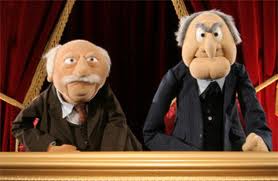
Midlife Muppet Crisis

With the impending release of Greg Smith’s tell-all book about his time at Goldman Sachs, it’s finally time for me to vent a little about his ridiculous New York Times Op-Ed last Spring.

Immediately following the online release of the New York Times Op-Ed that would launch a thousand Muppet jokes , I printed it out and handed it to my editor in chief[1] because I knew she would be interested.  I knew everyone would be interested.  Smith nailed the 2008-2012 financial Zeitgeist [Goldman is greedy!] and he made a credible witness as an insider.[2]

Now, there’s three things that must be said about Smith’s bombshell of an Op-Ed, two of them complimentary and the third one, not so much.

First, Smith’s letter, compared to Lloyd and Gary’s dead-speak corporate response, was an unfair fight the likes of which we haven’t seen since Mike Tyson took down some of his patsy opponents in the late 80s.  Smith can write some interesting sentences, while Lloyd and Gary, just as clearly, cannot.  Their passive voice construction, reference to a workplace poll about employee satisfaction, and clear put-down of his status at the firm[3] simply did not respond to Smith’s main accusation.

Second, and most importantly, Smith’s main accusation is absolutely true.  Yes, Goldman collectively only cares about the money.[4]  Yes, you get promoted at Goldman for profitable behavior.  Yes, higher complexity products have a greater chance of being profitable than lower complexity products, so you will be rewarded for trafficking in higher complexity products.  Yes, Goldman employees tend to favor their employer’s needs over the needs of their clients in the long run, and sometimes, in some cases, even in the short run.  All true, although I’m not sure why any of this is news.

Third, and most problematic, however, is Smith’s assertion that “Goldman has changed” during his ten year career from 2002 to 2012.  That, my friend, is complete malarky. [5]  Goldman didn’t change.  Goldman was like that when I started there in 1997.  Goldman was like that in 1985.[6]  Goldman was, no doubt, like that in 1931.  Goldman didn’t change.  Greg Smith changed.  He became a middle-aged guy who no longer wanted to compete and win at everything, at all costs.  He grew up.

And yet, he does still need to compete, and that’s the worst part.  There’s a kind of pathetic part of Greg Smith that does want to compete and win at everything, so he must tell New York Times readers about his scholarship to Stanford, the bronze medal in the Maccabiah Games in table tennis, and about being a finalist for the Rhodes scholarship.[7]  He must enumerate the size of his hedge fund clients and their assets under management.  After ten years he has evolved enough to know there is more to life than ripping clients’ faces off, yet he can’t quite break the habit of telling you how much size matters to him.

I wish you well, Greg Smith[8].  But I sense this is going to take some time for you.


[1] Mom

[2] albeit on his way to becoming an untouchable outsider in record time.

[3] Their roundabout way of highlighting what a no-status worker Smith was: while commenting that 89% of clients found service from the firm positive, and “for the group of nearly 12,000 vice presidents, of which the author of today’s commentary was, that number was similarly high.” Very clever, Lloyd and Gary.  We get it, Smith is a Vice President nobody in your eyes.

[4] If this is too blunt, we can treat you like a child and tell you the opposite: Yes, Virginia, there really is a Santa Claus, and yes, your friendly bankers at Goldman really want what’s best for YOU.

[5] As Joe Biden would say, to his good friend Paul Ryan.

[6] See e.g. Michael Lewis’ Liar’s Poker

[7] On the one hand he’s bragging.  On the other hand, the evil voice in me has to say: The what games? Never heard of them.  In table tennis, you say…Is this a joke?  Are you trying to undercut yourself?  And you’re bragging about being a Rhodes finalist?  And this is what you’re most proud of ten years later?…let’s just move on.

[8] But forgive me if I don’t rush out to read the book you’ve produced with a reported $1.5MM advance, chock full of descriptions about the size of your client base.

Post read (23853) times.