Book Review: The Price of Inequality

I began with so much sympathy for the ideas in The Price of Inequality, by Nobel-Prize winning economist Joseph Stiglitz, so why did I grudge-read the book the whole way through?

I concur about the causes and problems of persistent and rising inequality in the United States, and I suspect Stiglitz and I would vote for similar political candidates.  But my goodness, this is a painful book to read.[1]

First, Stiglitz writes lazily about banking, making errors and relying on simplistic generalizations to match his political points.  As an ex-banker, I’ve got a little problem with Nobel-Prize winning economists getting basic facts wrong about banks in this country.

Second, Stiglitz never surprised me – not with his descriptions, his anecdotes, nor the economic studies he cited. Instead, any consistent reader of the New York Times and Wall Street Journal will know, in advance, the arguments and examples he cites.[2]

Finally and worst of all, Stiglitz is a hammerer, not a sifter, of ideas.  He pounds away at the inequality problem, always from the same left-of-center perspective, until all current events have been beaten into the same shape.

A bit more sifting, or a weighing of alternative perspectives would have won me over to his side.

No, that’s not exactly right.  I started out on his side.  A bit more sifting of competing thoughts would have prevented me from wanting to jump to the opposite side and point out all the ways he simplifies and distorts the left-of-center perspective.  I read a hammer book like The Price of Inequality and I just want to throw the hammer away.

If the last book I reviewed Unintended Consequences has one set of opening assumptions – that growth is the most important goal of economic policy and that financial incentives are a key to growth – then The Price of Inequality takes the opposite view of economic policy based on a very different set of starting assumptions.

While Unintended Consequences built a measure of good will with me, as a reader with banking experience, The Price of Inequality quickly gets my hackles up with a series of incorrect statements about banks.

MF Global did not, as Stiglitz incorrectly states on page 36, falter primarily as a result of derivatives trades – but rather it declared bankruptcy after a series of overly aggressive bets taken by its head Jon Corzine.  Corzine thought European bonds were cheap, so he loaded up his firm’s balance sheet with them, in the hopes that European bond prices would recover.  He was wrong, and the firm went under.  Derivatives were irrelevant.

There are not, as Stiglitz incorrectly states on p. 46, “hundreds of banks,” in the United States.  In fact there are over 7,000 banks in the country.

More troubling than these factual mistakes, however, is Stiglitz’ oversimplification in describing bank misdeeds.  For example, banks did not, as stated on page 47, systematically rig LIBOR ‘enabling them to make still more profits.’  The LIBOR rigging, perpetrated by a small number of cheating traders, had an unknown effect on profitability of the banks overall, and a reasonable argument could be made that systematically lowering LIBOR actually hurt banks’ overall profitability, as their lending portfolios would suffer from the lower interest rates sought by the riggers.  The rigging was wrong, and the cheaters will be and are being punished, but Stiglitz’ simplification doesn’t help his credibility.

Most egregiously, Stiglitz perpetuates the view, mistaken in my opinion, that predatory mortgage lending constituted a predominant bank strategy in the years leading up to the Credit Crunch.  Stiglitz describes the ‘rent seeking’ behavior of mortgage banks exploiting the poor through predatory lending, which he claims brought the banks extraordinary profits.

Ah, where to begin on that one?  Perhaps with those “extraordinary profits?”  Did anyone else notice the extraordinary losses banks took due to lending to poor people?  The write-downs and bailouts of 2008 and 2009 were a direct result of losing money, not making money, on the sub-prime debacle.

And then, if predatory lending was such a winning strategy, why aren’t banks falling all over themselves now to lend to the poor?  There are certainly more poor, and more unemployed now than there were during the boom years.  It should be a real boom time to pile up all those banking profits lending to the poor – right now, no?

What, you say, banks aren’t lending to poor people now?  Why do you think that is Mr. Stiglitz?

The real answer, the logical answer, is that lending to the poor is generally a terrible banking idea, and that banks don’t do it in the ordinary course of business.  The lending that led to the Credit Crunch was a short-lived, devastating experiment.  A near-death-experience-type experiment for banks.[3]

Look, lending to poor people is a damned-if-you-do, damned-if-you-don’t situation for bankers.  For the past thousand years, traditional banks did not do it because it’s not profitable.  To make up for that lack of profitability, federal government policies[4] demand some measure of lending to disadvantaged neighborhoods, while Fannie Mae, Freddie Mac, FHA/VA and USDA (among others) each in their own way incentivize mortgage lending to poor households.

For a brief decade – 1998 to 2007 – banks responded to a combination of government and market incentives, and the sub-prime market boomed. They did it from 1998 to 2007 based on a misunderstanding of market incentives, primarily rising real estate values and history-naïve modeling.

Sub-prime mortgages – before they became a bad word – were praised as an ingenious way of expanding home-ownership, of inviting more Americans into the American Dream.  Stiglitz’ narrative of the banker as profit-making predator and the poor homeowner as naïve victim – while common – is a distorted myth that ignores history and reality.[5]

Why do I get so agitated over Stiglitz’ simplification?  Just this:  If we completely mischaracterize the financial debacle of 2008, we’re likely to learn all the wrong lessons from the Crisis.  I realize its politically appealing to blame the greedy bankers and absolve the plucky poor people exploited by the greedy bankers.  I’m a creature of the same culture as Stiglitz and I love to criticize bankers too.  But please can we agree not to lie to ourselves so much about the mortgage debacle?

Ok, now back to the other problems with Stiglitz’ book.

If I assume I’m a pretty good representative of the intended audience for The Price of Inequality – Non-academic, informed on current events, politically opinionated, concerned with inequality – then why is this book such a chore to read?  I think it has something to do with the fact that Stiglitz’ examples all come from the same headlines and articles I’ve already read in recent years.[6]  I kept waiting for the original idea or surprising, counter-intuitive insight, but I waited in vain.

He offers statistics on the terrible state of wealth disparity in the United States, but in the driest way possible.

In the final analysis, I expected a more thoughtful weighing of evidence and ideas.  Stiglitz’ book wades into an important ‘Battle of Big Ideas,’ but he has no taste for engaging the opposition on its own terms.  He’s a warrior for his own side who does not speak the language of his enemy and cannot conceive of their humanity.

When someone wins the Nobel Prize in Economics, does that confer a monopoly on all the good ideas about a complicated topic like socio-economic inequality?  Are there, possibly, unintended consequences[7] to his policy prescriptions?  Does the opposition deserve a careful and open hearing?

Stiglitz really knows how to put the dismal back into the dismal science.  For a more intuitive, specific, sometimes funny, and interesting read on inequality and its societal costs, can I interest you in an excellent book here?


Please see related post: All Bankers Anonymous Book Reviews in one place.


[1] This is the opposite of my reaction to Ed Conard’s Unintended Consequences, which I reviewed earlier in the month, and which forms a neat book-end as the opposite worldview to Stiglitz’ The Price of Inequality.  Even though I disagree with many of Conard’s proposals, I enjoyed reading the book and would recommend it.  I guess I’m a contrarian that way.

[2] The New York Times’ Thomas Friedman is guiltier of this than anyone.  Never read his books.  I picked up The World is Flat only to discover that he’d retreaded his and his colleague’s columns and observations from the previous 5 years.  If you read newspapers regularly, you don’t need one of his books.  Did you know that hedge funds are allocating capital quickly around the world?  Did you know globalization is having far-reaching effects, visible even in small villages in foreign countries?  Wow.  Give that guy another $45,000 speaking fee.

[4] Primarily via the Community Reinvestment Act, known as the CRA.

[5] An interesting time-capsule on sub-prime lending comes from The Federal Reserve Bank of St. Louis in January 2006, characterizing the risks and rewards of the booming sub-prime mortgage market.  The research article has the advantage of not being tainted by the moral outrage that followed every subsequent discussion of sub-prime lending after 2008.  Accurately enough, the article states “subprime lending is simultaneously viewed as having great promise and great peril.”

[6] One example of rehashing known headlines and anecdotes:  He cites on p. 163 the infamous (and possibly apocryphal) Tea Partier whose protest sign read “Govt hands off my Medicare.”  Nevermind the silliness of citing one foolish protester to make a point, the recycling of Jon Stewart zingers does not win him any originality points.

[7] See what I did there?

Post read (5801) times.

Hedge Fund as Pirate, Seizes Argentine Navy Ship

Earlier this week hedge fund Elliott Associates seized the ARA Libertad, a tall ship from the Argentine Navy in a Ghanean harbor, as partial payment for unpaid sovereign debt dating back to 2001.

I love this story, because I’ve got some history with both sides of this dispute.

Argentina’s debt default, of course, is why I ceased selling emerging market bonds at the end of December 2001, and became a mortgage bond salesman.  At the time, Argentina’s was the largest sovereign default in history, capping a financial train wreck we had watched develop for the entire previous year.  My emerging markets desk at Goldman shrunk from 13 salespeople to 3 salespeople in the few short weeks following Argentina’s default.  I moved from a bi-lingual, exciting dream job to pursue my passion for devising weapons of mass financial destruction for AIG.

More interestingly, Elliott is a former client of mine, and they’ve been doing this kind of unpaid debt enforcement thing successfully for a long time.  In the Fall of 2000, Elliott successfully and single-handedly threw the Peruvian government into temporary sovereign default, for similarly failing to make good on its defaulted debt obligations owned by Elliott.

The lead-up to that Peruvian event, like this week’s seizure of a tall ship in Ghana, also took years in the development.  The Harvard Law School case study is available here.[1]

To win the Peru situation, Elliott first had to overcome and overturn on appeal a century old law – called the Champerty Doctrine – that forbade New York lawyers from purchasing debt for the purpose of initiating a lawsuit.[2]  Since Elliott, as a distressed debt investor, does purchase debt obligations that it knows will involve litigation, it needed to prove that the Champerty Doctrine did not apply.  Instead, Elliott made the courts agree that it had purchased a valid Peruvian debt, and the lawsuit was merely the enforcement of the valid debt.

Next, Elliott managed to force bond payment servicers, first Chase Bank and later the bond-payment system Euroclear, to withhold payment on all Peruvian bonds, if the Elliott-owned debts remained unpaid.  Elliott got the New York and Belgian courts to recognize that it’s illegal to treat holders of equal-status debt unequally.

This forced Peru into default on its September 7, 2000 bond payments, despite the fact that Peru had the willingness and ability to pay all its bonds – at least all those bonds not owned by Elliott.

Elliott’s timing was also impeccable, in the sense that Peru’s strongman President, Alberto Fujimori, faced a political crisis at home that same week with a corruption scandal involving his closest ally, and Fujimori would flee the country by November 2000.  After about a week of political and financial squirming under the forced default, Fujimori’s government found the $50 million or so it owed Elliott and the problem was solved.

The seizure of the Tall Ship in Ghana this week is just another sign that Argentina will pay, one way or another, on the debt it owes Elliott.  The hedge fund reportedly owns $1.6 Billion in unpaid, unrestructured Argentine debt dating back to the 2001 sovereign debt default.

Obviously though, this story of the seized Argentine Navy ship raises as many questions as it answers.

  1. Will the 200 sailors reportedly aboard the ARA Libertad ever be able to hold their head up in a port town again after they got overwhelmed and seized by a nerdy hedge fund?  I mean, how does that happen?
  2. Will Elliott Associates’ Paul Singer challenge John Devaney’s Positive Carry to a real-life game of Battleship?
  3. Can the ARA Libertad offer Elliott’s outside investors the ultimate offshore vehicle?
  4. Is it true Johnny Depp will play Paul Singer in the movie?


[1] You can tell from the narrative that Elliott acts with extreme patience and careful, dogged determination.  As a betting man, I am sure they’ll get paid by Argentina in the end.  In the meantime, they’ve got that cool ship!

[2] The original idea of Champerty was that lawyers might try to generate unwarranted legal fees through the trick of purchasing debt and initiating litigation.  It was not meant to prevent the enforcement of valid debts, although Peru successfully argued the application of Champerty for a while, before losing on appeal.

Post read (3164) times.

Cracker Barrel Amateur Hour

The San Antonio Express-News reported that San Antonio-based Biglari Holdings failed last summer to notify the Justice Department of its intent to initiate an activist approach to investing in Cracker Barrel Old Country Store Inc, as required by law.

Sardar Biglari operates in the exceedingly small financial sandbox of San Antonio, where his firm’s $850,000 Justice Department fine makes news, or for that matter where $10 million in city initiatives constitute a significant portion of local venture capital investments over a three year period.

Does the Biglari fine matter?

It matters mostly to Biglari’s image, something he cares quite a bit about.  This is a businessman who has managed to get every single press mention of himself in recent years to compare him to value investor Warren Buffett.

Nevermind the fact that Warren Buffett has never engaged in hostile, aka activist takeovers, or management shake-ups – Biglari’s preferred investment style.

Biglari, and activist investors like him, seek to acquire enough shares in a target company to demand a board seat, and from that vantage point of power demand changes in management or company direction.  This is the kind of thing explained and exemplified in the popular culture by Michael Douglas’ Gordon Gekko.  Biglari’s fine from the Feds is precisely for not declaring his intent as an activist investor in Cracker Barrel.  Buffett, by contrast, famously only purchases companies in which he already admires and supports management.  Buffett is the opposite of an activist investor.

Also, nevermind the more important point, that a Buffett comparison is best bestowed by the investment world, not claimed by the investor himself.

Biglari’s is the kind of hubris and obfuscation you only can get away with locally in San Antonio, where comparing oneself to Warren Buffett isn’t immediately met with a snort of derision and a rolled eye.  For one thing, people are too polite for that around here.  For another, the wide gap between Biglari’s style and Buffett’s style would be too obvious to anyone from the larger sandboxes of the financial industry to take his self-proclaimed similarities seriously.

Besides just Biglari’s image, does the fine matter to Biglari’s actual business?

It should.  To the extent that a hostile takeover practitioner like Biglari depends on outside capital – as it no doubt does – he needs to credibly present himself as an expert in the field of activist investing, to attract sophisticated capital.  When you miss something as obvious as a regulatory filing – to declare your intent at activist investing – you really are declaring to anyone paying attention that you are not exactly covering all your bases.

This is not necessarily a problem the first time around.  But if I had money with Biglari – I don’t and I don’t plan to – I’d be a lot more skeptical about his claims of expertise as an activist investor as a result of this news.

Post read (2481) times.

My Front Row Seat For The AIG Debacle – SIGTARP V

The bailout of AIG stands out as the largest commitment of public funds for a single private company in financial history.  How did the world’s biggest insurance company become the largest corporate ward of the government, of all time?

For the curious, I recommend pages 2-4 of SIGTARP’s latest AIG report as it reports on the growth of the credit default swap business – which subsidiary AIG Financial Products (AIG FP) jumped into in a big way, and which ultimately brought down the whole company, and very nearly the global financial system with it.

For the even more curious, let me explain what I saw on Wall Street in the years before AIG blew up.

When I joined Goldman’s mortgage department in January 2002, I was paired with a senior mortgage bond salesman to help me learn the business as well as to help back up his clients while I built my own book of institutional business.  My sales partner’s biggest client – by far – was AIG FP.  I remember sitting down with him as he explained the trades Goldman was doing with AIG FP that had recently earned my partner the biggest “Atta-boys” from Lloyd Blankfein, then the head of the fixed income department.


Here’s my explanation of his explanation, in layman’s terms:


AIG Financial Products and Goldman jointly picked a large portfolio of companies on which Goldman wanted credit protection for a 10 year period.[1]  For an annual fee paid by GS, AIG FP guaranteed to make up the difference, financially, if a large number of these companies defaulted at the same time.  The companies chosen for these portfolios were highly-rated and well known, and each individually seemed highly unlikely to default.  In addition, the trades were structured so that only a highly improbable simultaneous default could put AIG FP on the hook for paying the credit insurance money to Goldman.

My first thought, and I said as much to my sales partner, was that AIG FP was selling deep-out-of-the-money “puts” to Goldman.[2]  He agreed.  I had just moved internally, the month before, from the Emerging Markets desk at Goldman, where one of the well-known rules in EM was that selling deep-out-of-the-money[3] puts always, always, ALWAYS comes back to bite you.  I filed this new information away as a thing to keep in mind.

For the next few years backing up sales coverage of AIG FP, I assisted my sales partner as he executed a number of similar, gigantic trades with AIG.  The trades often took weeks or months to put together – essentially an eon in the life-span of the trading floor, where a simple $ billion mortgage bond trade can be executed faster than you can read this paragraph.  My partner developed a reputation as an ‘elephant hunter,’ the guy who took a long time on his derivatives trade, but when they got done, they were huge – for him, for the mortgage department, and for the whole firm itself.

In combination with a few other large, timely trades done in the mortgage department in 2007 and 2008,[4] these elephant trades positioned Goldman to survive the Credit Crunch better than any other firm on Wall Street.[5]  Also, in combination with similar trades done with other Wall Street firms, these trades took down AIG in 2008, nearly bringing the world financial system with it.[6]

Each time these credit default swap portfolio trades were done with AIG FP, a number of senior managers would descend on our section of the trading floor to pat my friend on the back and offer high fives.

The really interesting thing about these trades, though, and something almost too deliciously ironic for words, is that over at AIG FP in Connecticut, the exact same thing was happening with our client.  Whenever he executed one of these trades, his own senior manager, including the now infamous London-based Joe Cassano, would offer huge congratulations and high fives.

As my sales partner explained, both AIG FP and Goldman thought they were taking advantage of the other side.  Each one walked away from the closing table of the deal convinced that they’d gotten one over on the other side.

AIG FP, for its part, used quantitative models that showed, to their satisfaction, that the likelihood of simultaneous bond defaults by high quality companies, and therefore the probability of having to make default insurance payouts to Goldman on the portfolio, was virtually impossible.  For them, the premiums Goldman paid were – at least according to their models – free money.

For the Goldman mortgage department, by contrast, the trades provided end-of-the-world insurance against the 1,000 Year Financial Flood, which the Goldman traders kind of know happens approximately once every 10 years.  In more technical terms, however, the Goldman traders also incorporated into their models the fact that the real world correlation between corporate defaults actually changes the probability of credit default insurance payout, when compared to simply taking the probability of corporate bond defaults in probabilistic isolation, i.e. one at a time.

The analogy here, in property insurance terms, is the difference between assuming that damage from destructive hurricanes occurs via a randomly distributed weather pattern, without taking into account the idea, in a global warming sense, that the appearance of one devastating hurricane may indicate that more devastating hurricanes are on the way.  With this difference in outlook between AIG FP and Goldman, both sides could reasonably believe they had gotten the much better end of their deals.

In retrospect, on these trades, AIG FP got one thing basically correctly, and a few things devastatingly wrong.

First, what they got right: AIG FP’s head, Joe Cassano, famously insisted on an investment analyst conference call in August 2007, in the face of the market moving against their CDS portfolio trades, that “It is hard for us, without being flippant, to even see a scenario within any kind of realm or reason that would see us losing $1 in any of these transactions.”  I believe his statements to be technically correct, in the sense that the trades did not actually trigger insurance payouts.

What Cassano forgot, or willingly misled investors on that call through elision, was a combination of key investing rules:

First, markets can remain irrational longer than you can remain solvent.  It wasn’t the actual losses on the portfolio, but rather the need for cash to post collateral, and then the suddenly unexpected unavailability of cash just at the wrong moment.  If AIG FP needed $20 Billion to post collateral for a trade in any other environment except the Credit Crunch of 2007/2008, they could have just raised it in about a week from the bond markets.  But they needed money precisely because the environment was terrible.  Markets are correlated.  As they always become when you’ve sold deep-out-of-the-money puts.

Second, a AAA-rated derivative structure made with investment grade corporate bonds – CDS trades AIG FP did with Goldman circa 2000 to 2004 – does not always translate positively to AAA-rated derivative structures made with nominally investment grade mortgage bonds based on sub-prime mortgages – CDS trades AIG FP did with Wall Street circa 2004 to 2006.

The third rule of investing Cassano and AIG FP forgot is that when you fry up on the griddle a combination of open-ended liabilities with heavy leverage, and then mix in complexity, you’re cooking a shit pancake.[7]

So on that summary note, what else do we learn about AIG from the SIGTARP report?

The SIGTARP report on AIG points to a number of primary causes:

First, no central government regulator had ultimate responsibility for overseeing AIG’s operations, which spanned the globe and straddled the insurance and Wall Street banking worlds.  The Office of Thrift Supervision (OTS), a relatively weak bank regulator, nominally had responsibility for AIG’s non-insurance financial operations, because of a small Wilmington, DE thrift that AIG owned.  The OTS had about as much chance of reining in AIG FP as Boss Hogg and Roscoe P Coletrane would have of taking on the Zetas in Northern Mexico right now.  OTS clearly got run over, in the years leading up to 2008.

With the benefit of hindsight we know the OTS had no way of regulating a sophisticated operation like AIG’s, and we can assume AIG benefitted in the lead-up to the Credit Crunch from a form of ‘regulatory arbitrage,’ in which the company chose which regulator to work with depending on its own advantage, rather than the public welfare.

This kind of regulatory shopping happens all the time, of course, but it’s still a failure of regulatory leadership which we need to notice.  Fortunately it appears that, as a result of Dodd-Frank, AIG will be designated a Systemically Important Financial Institution (SIFI) and will be regulated by the Federal Reserve Bank in the future.

We also know from the SIGTARP report, as well as subsequent news articles, that AIG will not trigger the next financial crisis.  The SIGTARP report tracks the halving of the AIG balance sheet in the last few years, through the sale and disposition of various lines of core and non-core businesses.  Unlike the Too Big To Fail Banks, AIG has actually gotten smaller and more focused, making it systemically less important, as seems appropriate, given its history.

The TBTF Banks, by contrast, actually control a larger share of assets and the US banking sector than before the Credit Crunch four years ago, entirely inappropriately, given their history.

AIG’s shrinkage, as tracked by SIGTARP, gives cause for celebration of public regulation for public good.  The TBTF banks’ growth since the crisis, unfortunately, represents the opposite.

As the SIGTARP reported earlier, we will not know the cost of this failure to address the pressing TBTF issue until the next crisis hits.


See Also SIGTARP I – Truth in Government

See also SIGTARP II – Biggest Banks Still Too Big To Fail

See also SIGTARP III – The Citigroup Bailout

See also SIGTARP IV – What Small Banks Are Going Under Next?


[1]In simplest terms, “credit protection” means that if a company defaults on its bond obligation and ceases to pay, the insurer offers to make up the difference to the buyer of credit protection.  In the case of the AIG FP and GS trades, GS wanted to buy insurance and AIGFP offered to sell the insurance.

[2] A put option allows the put buyer to sell something to the seller at a price below where the market is today. In other words, the put option allows you to dump something at a set price if the price drops dramatically.  When markets go bad, it’s wonderful to own puts, and it’s awful to have sold puts.

[3] “Deep-out-of-the-money” here means the agreed-upon put price is well below where the market is at the time of the derivative trade.  Things have to get really bad for ‘deep-out-of-the-money’ puts to become relevant.  Like, for example a 5 standard deviation move, also known as the proverbial “1,000 year flood” in financial markets.  By the way, has anyone else noticed that 1,000 year floods in financial markets seem to happen about once every 10 years, or is that just me?

[4] Goldman’s so-called “Big Short” of 2007 – for which Michael Lewis’ book is named but which he barely describes -would also be on the short list for major firm-saving moves that Goldman’s mortgage department enacted.  Goldman’s Big Short itself is better described in the final chapters of William Cohan’s Money and Power: How Goldman Sachs Came to Rule the World, reviewed by me here, for which Cohan got access to a few of my former mortgage bond colleagues, including Dan Sparks and Josh Birnbaum.

[5] I still consider it unknowable whether Goldman could have survived the weeks following Lehman’s bankruptcy without the US Treasury’s purchase of preferred shares in Too Big To Fail banks.  But I would argue that Goldman was in a better position than any other bank at the time.  My sales partner’s trades with AIG FP had a lot to do with that positioning.

[6] Now technically, the trades themselves did not incur actual credit losses for AIG.  Rather, the combination of credit downgrades, mark-to-market changes, and the resultant collateral calls from counterparts such as Goldman and a few others, is actually what made AIG insolvent in a matter of weeks.  But these were the trades that led to all that mess.

[7] I just made up that investing rule of course, but I do like the sound of it.

Post read (3301) times.

SIGTARP, Part IV – What Small Banks Are Going Under Next?

Ok, so it’s no secret I’m pretty sweet on SIGTARP, the Norse God of Financial Accountability.
There’s the pleasure of calling a fellow US Treasury colleague a liar.

There’s the feistiness of a government official pointing out that through our failure to rein in TBTF banks, we’ve laid the groundwork for the next crisis

There’s the carefully balanced review of the Citigroup Bailout.

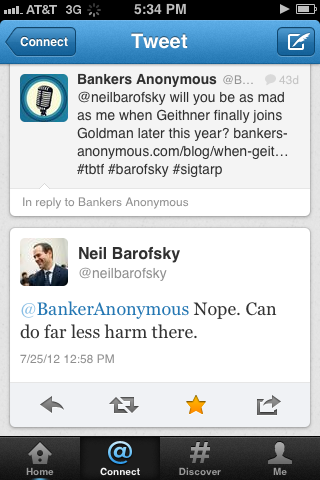
Frankly there’s the plain old fun of SIGTARP himself, Neil Barofsky, responding during his book tour[1] to my tweet about Geithner, unconcerned that Geithner would jump to Goldman, Sachs, because at least at GS he’d do less harm than as Treasury Secretary!

Barofsky’s response to my question about Geithner going to Goldman. “He could do less harm there.”

But I digress.  There’s a good deal of valuable information in SIGTARP reports, and in this installment I thought I’d highlight a few things we can learn about small and medium size banks.  I’m sad to say that four years after the Credit Crunch, many small and medium size banks are doing terribly.

US government regulators NEVER tell you which banks are in distress.[2]  But SIGTARP consistently goes where other regulators dare not tread.[3]  Read the full report to find out which small banks will go under next, probably by 2013, or simply go to the list of banks which have missed dividend payments.

On missing Dividend payments owed to Treasury for TARP money

The stated reason for TARP was to ensure that TBTF banks did not bring the entire financial system to a grinding halt when taken over by the FDIC or placed in receivership.  For less clear-cut reasons[4] however, Treasury also offered small and medium size banks a chance to take advantage of the fast-track route to recapitalization via government investment.

As it turns out, and despite explicitly forbidding this[5], the TARP money extended a lifeline to small and medium size banks that have failed to thrive following the Great Credit Crunch.  A few hundred of these banks have either succumbed to failure or have missed so many dividend payments to the Treasury that survival seems doubtful.

SIGTARP reports list not only those banks which have outright failed or those where the government has lost money, but also those banks that have missed dividend payments to the Treasury and the number of those payments as well.  The missed dividend signals the banks that are probably too far gone to survive.

Wondering if your local TARP-bailout bank is in good shape?  You can check for it in the SIGTARP report HERE.

To save you some time scrolling through the SIGTARP report, you can look on the following pages for:

Pp 98-102: 162 Banks that have missed one dividend or many dividends.

Pp 102-103: 41 Banks where the US Treasury has realized a loss through its TARP investment.

Pp 110-117: 99 Banks that have failed, gone bankrupt, or had their US Treasury investment forcibly restructured.


On troubled Community Banks that still owe TARP money

One measure of recovery from the Great Credit Crunch would be the strength and stability of banks in the United States.  And, unfortunately, a great number of small community banks, we learn from SIGTARP, are really still sucking wind.

While 90% of the original TARP money[6] from late 2008 has been repaid from all of the TBTF banks (except Regions Bank), small and medium size banks have been much slower to repay.

As of the latest Congressional report, approximately 400 small and medium size banks have yet to pay back TARP funds.  Even that group of 400 TARP banks overstates smaller banks’ ability to repay, since an additional 137 banks swapped TARP funds for a program custom-designed to let them off the TARP hook, through a financing called SBLF.

What are the implications for the future of small banks unable to repay TARP?

400 banks account for approximately 5% of banking institutions in the country, not a huge portion of the total.  In a strictly macroeconomic sense, it is systemically irrelevant whether these banks live or die in the years to come.  A case can even be made that fewer banks in the United States would be just fine.

From a taxpayer perspective the $20 Billion value in small bank preferred shares and warrants represents less than the US Treasury risked with individual banks such as Citigroup and Bank of America in the early days of the crisis.

On the other hand, comparing small bank failure to household financial failure shows the locally devastating effect if they implode financially.  That is to say, it matters to those banks and their communities if they fail.  Not only that, we can assume, not unreasonably, that failing banks will be concentrated in depressed regions of the country, exacerbating access to credit for small businesses and real estate developers in precisely those areas which can least sustain losses.[7]

The SIGTARP report provides evidence, if you read between the lines, that a great number of these smaller 400 TARP recipients are on life-support, and many will not make it out of the intensive care unit.

Congress passed the Small Business Lending Fund (SBLF)[8] nominally to provide more credit for small business, but in reality to allow medium and small banks to exit TARP and roll into a less restrictive government program.[9]  One hundred thirty-seven banks qualified for Treasury funding under SBLF by proving their likelihood of increasing their loan portfolio to small businesses – and exited TARP shortly thereafter.  Those who could exit TARP at that time, did – the rest could not.

Furthermore, executive compensation restrictions make it unlikely that any bank still owing TARP money has a profitable and sustainable banking franchise.  If they could have paid it back, they would have by now.

The 162 Banks Most Likely to Fail

As of the July 2012 report, one hundred sixty two, or almost half of the remaining 400 TARP banks, have missed dividends (currently with a 5% coupon rate) on the preferred shares owed to Treasury.  By law, the dividend rates jump to 9% on these bank preferred securities beginning in 2013.  Payments of 9% on their capital is an exorbitant rate for banks to pay when the costs of funds in the money markets for healthy banks remain below 2%.

In sum, the picture is grim for remaining small and medium TARP banks, but the financial system and ordinary taxpayers will not suffer extraordinary losses.  To badly hit communities, however, more pain awaits, probably in the second half of 2013 when 9% dividends deal the fatal blow to weak banks.


Also see:

In Praise of SIGTARP Part I, “Truth in Government”

In Praise of SIGTARP Part II, “We blew it on the repayment of TARP by the largest financial institutions”

SIGTARP Part III – “The Citigroup Bailout”

and SIGTARP V – The AIG Bailout


[2] There’s a good public policy reason for this.  Exposing a weak bank publically may create a self-fulfilling prophesy of weakness, as depositors and customers leave the zombie bank for its stronger competitors.

[3] Which is why it’s kind of an illicit thrill to see struggling banks publicly outed this way.  I know, I’m weird.

[4] One strongly implied reason at the beginning of TARP was the ‘safety in numbers’ idea.  That is, if many banks took TARP funds at the same time it would remove the stink of government intervention from the actual targets, the TBTF banks on the financial precipice.  Another reason is probably the sway of small and medium banks with their Congressional representatives.  One reason that makes less sense is the systemic value of small and medium banks.

[5] TARP funds were supposed to be only available to Qualifying Financial Institutions (QFIs.)  But the definition of a QFI included the mandate that they be “healthy, viable institutions.”  We know with hindsight that at least both Citigroup and Bank of America would have failed to qualify for this designation had “healthy, viable” been a truly disqualifying condition.  But we now also know hundreds of small banks failed that test as well.

[6] In this posting, by “TARP funds” I really mean to refer to the Capital Purchase Program (CPP) by which Treasury bought preferred shares and warrants in 707 banks, including the largest 17 TBTF banks.  Technically “TARP funds” could include a wide variety of other investment programs authorized under TARP, but I’d rather use the acronym TARP than CPP, since it is better known.

[7] See this interesting site with stats and maps of bank failures.

[8] In September 2010

[9] The initial dividend rate of 5% matches the TARP dividend rate of 5%, but crucially SBLF funding does not carry restrictions on executive compensation.  Much better, Smithers.

Post read (3549) times.

Book Review: Unintended Consequences

Would you like to understand where Mitt Romney’s economic ideas come from?

As soon as Edward Conard hit the book-selling circuit with Unintended Consequences: Why Everything You’ve Been Told About the Economy Is Wrong, I started to get messages from my reliably liberal friends.  Conard made the cover of The New York Times Magazine, – with the arresting headline “The Purpose of Spectacular Wealth, According to a Spectacularly Wealthy Guy” – and he made an appearance on The Jon Stewart Show, two hostile environments in 2012 for a former Bain Capital partner, apparently preaching an updated version of Gordon Gekko’s “Greed is Good” speech.

“You have got to review this book and tear this guy apart,” my friends urged, and I promised I would.

Suspecting I would not want to own the book, I put in a request to borrow it from my local library, only to endure 2 months on the waiting list before a copy became available.  Meanwhile Unintended Consequences hit the New York Times best seller list and Conard went on to represent the Bain Capital perspective all up and down the cable television circuit.  Unintended Consequences finally became available at the library at the end of the summer, and I read it over Labor Day weekend.

My dear liberal friends, I have a confession to make: I like this book quite a bit.

I’m not saying you need to go out and buy it, as I’m sure you will not.  But I am saying the guy has made a serious and effective effort to represent the Mitt Romney view of the world, one which has an internally consistent logic, if you agree with his assumptions.

Let me start by describing the part of the book I really liked, followed by the part I liked pretty well, and then I can finish with a critical flourish that I expect will return me to the good graces of my liberal friends who recommended I review it in the first place.

Conard organizes the book in three sections, “What Went Right,” “What Went Wrong,” and “What Comes Next,” sections which may otherwise be described as Past (1950-2005) Present (2006-2012) and Future (beyond 2012).  In summarizing my views of the book: I loved the Present; I liked the Past; and I plan to get a little snarky in the Future.


“What Went Wrong” – The Mortgage Crisis

I’ve invested a significant portion of my working life in the mortgage finance industry, first as a mortgage bond salesman, then as a hedge fund investor purchasing consumer debt including mortgages, and most recently as a self-appointed commentator – blogger – on the Credit Crisis and Great Recession trying to figure out causes and effects that stem from the mortgage market blowup.

As a result of my professional past, I cannot state strongly enough how much it bugs me to read terrible analysis from otherwise respectable journalism sources about what went wrong with the sub-prime mortgage market and the Credit Crunch.

If most journalists get the mortgage story 50% right and 50% wrong, Edward Conard gets it about 90% right, and for that fact alone I am grateful for his book.  In debunking a significant portion of the equine urine that passes for our national sub-prime mortgage narrative, Conard earns my gratitude.

Forthwith, some mortgage market narrative myths Conard helps debunk:

Predatory bankers frequently tricked people into taking out loans that they could not afford to pay back.  Um, no.  This is not a real world banker strategy, to lend money to people who cannot afford to pay back the loans.  It’s just not. It’s illogical to believe most bankers seek to make bad loans, and it drives me nuts to read this implied or stated by otherwise intelligent writers.  Bankers in the real world make loans to people they believe will pay them back.  In the run-up to the most recent crisis, Wall Street mortgage bond structuring departments and mortgage investors mistakenly believed rising home values and low interest rates would help sub-prime borrowers refinance before they defaulted 1 – a pattern that only worked for a short while – but it was a mistake, not a conscious predatory strategy. 2


On the other hand, I have dealt in my investing business with many predatory borrowers, people who took out mortgages they knew they could never pay back, but who hoped to get lucky with real estate price appreciation or who hoped to delay the foreclosure process long enough to keep a house for free while they defaulted on their debt obligations.  That scenario happened to me in my investing business almost too many times to count, but I never once met a banker who sought to make a loan that couldn’t be paid back.  It’s bad for business. Banks that make loans that can’t be paid back go out of business quickly.

2. Wall Street Banks, in a conspiracy with the rating agencies, duped mortgage bond investors in the run-up to the crisis.  Not even close. While it is true – and Conard acknowledges as much – that there’s an imbedded conflict of interest in the fact that rating agencies get paid by Wall Street to rate their products, its equally true that mortgage bond investors are among the most sophisticated financial analysts found anywhere.  They were, and are, hyper-aware of exactly who pays whom.  Mortgage investors know what massive grains of salt need to be applied to rating agency information.  Just because journalists and politicians recently discovered the role ratings agencies play in the investment world does not mean mortgage investors needed them to discover that role for them.  It’s a known Wall Street truism, which I stated before and will state again as long as I need to: Professional investors never react to rating agencies moves,3 and professional investors understand the limitations of bond market ratings.

3. CDOs and other mortgage derivatives became so complicated that they were bound to blow Wall Street up.  A common journalistic conceit in describing bank losses due to CDOs 4 and the alphabet soup of other mortgage bond structures (RMBS, ABS, CMOs, CMBS, IOs, and POs to name a few of the more common ones) implies that the opaque nature of structured products doomed them to failure.  Not true.  Just because a journalist does not understand the product does not mean that the structurer, trader, and mortgage investor do not understand the product.  The mortgage bond desks of Wall Street firms and of bond buyers make it their job to understand their products.


Some mortgage derivatives, CDOs in particular, suffer from a chronic lack of liquidity, for which in ordinary times the market demands compensation, in the form of higher yields.  In the Credit Crunch of 2008, CDOs and other structured products became untradeable at anything like fair market value.  They are terribly illiquid, not terribly complicated, for professionals who traffic in structured mortgage products.


In addition to effectively debunking some myths of the causes of the Credit Crunch, Conard gets the story right in a few other respects, namely:

  1. The optimistic policy begun in the Clinton era of encouraging expanded home ownership through low-money down loans had the unintended consequences of kick-starting a doomed boom in sub-prime lending.
  2. The run on liquidity throughout the crisis was far more consequential in destroying financial firms than any realized losses actually suffered by banks and insurance companies.  In other words, the panic was worse than the ultimate defaults.
  3. Credit Default Swaps (CDS) per se were not the cause of financial system distress, nor are they inherently anything more than risk transfers between counterparties, like buying or selling a bond or loan.

In sum, Conard builds up a lot of good will with me by getting the causes of the Credit Crisis essentially correct, or at least far more correct than I’ve read in other books and journalistic narratives.

“What Went Right” – The US Economy, 1950-2005

In this section we begin to see daylight between Conard and me, although not because he’s necessarily wrong, but rather because we have different starting assumptions.

Conard became such a target for liberals with the publication of Unintended Consequences for his unabashed celebration of massive wealth concentration for successful business people.  He sees inequality as a natural consequence of a difference in people’s work ethic, their innovative contribution to economic progress, and what he terms ‘lucky risk taking,’ by the entrepreneurial and investor classes.  As a Bain Capital partner, he and his book represent to liberals the ultimate voodoo doll for Romney-bashing in an election year.  We’ve seen enough of Romney’s comments on and off the record to believe that there’s considerable agreement between Conard and Romney on this view.

I have issues with the Conard/Romney world view, but I want to be careful to point out what I like about Conard’s argument.  His ultimate concern, clearly stated, is growing the total amount of economic output in the most efficient way possible.  He believes that incentivizing people and institutions to maximize economic output – via financial gain – is more effective than anything else at producing a growing economy.  Impediments to economic growth, in the Conard universe, include taxes, business regulations, trade restrictions, and income redistribution payments, each of which he believes lead to lower economic output over time.

Now, while Conard does not prove his assumptions to be true, they all strike me as logically correct.  I too believe that each of those factors leads to lower economic growth.

Where we differ, and where I expect my liberal friends will gather around me again in support, is whether maximizing raw output in an economy is the single most important goal.  I happen to believe that inequality of income and wealth outcomes have quite a bit to do with whether an economy is ‘successful,’ and have quite a bit to do, as well, with whether my society is the best it can be.  At a certain point, I would trade some GDP growth for a bit more justice in the world, and I might choose a societal safety net now at the expense of a marginal innovation in computer processing.

Conard consistently advocates the economic growth path over the economic justice path.  Before I paint him in overly simple terms, however, I think it’s worth returning to the Conard argument on its own merits, to appreciate it for what it is.

I find his argument entirely credible, for example, that our choice of wealth distribution via transfer payments dooms us to a lower growth path as an economy as a whole.  I believe him when he argues that taxing the wealthy, who allocate an average of 40% of their income to economically productive investments, will leave less capital available for innovation, production, and economic growth.  I agree with him when he states that in a global economy of efficient markets the unionization of US workers will quickly lead to offshoring of those jobs on the one hand, and higher consumer prices on the other.

One Conard argument about the success of the US economy in recent years stands out when compared to Europe and Japan.  He notes that in the last two decades of innovation in computers, software, the internet, and social media, the United States essentially ‘ran the table’ when it came to all of the most important businesses.  Citing “Google, Facebook, Microsoft, Intel, Apple, Cisco, Twitter, Amazon, eBay, YouTube and others,” he highlights the US economy’s investment climate and rewards for risky innovation as a differentiating factor compared to the rest of the developed world.

In sum: I believe Conard when he argues for the factors that lead to higher growth of an economy overall.  I don’t want to live in that society, but I do think it’s useful for people who disagree with the Bain Capital model to think about what they’re willing to give up to live in a different type of society.  Are you willing to be a little bit poorer?


What Comes Next – Conard’s Future

In the third part of Unintended Consequences I have to part ways with Conard entirely.  I can’t endorse his prescriptions for the economy, in part because I don’t agree with his view of growth vs. equality, but also because he begins to reveal a curious coldness that hurts his arguments.

In the wake of the Credit Crunch, Conard argues not for regulating banks more but rather for enduring bank runs like we experienced in 2008 since “The Crisis also reveals that the cost of government guarantees, excluding the future cost of moral hazard, was near-zero.  In fact, the government expects to turn a profit on the assets it bought to mitigate withdrawals in the Crisis.”  Notably absent is his reckoning of the cost in human terms or non-government costs of the financial wipeout for so many.

Conard also displays a curious tick in his thinking – and his writing – of quickly taking any government imposed limitation (taxes, regulations, unionization, trade restrictions) on individual or corporate wealth and translating that immediately into “even more lost jobs and higher consumer prices.”  As I review his book, he appears to do this every single time.  Anything that affects the rich and upper classes, in Conard’s description, has an opposite and larger detrimental effect on the middle and lower classes.  The first few times he does this I’ll acknowledge that, yes, some government interventions may have unintended consequences in other areas.  But when Conard continues to say it every single time I’m left thinking – ok, I get it, higher taxes on your Bain Capital folks is just going to bite the rest of us even worse every single time, in all cases.  Unfortunately, by applying the same response to different situations his opinions appear less evidence-based and more economic dogma-based.

My final thought about Unintended Consequences is that’s it’s curiously devoid of any personal or professional anecdote.  Conard worked for Bain Consulting, Wasserstein Perella, and then finished his career as a partner of Bain Capital, running its New York office.  Surely Conard accumulated not only material wealth, but a wealth of interesting business stories with which to illustrate his logical, yet dry, economic analysis?  But Edward Conard, the person, is curiously absent.5  So where are the people in Unintended Consequences?  Ultimately Conard’s book describes a mechanized world of efficient human economic units, each maximizing their own utility for private gain.

What does Conard think of people who don’t fit this dry, efficient world?  In his own words: “A shortage of talent exists, in part, because a large number of college graduates refuse to take the risk and responsibility necessary to bring unrealized investment opportunities to fruition.  Art history and Elizabethan poetry don’t employ workers; the arduous and tedious application of business sciences such as computer programming and accounting does.”

Ok, then.

If you would like a country with higher economic output and more wealth for some people, “Vote Romney/Ryan 2012!”

However, if you would like a world with a bit more poetry in it – and a measure of social justice – you may want the other guys.

Please see related post:

Book Review: The Upside of Inequality by Edward Conard

 All Bankers Anonymous Book Reviews in one place.


Post read (10540) times.

  1.  Just to flesh out the idea in a little more detail here.  A “sub-prime borrower” means somebody who has a FICO credit score below Prime, usually set at a FICO cutoff of 720.  By definition a ‘sub-prime borrower’ does not pay all debts on time.  Sub-prime mortgages therefore went to people who had trouble paying their bills.  In an environment of rising home values and easy refinancing – between approximately 1998 and 2006 – sub-prime borrowers paid back their mortgages in very high numbers.  This anomalous behavior by sub-prime borrowers gave false assurance to mortgage structurers and rating agencies about the likelihood and severity of expected defaults.
  2. I’m not saying predatory lenders don’t exist.  They do.  But I’m saying predatory lenders exist in a way irrelevant to the sub-prime mortgage debacle.  Banks try to lend to people who will pay them back.  When loans don’t get paid back, banks lose.  A majority of journalistic descriptions of the mortgage debacle are unclear on this topic, and I have to acknowledge Conard gets it right.
  3. Never, ever, ever believe a journalist who says the market moved today in response to a rating agency change.  Ratings are usually months, or at the very least weeks, lagging markets, and the ratings-change information is always reflected in the price of the relevant securities.
  4. CDO = Collateralized Debt Obligation.  Basically a delicious bond sausage made from the drippings and leavings left on the butcher’s floor by bond structurers after all the choice financial cuts have been sold elsewhere.  Always illiquid.  Always cheap.  Best not to ask what’s inside.  Some people love them though.
  5. In fact all people are absent from this book, except for the stock cartoonish characters of Obama and Bernanke.  Conard’s references to these two is so exaggerated as to suggest Native American monikers, along the lines of Barack “Hunts and Kills Business” Obama, and Ben “Rushing River of Currency Devaluation” Bernanke.