The Citigroup Bailout – SIGTARP Part III

We love to criticize the wastefulness of bureaucracy, the agency ass-covering, and the naiveté of government officials.  But it’s a surprising pleasure to read[1] The SIGTARP [2]  review of the government’s response to Citigroup’s near-death experience and its bailout in the Fall of 2008.

Here we have a US Treasury position created for the purpose of reviewing the government’s own actions in the heat of the crisis, and we might be excused for bringing low expectations to the table.  I have to admit, however, that my jaundiced eye opens wide with the quality of the analysis and indeed the downright feistiness of the SIGTARP report.

The report reviews the timeline of the crisis, the systemic need to bail out Citigroup, and the particulars of negotiating – actually, Treasury mandated – a $20 Billion preferred-equity capital infusion and a loss-absorbing backstop for a $300 Billion ring-fence around Citigroup’s riskier assets.

We do not know what would have happened without government intervention on behalf of Citigroup, but the SIGTARP nicely summarizes the case for Citigroup’s status as a Too Big To Fail (TBTF) Bank for those of us with short memories.  Citigroup was at the time the largest currency exchange bank, the largest consumer finance lender, the world’s largest credit card lender, the 2nd largest banking organization, the third largest mortgage servicer, and the fourth largest student lender, with over $175 Billion in uninsured domestic deposits.

SIGTARP shares numerous interesting details from the negotiations in October and November 2008.

First, the government needed to lie to itself and the public in the Fall of 2008 when it declared Citigroup a ‘healthy and viable’ banking institution[3], as a necessary condition for providing an initial $25 Billion capital infusion through the Capital Purchase Program (CPP) in October 2008.[4]  Treasury Secretary Paulson and New York Federal Reserve Board (FRB) President Geithner clearly felt at the time that they could only get Congressional support for the CPP if it came with a large dose of self-deception about ‘healthy and viable’ banking institutions.  Why would a ‘healthy and viable’ banking institution need an emergency $25 Billion capital infusion from the government anyway?  It’s a Potemkin Village type absurdity, and SIGTARP lets us enjoy the irony.

Next, Treasury, FDIC, and the FRB cut a pretty good deal for taxpayers in negotiating with Citigroup.  Most importantly, they announced to the public (and Wall Street) the ‘ring-fencing’ of over $300 Billion in Citigroup assets – government insurance against losses.  By ring-fencing, they separated presumably toxic assets on Citigroup’s balance sheet, and declared these assets would be treated in a special way to limit Citigroup’s total losses.

Here’s the clever part about the ring-fence; Citigroup remaining on the hook for the first $39 Billion in losses, with a combination of Treasury and FDIC absorbing the majority of the next $15 Billion in losses, and the Federal Reserve Board absorbing the rest of the loss risk via non-recourse financing.  While the announcement emphasized the government insurance for Citigroup’s riskiest CDOs, RMBS, CMBS, and auto loan ABS, loss-scenarios suggested only Citigroup would bear the losses on the portfolio.[5]

If you can’t figure, as neither Citigroup nor the market could out at the time, what the bank’s biggest loss could be on its portfolio, then the market would assume the worst and treat Citigroup as a soon-to-fail entity going the way of Bear Stearns, Lehman, and AIG.  But if you can precisely define, as the ring-fence did, the upper limit of the bank’s losses, then the market understands the known limit and the self-fulfilling prophesy of expected losses leading to financial wipeout can stop.   So, that’s clever.

Following this announcement, as intended, markets credibly believed Citigroup to be TBTF, with a perceived government guarantee on a huge portion of its riskiest assets.  The stock-shorting activity reversed, CDS spreads tightened, and we saw no world-wide run on Citigroup’s bank deposits.

SIGTARP’s feistiness surfaces most particularly in reviewing not only the actions of government leaders, but their disagreements with each other and with its review.  Numerous times throughout the report, we learn of requests by FDIC’s Sheila Bair to change or redact statements in the report.  We also learn that Citigroup successfully withheld a listing of its ring-fenced assets from publication by SIGTARP, citing propriety information[6], but SIGTARP is not afraid to respectfully disagree.

SIGTARP’s summary of the story emphasizes the ad hoc, but ultimately correct, decision of government leaders to massively intervene on behalf of Citigroup.  SIGTARP calls out our own government for what they failed to make Citigroup do; this distinguishes the report and makes for good reading.

SIGTARP gets to the heart of unsolved problems with the government interventions of 2008.  Citigroup, along with more than a dozen financial institutions, today remains TBTF.  Which means we could repeat the same crisis we all just survived. 

Not only that, but SIGTARP rightly states that the last bailout may increase the likelihood and severity of the next crisis, because the moral hazard problem also remains with us today.  High-risk takers, namely Citigroup creditors and counterparts, were not punished in the bailout, so they may reasonably expect to under-price similar credit and counterpart risk in the future, believing that the government provides an invisible safety net underneath high-wire risk taking.

Even short of a repeat crisis, we know that the implied government guarantee for TBTF institutions constitutes a massive subsidy to Citigroup and its brethren via lowered borrowing costs and collateral costs.  This subsidy provides huge advantages over smaller financial firms, but, more troublingly sets the taxpayer up for unlimited liability for private institutions, with little discernible public benefit.  Citigroup, the big red umbrella, is still not paying us citizens for the giant insurance policy we offer them.

I don’t criticize the government, and neither does the SIGTARP, for preventing a Citigroup collapse in the Fall of 2008.  I do blame the US government, and thankfully SIGTARP does too, for allowing TBTF banks to continue their invisible but nevertheless powerful draw on free taxpayer support.

Ultimately, as SIGTARP rightly (and depressingly) points out, we cannot know the cost of this Citigroup bailout until we know the cost of the next bailout, partly born out of this one.

Two concluding thoughts make me optimistic, however.

First, although SIGTARP is part of the government, it plays the ombudsman role fairly, critically analyzing what other parts of the government have, and have not, done since the acute crisis subsided.  There’s hope in a system which can criticize itself and thus correct its future course.  Course change is hard, but a report like SIGTARP’s makes it possible.  I made this thematic point in an earlier post, but it’s worth emphasizing.  I’m not sure we’re improving, but I am sure that critical thinkers within the system, like SIGTARP, give us a chance at improvement.

Second, throughout the narrative of Citigroup’s near collapse and rescue, we see instances of massive government intervention but not a massive government power grab.  This too bears remembering.  The United States has a tradition of public official respect for private enterprise, which is both understood and credible  – but not always recognized by politicians wanting to score points. [7]

A market collapse and an overwhelming government bailout naturally give rise to conspiracy theories on the political fringes.  Many, if not most, societies in the rest of the world would fit the Citigroup events into a conspiratorial, but ultimately unhelpful narrative.  The specific history of Citigroup as told to us by the SIGTARP, however, reminds us that even if the government did not get everything right, they actually did pretty well, considering.


Please also see SIGTARP Part I – Truth in Government

SIGTARP Part II – Biggest Banks Still Too Big To Fail

SIGTARP Part IV – Which Small Banks are Going Under Next?

and SIGTARP Part V – The AIG Bailout


[1] Assuming you like wonkish reviews of the government’s response to the 2008 Credit Crunch as much as I do.

[2] Special Inspector General for the Troubled Asset Relief Program, aka SIGTARP, aka Norse God of Financial Accountability.

[3] Both Treasury Secretary Hank Paulson and FDIC Chair Sheila Bair used this description in written and spoken statements.

[4]A banking institution had to be “healthy and viable” to be considered a “Qualifying Financial Institution,” as only “Qualifying Financial Institutions” could receive this capital infusion.

[5] As, in the end, it turned out.  When the $300B guarantee program unwound in the Fall of 2009, only Citigroup had suffered losses.  So we’ve got that going for us.  Which is nice.

[6] In pointing this out we get to share SIGTARP’s undoubted chuckle about the ‘special sauce’ of proprietary information Citigroup keeps from its competitors, which contributed to one of the most catastrophic losses in human financial history.  Seriously, guys?  No one wants your special recipe of assets that contribute to financial Armageddon for your bank.

[7] Anti-market and anti-government cranks both see vast conspiracies and vindication of their own warped views in the events of 2008, but thankfully they mostly troll the Internet commentary pages and do not reflect, you know, reality.

Post read (9021) times.

In Praise of SIGTARP Part II – We blew it on the repayment of TARP funds by the largest financial institutions

See related post In Praise of SIGTARP Part I here

We are now at the four year mark on the deepest part of the Great Credit Crunch and Great Recession, so I’m moved to ask:

When it comes to avoiding the next financial blowup and bailout we need to ask “Are our bank protections better off now than they were four years ago?”

A Congressionally-mandated investigative entity, SIGTARP[1], AKA the Norse God of Financial Accountability, does not think so.

We know the United States government leaped into bailout frenzy throughout 2008, attempting virtually every permutation of intervention to keep the country’s largest financial institutions – and by extension – the world economy – from complete collapse.  The US government used mergers, direct investments, shotgun marriages, bankruptcy, receivership, loan guarantees, voluntary asset sales, forced asset sales – the whole toolkit.

While the bailout process could best be described as ad-hoc, we hope that the delicate unwinding of the government safety net for Too Big to Fail institutions will be more thoughtful, and less chaotic.

We hope, however, in vain.

According to the SIGTARP report the bank’s exit from government protection has been quite ad-hoc as well.  Worse, we[2] let weak TBTF banks pay back public funds before they were really steady on their feet with enough capital.  The same banks – Citibank, Bank of America, Wells Fargo – remain weakly capitalized.  This matters a whole lot because taxpayers continue to silently subsidize the safety net for TBTF banks.

SIGTARP’s report on repayments by the TBTF banks raises and answers key questions, such as

  1. Why did banks want to repay TARP money so quickly, before they were fully ‘ready’ to access private markets for their funding?
  2. How do we know the process was ad-hoc and rushed?

The answer to question number one is simple.  Bank executives said it was to remove the shame and stigma of continuing to receive public bailout funds from TARP.  I think anyone who has spent time around finance executives, however, knows that shame could not possibly weigh as heavily on them as did the TARP restrictions on executive compensation. [3]

The answer to question number two forms the bulk of SIGTARPs report from September 29, 2011, and the details are fascinating.[4]

To get the full gist of the issue, we need some background first, which SIGTARP nicely provides.

The authority to directly invest in TBTF banks[5] via preferred shares came with a sensible proviso that banks could not repay TARP money for 3 years, but Congress reversed course a few months later in early 2009 with a new law[6]  that allowed banks to repay the borrowed capital more quickly.  Although TARP money came from Treasury, the Federal Reserve Board headed up the regulatory team[7] charged with setting criteria for repayment.

Nine reasonably well-capitalized banks[8] repaid TARP funds in June 2009, while another eight – including 3 of the 4 largest banks in the country(Citigroup, Bank of America, and Wells Fargo) – failed a bank stress test.  Among the criteria developed then for the weaker banks was a requirement that they raise a significant amount of TARP repayment funds – specifically 50% of the cash required for repayment — through common stock issuance.[9]

When push came to shove, however, we learn from SIGTARP’s report that regulators stretched, pulled, waived, and disagreed with one another about whether to make banks comply with the rules they had just put in place.  Treasury’s rush to encourage repayment, it turns out, trumped the regulatory need for strong banks.  And if you suspect large banks get better treatment than small banks, here’s your evidence.

Bank of America, for example, raised capital partly through preferred shares issuance, a less regulated type of capital.  Citigroup, as well, fell short of its required 50% issuance of common stock.  Wells Fargo attempted multiple times to wriggle out of the need for a fully dilutive equity issuance but ultimately raised the required amount at the end of 2009.  Regulators, nevertheless, signed off on all three banks’ 2009 repayment plans, waiving their own requirements mere months after setting them.

FDIC’s then Chairman Sheila Bair, however, stands out as a vocal critic of the regulatory cave-in to the combined Treasury and bank-executive pressure.

Treasury, FRB and OCC officials apparently claimed that private markets were too weak to support the admittedly massive equity issuance needed for the banks.  Paradoxically, at the same time Treasury, FRB and OCC implied the direct opposite, that banks were strong enough to pay back public funds.

As FDIC Chief Sheila Bair points out,

“The argument [FRB and OCC] used against us – which frustrated me to no end – is that [Bank of America] can’t use the 2-for-1[10] because they’re not strong enough to raise 2-for-1.  That just mystified me.  The point was if they’re not strong enough, they shouldn’t have been exiting TARP.”

Sheila Bair called out the impossible double-speak coming from Treasury, the Federal Reserve and the Office of the Comptroller of the Currency.

It makes sense to me that you can’t be both too weak for private capital markets but plenty strong enough to leave public protection.  Regulators blew it by letting the banks out of TARP too early.

As a result of the rush to re-privatize we missed the chance to control, from a regulatory standpoint, the destiny of TBTF institutions and our public exposure to the next big crisis.

SIGTARP’s September 2011 report has a ‘remains to be seen’ conclusion on whether banks are now strong enough to absorb future financial shocks.  That’s a pretty interesting negative-report from within the government, significantly doubting whether regulators have properly done their job.

Also, there’s this, from SIGTARP:

“Unless and until such institutions, either on their own accord or through regulatory pressure or

requirements, are restructured, simplified, and maintain adequate capital to absorb

their own losses, they will pose a grave threat to the entire financial system.”

That’s a compelling and scary argument right now, with Bank of America stock down 50% and Citigroup down 30% from when they repaid TARP in November 2009.


Also, please see In Praise of SIGTARP Part I here

SIGTARP Part III- The Citigroup Bailout

SIGTARP Part IV – Which Small Banks are Going Under Next?

and SIGTARP Part V – The AIG Bailout


[1] AKA Special Inspector General of the Troubled Asset Relief Fund.

[2] And by “we” I really mean primarily the US Treasury Department.

[3] When explaining bank executive behavior, always assume personal compensation comes first, until proven otherwise.  It’s just a rule I follow and it’s never steered me wrong.  Bankers feeling shame at receiving public funding to save their bacon?  Please don’t insult me.

[4] All of this is assuming you find financial regulatory reviews fun reading, as I do.

[5] Through the Emergency Economic Stabilization Act of 2008 of October 2008

[6] Through the American Recovery and Investment Act of February 2009

[7] Generally the Federal Deposit Insurance Corporation (FDIC) and Office of the Comptroller of the Currency (OCC)

[8] GS, MS, JPM, US Bancorp, Capital One, Amex, BB&T, BONY/Mellon, State Street

[9] Regulators like common stock issuance because it improves a bank’s ability to absorb future losses, ie. it’s ‘capital ratios.”  Bank executives dislike stock issuance because it dilutes value for shareholders, including themselves.

[10] “2-for1” is the regulatory short-hand language to indicate that 50% of TARP repayment money must be raised as new common equity

Post read (7044) times.

My Diary, September 11, 2001

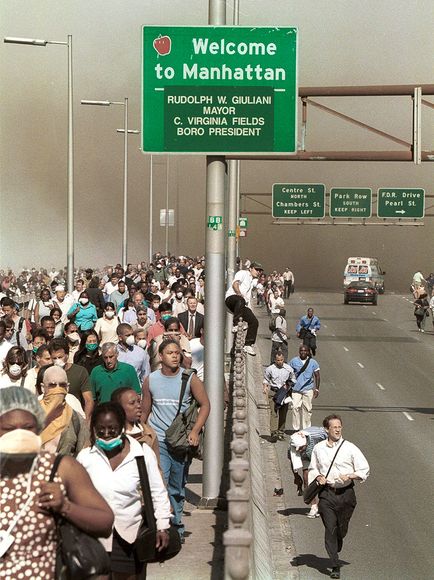
The Great Recession and the World Trade Center attacks reshaped our country and continue to dominate the way I see the world and our place in it.  While I concentrate on the former events at Bankers-Anonymous, today I commemorate the latter on the 11th Anniversary of September 11 2001. 

I transcribed my diary below from that day. I’ve annotated my diary entries with additional recollections of what I saw and felt.

Here is my wife’s diary from that day as well.


September 11, 2001


“I hope never again in my life to be so close to mass tragedy and mass terror as I was today.  I watched a silent television image of a burning hole in the side of one of the World Trade Center buildings, and then, while on the phone telling Jim that I was ok, I watched a second plane slam into the side of the second World Trade Center building, which exploded at the point of impact.”


Bond markets reacted instantaneously to the first attack, but it remained unclear to all of us on the trading floor whether the first tower fire was caused by a bomb, an errant small commuter plane, or something else.  A bomb seemed the most likely scenario, since the Towers had been attacked previously.  The clear blue sky day didn’t favor the commuter plane theory.  But we just didn’t know.

Between the time of the first tower and second tower being struck, many of us on the trading floor of the 85 Broad Street Goldman building looked up at the sky to see a mixture of smoke and paper debris flying just over the top of our roof.  Although we worked a number of blocks away from the World Trade Center, we were apparently directly downwind of the first burning tower.  Staring upwards out of the window, one of my Emerging Markets derivatives traders remarked absently and ironically about all the written derivatives contracts that had literally flown out the window.  At the time, about 8:55am, it didn’t seem overly callous – we just didn’t know that this was an attack, and we didn’t realize yet that this wasn’t something that could be joked about.

Also, Jim is my brother.


“Jim made me swear I would leave the building, which I did do, although the Goldman building is a 5-minute walk from the Twin Towers.”


In fact, “swear” in this sentence has a double-meaning, because as we were both watching CNN on the television from our respective offices, while talking on the phone together wondering about the cause of the initial hole in the first tower, we saw the second plane hit live, and all I could hear in my ear from Jim was a series of explosive F-bombs telling me to get away from Wall Street, that we were under attack, and “blankety blank blank blank get the blank out of there!”


“I walked to the closest subway, Wall Street, then was forced to Fulton Street, and finally caught an uptown 6 Train at City Hall.”


The second tower was struck at 9:03am, and I was out the door of 85 Broad Street by about 9:08am.  Wall Street and Fulton subway stops had closed by the time I reached them at 9:15am, but the City Hall subway stop remained open.  So I had a 10 minute, approximately 10 block walk North to City Hall.

Three or four of us boarded the subway at City Hall, tear-streaked and shell-shocked, only to greet Brooklyn-based commuters who had no idea what was going on above ground.  They had gotten in the train 20-30 minutes earlier, but had no idea that in the course of their Brooklyn to Manhattan commute, the entire world had changed.  We were the first ones to tell them New York was under attack.

Originally I took the subway to 54th Street to try to find my brother Jim, who had insisted, between F-bombs, that I should head to his midtown office.  I know mine was among the last trains heading north.  After I got to midtown and tried to re-board the subway just ten minutes later, it no longer ran.

By the time I arrived at his office, Jim had left to join his wife and newborn daughter at his apartment on the Upper West Side.  Some of his office mates – still in his office – greeted me as if I was a ghost back from the dead.  My brother had left them with the mistaken impression – based on his concern at me being down on Wall Street – that I worked in one of the Towers.


“Fortunately I was in time before they shut down the train, which saved me from walking all the way uptown, although I needed to run from 54th Street to 104th Street, where I spent the rest of the day with Kim and Jim.”


Other recollections from the afternoon with Jim: I didn’t know the towers had collapsed until I made it to 104th Street, and his doorman told me, as he’d been watching it on TV.  By mid-day on the Upper West Side, every store owner on Broadway had brought down those garage-door style metal curtains covered in graffiti, in effect battening down the hatches.  It was unclear to us at that point whether the citizens of New York would respond in patriotic solidarity – as mostly happened – or whether rioting and looting might take over.  Store owners weren’t taking any chances.  In the late afternoon of 9/11, my brother and I ventured out from his apartment onto the deserted streets, to withdraw a chunk of cash from an ATM machine, in the event that we were about to enter a Mad Max-style futuristic dystopia.  Anything seemed possible on that day, with the Pentagon under attack and an unknown number of passenger planes still unaccounted for.  In one of the few moments of levity in the day – at least in retrospect – we carried tennis racquets with us to ward off looters.  We strolled down the empty Upper West Side like Bizarro-world Williams sisters, alert and on the balls of our feet, ready for the apocalypse.


“The most horrific thing I witnessed was a falling body from near the top of the World Trade Center to the ground.  I shudder when I think of the abject terror those falling people must have felt from 100 floors up.”


During my 10-minute walk North to the City Hall subway stop, I also remember the thousands of people on the street, in the blocks nearby the burning towers, just staring upwards in horror.  The vertical steel stripes near the top of the towers glowed red.  Smoke rose upward, while debris and the occasional human shape fell downward.  Thousands of us, slack-jawed, tears streaming, hands clutching our mouth or our heart, leaning on the arm of the next person just to remain upright.   I walked past thousands of us, watching this from the ground.


“I am very scared for Darren Schroeder, Michael Skarbinski, Guillaume Fonkenell and the few others at Pharo who worked on the 85th Floor of Building One.”  


At the time I wrote their names, I was sure I was writing their epitaph in my diary.  Pharo Management was a relatively new Emerging Markets hedge fund at the time, and I had visited their office on the 85th Floor of Tower One about two weeks earlier, and I had the image of the view from their office in my head at the time I wrote this diary entry.  The next day after 9/11, I read on Bloomberg that not only had they survived, but that Pharo had an off-site backup contingency system for all their trade data and Fonkenell, the founder, had managed to get the word to his customers via Bloomberg about their survival.


“I pray to any God who is up there that they did not suffer.”


As an institutional bond salesman, I sat on the trading floor facing my bond traders, about 5 feet away, each of us separated by a row of computer monitors.  Wall Street Bond traders all traded bonds with other Wall Street firms via inter-dealer brokers with the at-the-time obscure names of Cantor Fitzgerald, Tullett & Tokyo, and Prebon.  For a small commission per trade, the inter-dealer brokers offered a measure of anonymity and liquidity between, say, Goldman Sachs and Morgan Stanley.  My traders and the inter-dealer brokers didn’t use traditional phones between them, but rather a ‘hoot,’ an intercom system which allowed them to be in constant audio contact.  Mostly these inter-dealer brokers worked in offices on the top floors of the World Trade Center Towers.

In the minutes between the first and second tower being struck, the traders in my group communicated to us one of the most awful scenes of suffering imaginable, from their counterparts at Cantor Fitzgerald and Tullett & Tokyo.  The Cantor and Tullett guys from the first tower were trapped above where the first plane hit, and they realized there was fire blocking their elevator and stair exits.  They reported to my traders that some of them were heading up to the roof, rather than down, in the vain hopes that they might be rescued from there.  We received their pleas for help and for advice over the hoot on the trading floor, in real time.  We now know none of these bond brokers survived.


“My closest friends and family seem to be safe right now, and I have no word on specific tragedies with people I know.  I hope the guys at Pharo survived the horror.”


I spoke on the phone to Pharo’s Michael Skarbinski about 3 days after 9/11.  He told me the first plane struck 2 floors above their office, smoke filled their entire floor, but they survived the impact.  They started to head downstairs almost immediately.  He reported it took them most of an hour to walk the whole way down, but they all made it out of the tower a few minutes before his tower collapsed.

“I have felt sick and weak all day and sad that Barbara has been at the hospital all day.  All I want to do is hug her and appreciate our luck, up until now.  I am sick with fears as well that this will spell the end of certain liberties and a carefree life that we have until now enjoyed.”


That afternoon’s post-apocalyptic walk with my brother on the Upper West Side had reminded me that if you just scratch the surface of a civilization, there’s a bestial nature waiting to come out.  I really felt writing this diary on the night of 9/11 that we might be on the verge of something new and awful in human experience.


“Baby Caroline may grow up in a different world.”


Caroline is my niece, born just 2 weeks before 9/11.


Also See: My wife’s diary from that day

Post read (9439) times.

In Praise of SIGTARP, Part I –Truth in Government

As a recovering banker, a main obsessive question of mine remains “How did we get into this mess?”

By “mess,” I mean both the Credit Crunch itself and our collective response to it, at the government and personal levels.

My obsession drives me to read reports by the Special Inspector General for the Troubled Asset Relief Program (SIGTARP).  As a first draft of financial history, the SIGTARP reports have become essential to understanding the bailouts of Citigroup, AIG, other TBTF[1] Banks, and smaller banks as well.

Perhaps it’s a function of my low expectations for a government-produced document on finance.  Perhaps it’s my contrarian nature.  I’m not sure.  But I do know there’s something refreshing and downright exciting about the reports coming from the office of the SIGTARP.

I love SIGTARP so much I want to highlight the key things everyone should know from the reports, on the off chance you aren’t as obsessed with reading government documents as I am.

Two great things, just for starters, to know about SIGTARP’s reports.  First, they’ve got the ring of honesty.  Second, they remind me why I do have faith in our system of government and finance, despite all the reasons to lose faith, and despite all the crazy fringe talk we get bombarded with on a regular basis.

In the April 2012 report, just to cite one happy example, you will find such pleasing curiosities as a Treasury official who tells you her colleagues in another part of Treasury are lying to you, to wit:

“It is a widely held misconception that TARP will make a profit.[2]  The most recent cost estimate for TARP is a loss of $60 Billion.  Taxpayers are still owed $118.5 billion”

Now that’s what I’m talking about!  Some straight talk from the federal government.[3]

Another example of facts cutting through the haze of political speak:

“TARP’s explicit goals of preserving homeownership and promoting jobs were evidence that Congress wanted to help homeowners during the crisis, not just banks.  However…Only 9% of the TARP funds set aside for mortgage modifications have been spent to help a fraction of eligible homeowners after more than three years…after two years, only 3% of the funds obligated [for the Hardest Hit Fund] have been spent to help only approximately 30,000 homeowners.”

In other words, the government’s largest federal programs for mortgage modification and homeowner relief are poorly designed or poorly implemented, or both.

I’m not happy about this.  But I don’t particularly care to blame Congress, or the President, or a bunch of nameless bureaucrats we’ve never heard of.

I am happy, however, to read a technocratic document like SIGTARP’s quarterly report that gives me the hstraight dope about what is working and what is not working in the financial bailout.  The honesty of the reporting gives me hope that people are willing to work on practical data, practical solutions, and do not seek to score points against the other side only for ideological reasons or political gamesmanship.

Too often we fall down the rabbit hole of financial discourse online, where the avatars of pitchfork wielding right-wing trolls do imaginary battle with the avatars of left-wing demagogues who make the Scarecrow’s Occupy Gotham scene seem like a plausible near-future alternative.  I’m pretty sure Dark Knight villains Two-Face, Bain, Joker, and the Scarecrow actually exist, because I feel like I read their stuff in the comments section of respectable online financial outlets.

It’s enough to induce despair, which is always the goal of the Dark Knight’s foes.  That forum has plenty of Gotham-City shouting and fear-mongering but precious little listening, and even less understanding or analysis.

Who can fight against the financial darkness?  SIGTARP can.

I love SIGTARP so much I created my first fictional comic book hero[4] in his honor.  I love SIGTARP so much because he makes me believe in my country’s government again, which is no small feat.

Would you like to feel better about our country and the government’s ability to self-criticize and therefore, possibly, learn from its mistakes?  I suggest you brew some tea and curl up with a nice SIGTARP report sometime.  You’ll feel a lot better.


[1] Too Big To Fail, but you knew that.

[2] Meaning: Please pay no attention to my Treasury colleagues quoted in the Wall Street Journal who wrote the following “Overall, the government is now expected to at least break even on its financial stability programs and may realize a positive return”

[3] Usually it’s the journalists who tell us the government is lying, so it’s nice to see the rare government official willing to make the same claim.

[4] You have to admit SIGTARP does sound like Norse God, no?


Post read (2831) times.

Ask An Ex-Banker: Is the Finance Game Rigged Against Outsiders?

Q: A question for debate:

We all seem to get mad that the financial-industrial complex is repeatedly rigged for the Big Boys.  I’d suggest to you that the public should just give up on the wall street-banker/big bank/mutual fund industry as having any possibility of being fair to you or me.  Thus, it makes no sense to be mad at it.  Instead, people should invest the way their grandparents did: bonds, cash savings in a local bank or a hole in your backyard, real property, and (if they’re savvy enough) businesses or stocks that they understand.  –Michael G., San Antonio, TX


This is a really good question for debate, Michael, and I agree with some of the spirit of it.  I suspect millions of people have had a version of this thought, wondering if they’re the suckers at a rigged game and whether it’s time to take their marbles and go home – to bury their savings in the back yard or the local bank.  But while I’m sympathetic with the question, I disagree on the actionable consequences of your view.

I particularly like your suggestion, paralleling Michael Pollan’s food movement of the last few years,[1] to do only what your grandparents would recognize as investing.  There’s virtue in simplicity, and you could not go too far wrong that way.  Many of us have an imaginary Amish pastoral scene in mind as a balm on a particularly confusing day.  The horse-drawn buggy approach to financial life could be a good financial life.

I’m not willing to actually go along with the Amish pastoral investing life, however, either in my own life or for people who ask me my opinion on what they should do.

Mutual funds, to pick the most beautiful of the babies you’ve tossed out with the bathwater, are just like some of the other totally awesome things we love to complain about.  If you’ve got money to invest, with a few clicks or a simple phone call, you can own a piece of a wide swath of the world’s most successful companies.  At any point in your lifetime, should you choose, you can get your investment back with a similar amount of effort, with a day’s notice.  Real property investing doesn’t work that way.  CDs don’t work that way.  Private business investing doesn’t work that way.  Our grandparents had to wait for the end of their 6 months (or whatever time) period to get their cash out of CDs, or possibly years to liquidate their real estate or private businesses.

ETFs, the ADHD sufferer’s version of mutual funds, are similarly awesome, if used correctly.  You can even invest in a wider variety of instruments than mutual funds, including currencies, commodities, real estate, in addition to the opportunity to short markets and take on leverage.

As a recovering hedge fund manager, I also obviously maintain a soft spot in my heart for hedge funds as a way to access a still wider variety of investing strategies.  As a former mortgage bond salesman as well, I could similarly wax poetic about a whole universe of investment vehicles with an alphabet soup of acronyms that, like an Elizabethan sonneteer declaring his undying devotion, would make you long to  possess a super-senior CDO linked to a basket of credit default swap positions.  Ah, financial innovation…But I digress.  Where was I?

In sum, I’m actually a fan of financial technology, albeit with one important caveat that I think will link back to your original question, about whether the financial game is incorrigibly rigged for the Big Boys.

Not to be too John Kerry about it, but my answer is No, and Yes.

I infer that what you mean by “rigged” is the idea that insiders cheat in sufficient numbers to leave outsiders at a severe disadvantage when it comes to earning a fair and worthwhile return on capital.

I disagree.  In my fifteen years in the financial industry I saw no evidence of widespread cheating.  On the contrary, I can honestly say I trust “the system” in our country to treat outsiders far more fairly than any other industry I’m aware of.  I would also trust our system in the US better than any other country’s financial system, based on quite a bit of anecdotal and experiential evidence across borders.

Where I would blanket-statement agree on the rigged part for your average outside investor, however, is in costs.  The insiders depend on your ignorance of the cost of their product.

Most investment products designed in the past 50 years are compensation schemes for insiders.

Hedge funds are the most egregious example, of course, as knowledgeable insiders correctly and dismissively refer to hedge funds as ‘compensation schemes masking as investment vehicles.”

Products like retail ETFs, primary designed to encourage high-frequency day-trading, wrap up a casino-like product in an investing package, for the benefit of the house casino.

Even the mutual fund industry typically charges far more than is necessary to accomplish what are really simple tasks with minimal value-added.

Fees to insiders in all of these areas remain stubbornly high and extremely difficult to track down for the average outsider.  In no other area of life do we willingly purchase a product costing many thousands of dollars without asking about the price of the product or attempting to price-shop the product.

I can’t emphasize enough how much of the inside game is devoted to convincing outsiders of the ‘special sauce’ of a particular investment vehicle.  Contrary to what the insiders want you to believe, simple would generally be better and low cost would be best of all.

I linked to this page before, but it bears repeating.  I have no link to this investment advisor, I’ve never met him, and I just found his stuff a month ago.  Do yourself a favor, print out pages 9-12, post them on your bulletin board, and refer to them frequently when considering where and how to invest.


[1] He famously advised people to avoid eating anything your great-great-grandmother wouldn’t recognize as food.  Incidentally, my great-great-grandmother ate a lot of Nutella.  In my own mind.

Post read (6760) times.

Ask an Ex-Banker: Annuities!

Q: I am thinking about buying an annuity.  I want to generate dependable income,  BUT,  how do I make sense out of whether or not an annuity is a good investment in addition to providing a degree of comfort.  The tradeoff seems a big gamble,  i.e. how long I will live.  –Captain Bill H., Friendship, Maine.

A:  Apparently annuities are a growing segment of the retirement market, so Bill, your question is timely.

I thought it would be useful to explain how a banker thinks of an annuity.  By “banker,” I also mean to explain how your insurance company thinks of the annuity they’re offering you.

From the banker’s – as well as insurance company’s – perspective, an annuity is a great deal, and it’s not a gamble.  From your perspective, the story is more mixed.

HOW A BANKER OR INSURANCE COMPANY THINKS OF AN ANNUITY

First off, your insurance company – despite what your friendly insurance broker may tell you – does not offer you the annuity to “guaranty your financial health,” “generate dependable income,” “protect your loved-ones,” or to “make sure you have sufficient income in your retirement years.”  The insurance company, instead, is an investor maximizing its profit.  When considering an annuity, let’s always keep that in mind first.

Now, like all for-profit financial companies in the known solar system, your insurance company seeks to buy money cheaply and to sell money expensively.  This falls under the well-known investment activity: “Buy low, sell high.”

I do not mean to be obtuse when I write “buy money cheaply,” since to the non-financial person “buying money” may begin to sound like Orwellian tautology, but bear with me for a moment.  Financial people -including the people who employ your friendly insurance broker – definitely think of their business as buying cheap money and selling expensive money.

Now let’s briefly peek ahead at the Answer Key in the back of this blog: your annuity represents an opportunity to buy cheap money for the insurance company.

Ok, back to the main text of my answer.

All insurance companies need a massive pile of money to operate,[1] so they constantly evaluate the best ways of buying money.  When acquiring money, insurance companies have a choice of where to get their money.  I’ll run through the three main ways:

  1. Sometimes insurance companies acquire equity capital through the sale of shares to private or public stock investors.  In other words, the companies sell part of themselves to other owners, in exchange for money.  All publically owned insurance companies have done this.  Equity capital is typically considered extremely expensive money, so insurance companies do this only as a last resort.[2]
  2. Often insurance companies acquire debtor capital money, otherwise known as borrowing, possibly from a bank but more commonly in the form of a bond from institutional investors.  An investment grade insurance company[3] may be able to borrow $1 Billion for 10 years right now at, say, 4% in the bond market. This means the insurance company gets use of $1 Billion, it pays $40 million per year in interest for that privilege, and then it returns the $1 Billion in principal at the end of 10 years.  Since rates are historically low right now, and the institutional bond market is extremely efficient at providing capital to insurance companies, this is a great way for insurance companies to acquire money on the cheap.
  3. And finally, there’s rock-bottom cheap money: your annuity.[4]  Given all the costs of acquiring you as a customer[5] and servicing your annuity for your life, plus the retail nature (ie. small size) of the money you’re providing to the insurance company, you would expect this money to be VERY cheap indeed, to make it all worthwhile for the insurance company.  Again, remember, they don’t actually care about all the comforting things President Palmer talks about during the Allstate ads.  To provide you, the customer, with an annuity, it’s got to be really cheap money.  If it wasn’t super cheap, they would just borrow money from the bond markets.

How cheap is cheap?  I just went on my own personal preferred insurance company/bank’s website[6] and applied for a $100,000 annuity.  I’m 40 years old and applied for a lifetime monthly annuity, with a (fairly typical) 20 years of guaranteed payments.[7]  In exchange for my upfront $100,000, the company offered $358.39/month for the rest of my life.  The company guarantees that, even if I die suddenly, the first 20 years, or 240 monthly payments, will be paid to my heirs, for a guaranteed payment amount of $86,013.60.

Now, if you’ve been following closely up until now, you’ll already know that I set up my answer to Bill’s question as a less than ringing endorsement for annuities, but the actual quote allows us to see exactly how good or bad the annuity opportunity is in pure financial terms, for both the insurance company and the annuity buyer.[8]

The insurance company will never tell you the cost of borrowing money from their perspective, but I will share with you what their cost would be for my specific annuity.

If I live my expected[9] additional 37.8 years to the ripe old age of 77.8 then the insurance company’s cost of money is 2.79%.[10]  Another way of thinking about the calculation is that I would earn 2.79% annually on my $100,000 for the next 38 years if I am lucky enough to live that long.  If I’m unlucky, and live fewer years, then my insurance company effectively borrows money at substantially less than 2.79%, possibly below a 0% cost of funds.  In that early death scenario, they get money that’s cheaper than free!  Equivalently stated, the % return that I receive on my annuity could be negative if I die before my expected time.[11]

If, instead, I live as long as I expect to live, that is to say, until age 100,[12] then my return can be as high as 3.84%, and the insurance company’s cost of funds is equivalently 3.84%.  Notice this is still below the 4% they can expect to pay to borrow money in the bond market, making an individual annuity worthwhile to them even if I far exceed my life expectancy.

Let’s take another example.  Let’s say Bill, the original questioner above, is a 70 year old man, who can expect an additional 13.7 more years, according to the Social Security actuarial tables, living to the wise old age of 83.7.  I applied online to my same insurance company as a 70-year-old man,[13] willing to take just 10 years of guaranteed payments (a reasonable scenario rather than the 20 years of guaranteed payments that a 40 year old might want.)  For his $100,000 annuity premium, Bill could expect to receive $597.19/month for the rest of his life with 120 guaranteed payments.

What is the insurance company’s cost of funds in this case, and conversely, Bill’s expected return?  If Bill lives to his expected life-span, he would receive a total of $98,536.35, or less than he paid upfront for the annuity, for a negative return on his money.  In other words, under a reasonable baseline scenario, the insurance company acquires money at a negative rate of interest.  That’s better than free!  That’s awesome.  If you’re a death-eating, snake-tattoo-on-your-arm annuity provider, of course.

Now, if Bill also lives, as I’m sure he expects to, until the ripe age of 100, he can expect a much improved 5.92% return on his investment, while the insurance company conversely incurs an expensive cost of borrowing from Bill, at 5.92%.  However, the insurance company has wisely balanced the probability of free money under an ordinary scenario (Bill lives to his expected life span) versus the very remote probability of maxing out at 5.92%, if Bill hangs on to this mortal coil for a whole century.

Now, I have few rules in life, but one of them is that when you can acquire money somewhere between free and 5.9%, with the probabilities skewing much closer to free, well then you should acquire as much money that way as possible.  And figure out what to do with it later.  Like, for example, build massive skyscrapers with your money.  In a related piece of news, has anyone else noticed that insurance company skyscrapers dominate most major US city skylines? Your death, plus your neglect, help make this happen.  I’m just sayin’.


 OTHER FACTORS BESIDES RETURN/COST OF FUNDS – SAUSAGE MAKING

In addition to the cost of money for an insurance company, it’s worth understanding another reason insurance companies seek to provide annuities.  Most annuity providers are also life insurance companies.  This makes sense in the same way that a sophisticated slaughterhouse might provide both premium sausage meat and processed hog food, as one customer’s premature death is balanced by, or better said, hedged by, another customer’s unfortunate longevity.

What do I mean by this?  A life insurance policy allows the insurance company the opportunity to collect regular, moderate – typically monthly – premiums.  For that opportunity, the insurance company has the obligation to pay out a substantial lump sum upon the death of the insured person.  An annuity is the mirror image of a life policy.  The insurance company has the opportunity to collect a substantial lump sum up front, and then takes on the responsibility, or liability, to pay out regular, moderate – typically monthly – premiums.  When the life insured customer dies, the insurance company “loses.” When the annuity customer dies, the insurance company “wins.”  When a company can offer both life insurance and annuities simultaneously, it creates an efficient kind of perpetual sausage-making machine in which money can be continually bought cheaply and sold expensively.

A rash of deaths causing a string of sudden life-insurance payouts can be compensated by a release of the obligation to pay ongoing annuity income to the newly dead.  It all works out nicely.  If you’re an insurance company.


SHOULD BILL GET AN ANNUITY?

Now that we know the range of investment returns we can expect on an annuity, does it make sense to purchase an annuity, Bill’s original question?

The answer to Bill’s original question is obviously more complex than can be understood in terms of cheap money and expensive money, even if that’s the primary lens of a banker or an insurance company.

The appropriateness of an annuity for any individual owes quite a bit to the individual’s appetite for risk.  To return to geometry class, picture the XY axis where X shows an arrow of increasing risk and Y shows an arrow of increasing return.  The annuity represents one of the lowest risk and return assets you can possibly acquire, pretty much right next to the 0,0 point on the graph, just above and to the right of straight cash.

If you don’t mind providing free money to insurance companies, and you quite like the idea of cash-like returns, then annuities could be just the thing for you.  When you think of if that way, annuities are a perfectly reasonable cash substitute.  Despite S&Ps recent warning, State and Federal regulators manage to make the insurance industry a safe place to park funds for life, as long as you understand a) that the return will be terrible and b) the insurance/annuity provider will never, ever, tell you the return you are getting.  That information, if disclosed, would embarrass them.  And it’s hard to build skyscrapers when you’re feeling embarrassed.


For more on annuities and using the mathematics of discounted cashflows to evaluate them, please see this post:

Discounted Cashflows – Using the math to evaluate an annuity.


[1] Like a bank, the main requirement for operating an insurance company is to have a pile of money.  None of the other functions and requirements for operating an insurance company matter much if you don’t start with a pile or money and then maintain it at all times.  Once that pile of money shrinks, it doesn’t matter how good you are at the rest of the things that go into being an insurance company, you’re out of business.

[2] Like for example how Credit-crunch-poster-child-insurance-company AIG sold $17.4 Billion worth of shares in 2012, because, well, how else are they going to get money?  No one wanted to give them money anymore since they were a root cause and casualty of the 2008 Credit Crunch.

[3] I acknowledge “investment grade insurance company” is a bit of a redundancy in the US context, since non-investment grade insurance companies are generally not allowed to operate, but rather are put into a special receivership status by federal or state regulators, and their portfolios allowed to run off over time.  Sometimes this takes decades.  I have invested in annuities like this via my investment business, but I digress.

[4] It may not have been apparent to you as an annuity customer until now, but essentially you’re lending money, just like a bond, to the insurance company.  Instead of a $1 Billion loan in the form of a bond, you might turn over $100,000 up front in the form of an annuity.  But then – just like a bond – the insurance company has an obligation to provide regular payments back to you in exchange for use of your money.  One great aspect of this loan-in-the-shape-of-an-annuity, is that the loan isn’t limited to, for example, 10 years, like a bond.  In fact, the loan is forever.  You see, the really cool thing about your loan/annuity, (from the insurance company’s perspective) is that they never have to pay you back the principal!  You just die, and they keep the $100,000 of your money!  Seriously, how great is that? The answer is: very great, as long as you’re an insurance company.

[5] Advertising, monthly statements, fund transfers, investment disclosures, customer service for your lifetime, plus all those drinks your insurance broker provided you at the Golf Club…none of this comes cheap people!

[6] I do all my banking and insurance with USAA because their customer service absolutely rocks.  It’s leaps and bounds better than any other major customer service business I’ve ever dealt with.  Regardless of their customer service awesomeness, I believe their annuity quote to be typical.  Let this footnote serve as my unsolicited highest endorsement of USAA, although there’s no absolutely no tie between me or Bankers Anonymous and USAA.  But I kind of wish there was.  USAA, hit me up, I could be your President Palmer.   Call me, maybe.

[7] Just to walk you thought the thought process if you’ve never applied for an annuity, its common to request an annuity quote for lifetime payments with some period of payments guaranteed to avoid the “I bought the annuity today for a big premium but got hit by a bus next month” problem that most annuity buyers would never be able to overcome.  So, typically you buy lifetime payments and the annuity/insurance company agrees to pay your designated heirs at least some year’s worth of payments if you die suddenly.  For a relatively young person a 20year guarantee is not atypical.  A much older person might choose a shorter guaranteed payment period, like 5 or 10 years guaranteed.

[8] Incidentally, I’m 99% sure that insurance companies never provide a % return estimate for annuities of the type I’m providing in the main text paragraphs to follow.  So the fact that I’m providing this clear-headed financial return analysis may be largely attributed to two factors: a). I’m your best friend, and b). Insurance Companies are not your friend.

[9] Have you ever wondered what your expected lifespan is, as well as your probability of death in any given year?  The Social Security administration has the answers.   Not only am I your best friend, but I can predict your date of death as well.  Weird.  It’s like I have special powers.  Anyway, you’re welcome.

[10] How did I get this % interest rate?  I’m kind of glad you asked.  Join me a little way down the financial rabbit hole.  I got there by applying a single Discount Rate to a formula for figuring out the present value of all the expected future cash-flows.  What is a Discount Rate?  That’s the single % rate I can apply to all the future cash-flows of an annuity which add up to $100,000 (my original annuity cost).  The formula for each single cash flow is “Nth Annuity Payment” in the numerator divided by a denominator of (1+Discount Rate/12) raised to the power  of the Nth payment.  I know this makes absolutely no sense if you haven’t already worked with the formula before, but my wife made me put it in here.  I’ll tell you what, how about some curious and astute reader sends me a note asking me to explain discounted cash flows and I’ll do a whole post about it sometime soon.  Is that a deal?  In the meantime, trust me that this is how every bank and insurance company evaluates the amount they’ll pay you for your annuity.

[11] If you have a paranoid frame of mind, you can see how the annuity provider begins to resemble a financial vulture, hoping for your premature demise so they can get free money.  Does the flapping of their wings smell like death to you as well?

[12] In the year 2072, I’m comforted in my old age by my bedside Rihanna clone – scientifically engineered to remain 24 years old.  I die quietly in my sleep on our hovercraft, while she lullabies “SOS” until a pass to the next world.

[13] Let’s just agree to call me Harrison, shall we?

Post read (33878) times.