
Interview Part II: A Member of the 1% on Mitt Romney and the Death of the American Dream

Please click above to listen to full interview.
I continue the conversation with Jim, a member of the 1% who made his career in advertising to the high-end consumer, and who has studied the stratification of America professionally.  We spoke about the problem Mitt Romney will have portraying himself as a “Job Creator,” the disappearance of the American Middle Class, and the implications of that disappearance for the publishing business.

Click here if you would like to listen to Part I of this interview.

Jim: My name is Jim, and I’m a former publisher of a major, national, luxury magazine.

Mike: Thank you for joining Bankers Anonymous this morning.

On Mitt Romney as a “Job Creator”

Mike: I liked what you said in an earlier conversation about the trouble that the nominee Mitt Romney is going to have in arguing that he is a job creator, and I just thought you summarized in a funny way basically what the Democratic argument is going to be against him as a Bain Capital guy, which has gotten some press – after you said it of course.  Do you mind telling me your thoughts on that – the problem of Mitt Romney as a job creator.

Jim: Sure.  I mean, when you’re an executive of any company – certainly I can speak for myself, in the publishing industry – whenever you have a good year, you aren’t looking to ‘create more jobs.’  You’re getting pressure from your investors, or your boss, or your corporation, or your partnership, to actually squeeze more profit out of whatever you’re doing.  And usually the fastest way to do that is to keep your head count down.  So this idea that given the chance to invest and spend you’re going to add a ton of people to your payroll is absurd.  In fact, you’re going to find ways to outsource all of that, to NOT hire that person.  So you don’t have to pay them health insurance, to have it done in Indonesia, or overseas, and to find ways to use technology to save costs.

So this idea of executives dying to create jobs is absolutely absurd, in fact there’s a tremendous amount of pressure from the top to, when you hit a certain profit level, to see if you can hit that same number, with less people.

Mike: Mitt Romney is the ultimate, he will become the symbol this Fall of the ultimate 1%er.  The difference between how he knows how things really work – which is like you just described: Investors need to cut jobs not add jobs – and what he needs to say to get elected…The gap is so wide that as you and I, [who] have been inside that world of the 1%ers…it’s extraordinary to hear what he knows must go on, and that he has done, and what he has to say in order to be elected.  It’s really an amazing gap.

Jim: Yeah, and I wonder sometimes this whole idea of repeating a mantra over and over and over again. He’ll give a speech in Iowa to a predominantly middle class group, and the language he uses over and over again I think you begin to believe your own press releases, and your own dialogue.


On the Disappearance of The Middle Class and the American Dream

Mike: One of the thoughts that has occurred to me in the Occupy Wall Street Movement and to some extent the Tea Party – mirroring them on the other side – is that as a country we have this idea of “everybody has a chance to make it” and we’re somewhat of an egalitarian society, and we don’t talk about severe income and wealth stratification as if it exists.  Everybody’s middle-class.  We have this illusion that everyone is middle-class.

And yet what’s changed is in fact these two movements are basically saying “No, there’s a group of elites who are permanent.  And we can’t access them, and they don’t care about us.”

And yet you were talking to elites about this idea long before it became part of the public dialogue.

Jim: I mean, what people don’t know is we have the most stratified income and wealth inequality of any democratic, industrialized country.

In the history of America the whole zeitgeist is “The land of opportunity, for everybody.”  The Horatio Alger myth: “If you work hard you can pull yourself up by the bootstraps and you become part of this top 10%.  I happen to not believe that that is as easy to do as it was before, for a lot of different factors which I can go into, or not go into.

Mike: the myth has gotten more mythical and less real over time.

Jim: very mythical.

Mike: it’s a very helpful myth.  It is a very good story that we tell ourselves.  But the question is: Is there a reality behind the myth?  And that’s unclear.

Jim: You know, you look at what the wealthy have done to drive up the cost of education at the University level.  I mean how many people can afford $35,000 per year minimally to go to these colleges, and end up in that top 1 to 10% unless your parents are already in that top 1 to 10%?  And remember, the number of jobs involving physical labor or simple mechanics and engineering just don’t exist.  That’s what drove the middle class in America.  And as corporations and executives try to cut costs, and thus to pay themselves more money, because most executives are paid on profits, they lay off the people, replace the people with technology, and then outsource everything else they can to another country.

So what do you do when you don’t create those big middle-class jobs that we used to have an America?  We have to educate the workers, and once again the system is rigged.  That unless you have enough money to educate your children, you’re at a serious disadvantage.  So, I think because of globalization and technology [I would say to] the people who continue to say “hey with a little hard work you too can do it,” that was true in almost every part of American history, but because of globalization it just simply is not a reality today.


On The Disappearance of the Middle Class As Seen in the Magazine Business

Mike: Yeah.  I want to ask you about the magazine business.  I think what you’re saying is that advertisers are saying, “No, we do care about at least the top 10%” – or at least people with access to credit – which is middle, and upper-middle [class] aspirational buyers.  But they rejected your idea of the stratification, not so much on this illusion of American equality but more just because they actually just believed [Middle-Class consumers] had money to spend, which was only based on credit.

Jim: Yes they believed they had money to spend.  And, yes they did have money to spend, but it wasn’t real money.  It was borrowed money.  And eventually, eventually the banks and credit card companies are no longer willing to lend it to them.  So they had no wealth creation, they had no income gains when adjusted for inflation, and once they didn’t have credit they felt their lifestyle change dramatically. And then they started to look at how unfair the system really was, and how bad the disparity has gotten.

Mike: You were appealing to luxury advertisers.  And your competition to some extent was trying to appeal to the middle-class, mass affluent, people with some disposable income.  Do you have any sense what happened to them?  Was that just an error they made, when we went into recession?   Are those magazines dead?  Hurting? Will come back? Do you know where they stand versus the magazines like yours that appealed only to the truly wealthy.  What’s the relative performance – do you know?

Jim: Yes, there’s definitely some evidence that the magazines that strayed from their original luxury mission – pure luxury with a pure editorial product that appealed to that top 1 to 10% – during the boom times when the aspirational consumer seemed to be spending as much on luxury as the affluent consumer a lot of these magazines chased that aspirational consumer.  Made their articles more accessible, dumbed down the editorial a little bit, and for a short period of time were very successful doing it.  They saw their circulations go up.  They saw their ad pages go up.  And unfortunately when it became clear that that aspirational consumer wasn’t going to be able to buy the products that were featured editorially, and featured by the advertisers in the magazines, a few of them actually went out of business.

You look at a magazine like Gourmet which had been exclusively for the high-end consumer, they became much more accessible: shortened the recipes, talked about value, talked about fast food, TV dinners.  I mean everything that would have been anathema 10, 15, 20 years ago.  And they’re actually out of business.  Another example would be House and Garden magazine which catered to the aspirational consumer – kind of just under the Architectural Digest super-affluent consumer – and they too went out of business because they got lost in the middle.

I think it’s very tough for any brand to target that middle-end consumer – whether it’s J.C.Penney or whomever else because it simply doesn’t exist.  You have two classes: the high-end and the low-end.

Mike: And that doesn’t seem to be changing anytime soon.  If you were to look what is the future of magazines or anybody appealing to the middle-class or the very cost-conscious consumer, it must be very tough times.

Jim: You know the magazines that cater to the Walmart consumer, or the CVS or the Target consumer, whether it’s Cosmopolitan magazine, Good Housekeeping, or Glamour , those magazines are doing very very well.  A lot of the editorial is the “Look for Less” or “How to Get that High-End Look For Less Money,” how to get that high end skin cream for less money.  “What are the products available at the lower end stores that still look like $1 Million Bucks.”  Those magazines are thriving, and at the very top-end magazines like Departures, and Robb Report and Architectural Digest are doing very well also.


Want to hear more from Jim?

Part I of the Interview with Jim is here.

Post read (9331) times.

The Rise of the Machines

rise_of_the_machines

SkyNet made its mark on US stocks again this morning at the market open, as about a dozen companies saw their shares jump or plummet wildly in the opening minutes on the New York Stock Exchange, on exactly zero news, most likely due to computer-driven orders, and with no human input.
Outside of the specialized world of stock trading, many retail investors probably do not know that an estimated 80% of US stock trading volume is based on computer-programmed buy and sell orders.  In other words, 4 out of every 5 dollars flowing through stock exchanges has no human decision-maker behind it.  Stocks trade only a programmed response to preset algorithms.  At this point, SkyNet completely dominates stocks.

How did this come about?  High Frequency Trading firms (HFTs) seek to profit from predictable responses of some shares to the movement of other shares and market inputs, but HFT computers need to execute trading orders in fractions of seconds in order to benefit from their ability to see the immediate predictable future.  Since humans cannot act fast enough, the machines have been programmed to trade in their place.

When things in stocks get really screwy, as they did this morning, and as they did most dramatically during the 2010 Flash Crash, we’re reminded that the humans are no longer in charge.

Lobbyists for the HFT firms have already come back from the future and are visiting the offices of our Congressman one by one to eliminate any Sarah or John Conners that seek to regulate HFT’s role in US stock markets.


Please see related book reviews:

Inside the Black Box, by Rishi Narang

Flash Boys by Michael Lewis

Critique of Flash Boys by Pete Kovac


Post read (5044) times.

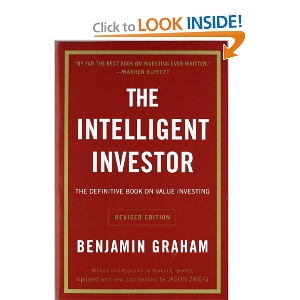
Book Review: The Intelligent Investor

I never intend Bankers Anonymous as a “How to invest” site,1 but B$A readers may safely approach The Intelligent Investor as a “How Not to Invest” site, a more profitable set of rules in the long run, in my opinion.  I prefer The Intelligent Investor to any modern investment book I’ve ever read, and I recommend it as inoculation against the investment advice crap that fills up bookstores, television, and the interwebs.

Since I started working in finance 15 years ago, acquaintances frequently learn about my background and start in with a “So what do you think of the market here?” or “What do you think of X stock?”  The conversation typically gets awkward from there, as I mumble that fixed income markets are different from ‘the market’ they are asking me about and that I typically have no opinion whatsoever about particular stocks.

My professed ignorance is real, but The Intelligent Investor reminds me of why it’s best that I have no opinion.  Benjamin Graham’s quick answer would be that security selection 2 is investing – rather than speculating – only if you have an idea about the value of the company you invest in.  The company’s true value, in turn, would depend on knowing something about the cash flows which may be reasonably expected3 to accrue to the business you’re buying.  Approximately 0.01% of the people4 asking my opinion about a particular stock have sought to value a company’s cash flows5 before making their purchase, or before asking my opinion.  So what my acquaintance really is asking me is whether I prefer red or black at the Roulette wheel, or whether I hit or stay on 16 when the blackjack dealer is showing a 5.  Frankly, I have no opinion, but it’s usually considered impolite to add that I’m pretty sure the house is going to win against you in the long run. So I try to stay quiet and mumbly.

Please allow me to justify my somewhat extreme response, as it’s contrary to everything most other financial professionals want you to believe, from the Motley Fool to the CNBC fool 6 whose primary parlor trick consists of reciting nonsensical facts he memorized about stocks just before the cameras started rolling.  I don’t want to come off like a pretentious finance guy looking down my nose at amateur day traders.  My real target here is not my day trading acquaintances, but rather the entire financial-infotainment-industrial complex, from CNBC to TD Ameritrade, from Goldman Sachs to Charles Schwab, which wants you to believe any or all of the following myths:

1. You can beat the market.

2. Your mutual fund manager can beat the market.

3. Jim Cramer7 can beat the market.

4. Your investment advisor can beat the market.

5. Your hedge fund guru can beat the market.

Although first published in 1949, very little of The Intelligent Investor feels dated.  I estimate 95% of the opinions and techniques described by Graham still apply.8

Here’s a few rules of Graham’s approach that we all mostly honor in the breach, when investing:

  1. Investing in volatile markets requires not a timing approach, but rather a pricing approach.  The entire financial-infotainment-industrial complex will guide you to the former, but investing according to value, when the stock dips into an attractive price range, requires knowing something about how to value a company, and something about the value of your particular target company.  Trust me when I say neither Jim Cramer nor TD Ameritrade will help you in this process.
  2. You should receive investment advice with deep skepticism, whether it comes from your investment advisor, brokerage houses, investment firms, friends, or relatives.  The best investment advisor is one who does two things: She prevents you from imprudent investment behavior, and she claims not brilliance but rather careful and conservative competence.
  3. New issues favor the seller, not the buyer, as the seller has the best access to information and almost by definition picks a favorable time to sell securities.9  Individuals should almost never seek to buy new issues.
  4. When deciding to purchase a stock, think like an owner, as that’s what you’ve become.  Expect and hope to be treated by management like an owner.  Realize, however – and this was as true in 1949 as it is today – that shareholder rights barely exist in practice.
  5. Be business-like in your investment practice.  If you would not make professional decisions at work on a whim, based on emotion, or following a rumor you picked up from your gym-buddy, try to resist doing any of those things when making investments.  If you approach investing as an amateur, do not expect profits like a professional, just as you would not in your day job.  Businesslike investing for businesslike profits requires work, an idea which the financial-infotainment-industrial complex would like you to forget.

Benjamin Graham exposes the awful truth that very few of us can competently handle the work required to invest, rather than to speculate.  Even worse, most investment advisors encourage the latter rather than the former.

Once you’ve absorbed this awful truth, what’s an ex-banker to do, you ask?10  I’ll paraphrase Graham and add my own editorial suggestions in the light of The Intelligent Investor:

  1. Hire an investment advisor, but pay them to keep you prudent and to deliver market results.  As a logical consequence of this expectation, don’t overpay for investment advice.
  2. Expect market results.  Do not expect to ‘beat the market.’11
  3. Markets can be volatile, and that’s not entirely a bad thing.12
  4. If you enjoy investing as a hobby, allocate some small part of your investible capital to your hobby, and expect to pay appropriately for that entertainment.  Allocate the greatest portion of your investible capital to a low-cost investment vehicle, not managed by you, that fits your appetite for risk.
  5. Know your appetite for risk.  For example, can you handle losing money?  How much would you be able to lose without losing your head?  Have you considered FDIC-guaranteed bank deposits as a result of thinking about this?
  6. Most people seek to highly diversity their investments, and rightly so.  On the other hand, most people who become very wealthy in their own lifetime typically have extremely concentrated equity exposure.13 Are you someone who knows enough about owning your business(es) to be extremely concentrated in your equity investments?

Unlike The Motley Fool, I write Bankers Anonymous to “amuse and inform,” but not to give investment advice, or to “enrich.”  Financial advice hasn’t improved much in the last 60 years, which is why The Intelligent Investor is where to begin if you’re looking for investment advice, and it might just be where to end as well.

Please see related post: All Bankers Anonymous Book Reviews in one place.


Post read (14118) times.

  1. It’s funny how many people, upon hearing my intentions with B$A, have said “So that’s just like The Motley Fool,  right?”  I’m not here to “Educate, Amuse & Enrich.”  Just the first two, sorry.
  2. I don’t mean to be jargon-y saying ‘security selection’ instead of ‘stock picking.’ I’m using ‘securities’ to mean stocks or bonds, and Graham refers to them both.
  3. Allowing for Graham’s signature investing rule to always allow for a “margin of safety”
  4. I rounded up that figure, fyi.
  5. I’m saying cash flows here to mean either the income from a bond you own or the expected profits from the company that you own shares in.
  6. Jim Cramer
  7. Yeah, that guy with the clown squeaks, horns and whistles.  Needless to say this brings to mind the great Jon Stewart take-down of Jim Cramer.
  8. Oddly enough, interest rates have done a round trip since 1949, from 2.5% on the 10year to 16% and then back, such that his discussion on expected bond returns feels fresher than it probably would have 30 years ago.  Kinda weird.
  9. For a little more detail on my views of IPOs, can I interest you in this posting?
  10. Last week I came across the best four pages of bullet-pointed investment advice and investment advisory advice I’ve ever seen assembled in one place.  You’ll want to scroll down to Appendix 3, pages 9-12, of this attached PDF.  If any of this blog post/book review speaks to you, you will love printing out those four pages and hanging them on your wall for future reference.  I have zero connection to that author, and I had never heard of him before last week.  You’re welcome.
  11. Now is as good a time as any to acknowledge the weird and ironic truth that Graham’s best-known protégé, Warren Buffett, is the most famous market-beating investment manager of all time.  When I read The Intelligent Investor, I get the strong sense that very few people will ‘beat the market,’ so I should not try it.  But Buffett must have gotten the strong sense of the opposite: that through his efforts he would be one of the rare people who could beat the market.  That’s just one of the small ways in which my life trajectory has differed from Buffett’s.
  12. Graham means it in the sense that stocks sometimes get cheap, so volatility can be your friend.  I mean it in another sense as well.  In the post-Madoff era, we’ve learned that a consistent return with no down months does not mean your investment advisor is a genius, it means he’s a fraud.  Remind me to tell you some time about my client who berated me for 20 minutes over the phone when he experienced the first down month in my fund.  After a period of steady returns investing with me he had come to expect no down months, and suddenly I was “terrible at my job,” and he wanted his money back immediately.  In a related news item, he found out by January  2009 that he had not just Madoff in his portfolio but 3 other Ponzi schemers as well.  He was a lot sweeter to me after that.
  13. The wealthiest man I’ve ever known, someone on the Forbes 400 list, told me when we first met that he’d never invested in the stock market.  Most of his family’s net worth, however, derives from their ownership of a single successful retail business.  That kind of concentrated equity exposure is typically a pre-condition of people who experience massive increases in wealth in their lifetime.  Think Rockefeller, Gates, Jobs, and Zuckerberg.
    These folks did not get wealthy through diversification, but rather the opposite.

In Praise of SIGTARP, Norse God of Financial Accountability

“…But in 2012, the people became restless.  They mistrusted the 1% who lived far away in beautiful, unattainable, icy Jotunheim.

And the people quarreled amongst themselves.  They could not agree with one another or keep the peace.  The people were the 99%, and they divided into warring ideological camps, visiting bloody internecine raids upon the other side.

One group, the Teaparty tribe, worshiped the demigod Free Market and raged against encroachments from their sworn enemy, Big Gov, who dwelt smugly in the elaborate Federalist castles of Washington DC.

The others, the Occupy tribe, supplicated before the Mother Goddess Collective Action, and they named their enemy Big Bank, who ruled cruelly from the executive suites of New York skyscrapers.

Periodically one tribe drew blood from the other side in a furious ideological battle.  But even amidst the carnage, both sides wished for a savior, a hero who could unite them.  The One.

In the beginning, little did the people notice online publications from Neil Barofsky, which showed the 99% their common enemy lived in both Washington DC and Wall Street.  Who was this Neil Barofsky?  At first he appeared to be a mild-mannered grunt, a common civil servant, toiling in the basement of the US Treasury from 2008 to 2010.  But on July 25, 2012, with the publication of Bailout: An Inside Account of How Washington Abandoned Main Street While Rescuing Wall Street, he became known to the world as SIGTARP[1], Norse God of Financial Accountability!

At last revealed in all his glory, SIGTARP arrived, flanked by Amazons!

The 99% needed a hero to unite them, to show them how both Washington and Wall Street betrayed them all.  SIGTARP unfurled his fearsome flag of financial accountability.  The two tribes put down their weapons against one another and turned toward the new banner.

They finally understood the truth.  Big Government and Big Bank conspired together to keep them down.  A new unity began to emerge, as the armies of the 99% integrated.

No longer needing his disguise as Neil Barofsky, SIGTARP ripped off his itchy wool suit to reveal rippled musculature and a mighty pen describing infernal, festering corruption.  Under the Bailout banner, SIGTARP and the newly united 99% began their determined march upon Jotunheim.”


Ok, I haven’t read Bailout yet, as it was just published today.  Based on today’s NY Times Review, the book suffers from some simplistic moralizing and, perhaps, Barofsky’s savior-complex.

But – and I mean this in earnest – I have had a serious man-crush on Neil Barofsky for a while now.  As SIGTARP, he managed to accurately review the TARP process, while maintaining critical distance from both Washington and Wall Street.[2]  I will highlight in the next few weeks some of the excellent reporting done by his office.  For all the unhappy things that may be said about the cynical nexus of Wall Street and Washington, SIGTARP has given me hope in the last year that our system can be resilient and accountable.  A hero may yet rise.

Thank you SIGTARP!

“No problem, kid,” answers a booming, disembodied voice, before soaring upward, headed toward Jotunheim.


[1] SIGTARP stands for Special Investigator General  for the Troubled Asset Relief Program, the Congressionally appointed watchdog over the $700B TARP program created in 2008 at the height of the Credit Crunch.

[2] Not an easy trick!  As the NY Times review excerpts from the book preface, Barofsky met in 2010 with Herb Allison, former head of TIAA and Fannie Mae:  “ ‘Have you thought at all about what you’ll be doing next?’ Mr. Allison asks Mr. Barofsky, soon adding, ‘Out there in the market, there are consequences for some of the things that you’re saying and the way that you’re saying them.’  ‘Allison was essentially threatening me with lifelong unemployment,’ Mr. Barofsky concludes, and alternatively suggesting a plum government appointment some day if Mr. Barofsky would simply ‘change your tone.’  When Mr. Barofsky tells his deputy of the exchange, the deputy says, ‘it was the gold or the lead,’ resorting to their joint experience prosecuting drug kingpins in New York: Cooperate and share the riches, or don’t and get plugged.”


Post read (4287) times.

Interview: What the %#@! is a Fund of Funds?

Please click above to listen to full interview.

I spoke with an old friend Trevor, a former Director of Research at a Hedge Fund of Funds.  In college, a mutual friend of ours imaged a radio show named “What the Fuck Do you Do?” in which he interviewed people in jobs that nobody else understood the name of, or the function of.  This interview is in that spirit.  He spoke about the business, lucking into one of the best bosses in finance, and then leaving it all.  This interview is also in the spirit of Trevor himself, a recovering banker trying to figure out what’s next for him.

What is a Fund of Funds?

Trevor:  Hi my name is Trevor and I used to be the director of research for a fund of funds.

Michael:   Trevor, thank you for agreeing to be part of Bankers Anonymous. I’m wondering when you said you’re a fund of funds manager, what percentage of people that you ever talk to, who you identify yourself as a fund of funds manager say, “Oh, I know exactly what that is,” or do people have no idea what you’re talking about?

Trevor: People have no idea what I’m talking about.

Michael: What do you usually say?

Trevor:  And it’s usually a stultifying opener when I say – people say what do you do and I say, “I work for a fund of funds, fund of hedge funds.” Three-quarters of the time there’s a blank stare and then one-quarter of the time people actually ask a follow-up question about what it is. But the topic of finance generally sends people running away from the conversation. So I usually lie now when I tell people what I do.

Michael:  What’s your backup answer now, zoo keeper?

Trevor: I raise bees, African honey bees which produce a very spicy variety of honey.

Michael: Awesome. I know what a fund of funds business is more or less, although I’ve not worked at one, but is it easy to describe what that means?

Trevor: It is. It is a collection of funds run by other people managed by the fund of funds operator. Usually I give people the analogy of mutual funds because most people know what mutual funds are. The business model is if I was going to create a fund of mutual funds, so instead of you investing in mutual funds directly and picking ten mutual funds, you could invest in Trevor’s fund of mutual funds and by investing in my one fund you get exposure to however many underlying mutual funds I choose to put in the portfolio.

The fund of hedge funds is the same idea but instead of underlying investments being in mutual funds, the investments are in hedge funds. That’s usually when people freak out because they’re like “Oh my god, hedge funds; now you’ve lost me. Aren’t those all terrible?”

Michael: Are you part of the evil hedge-fund world?

Trevor: Yeah.

Michael: I’m familiar with that, where people hear fund of funds and suddenly there’s a blank stare and everybody’s like “Oh my God look shiny object over there.”

Trevor: And, to interrupt you, then the smart people say, “Oh, so that’s an extra layer of fees, so basically you pay fees to the hedge funds and then I pay fees to you, and then there’s multiple layers of fees. So it’s not really a business, it’s just a set of fees.” That’s what the savvy, cynical, smart people usually observe right away.

Michael: The classic criticism of hedge funds themselves is they’re not really an asset class but a compensation scheme.  As a derivative of a hedge fund you could be a compensation scheme on top of a compensation scheme.

Trevor: Yes.

Michael: But having been in the world, do you think the added expense is worth it?

Trevor: The firm that I worked at launched multiple products going back over the last twenty years and their long-term results easily beat the S&P500 with better performance characteristics, as net of all fees.

Michael:  Performance characteristics: Volatility, Return, what else am I worried about – draw down I guess; how much did you lose in a bad year?

Trevor:  Yup, and then one more which is correlation to the index.  If the index is going one way the fund of funds is not necessarily having the same pattern. So there are fund of funds which have been able to outperform the broad-based market net of all fees over a five, ten, fifteen, twenty-year time frame.

Michael: And your fund did that?

Trevor:   Yes.

Michael:  So post-credit crisis in 2012 is the world different for fund of funds?

Trevor:    I think there will always be a need for fund of funds because institutional investors want access to alternative investments and part of that is access to hedge funds. A lot of those programs don’t have the resources to research hedge funds, and invest in them, and monitor them. So if you’re a 200 million dollar endowment for a secondary school or small university,

Michael:  Basically, tiny.

Trevor:  And you allocate twenty percent to hedge funds, so you have 40 million dollars going into hedge funds. And of that, you have half of that going into long/short equity hedge funds, you can’t hire the staff to adequately research and monitor it. So middle-sized endowments will always have a need for a gatekeeper to help them.

Then a lot of larger institutions often hire funds of funds to create a starter kit and they will put together fund of funds for the larger college endowment, and then the endowment will eventually take it over once they’ve learned the ropes.

And the last category that’s probably never going away is if you’re a high net-worth individual but you’re not super, ultra-rich, you can’t afford to create your own diversified portfolio hedge fund because they generally have a one million dollar to five million dollar minimum, so if you, say, only have ten million dollars to invest and you put twenty percent in hedge funds which is two million dollars, you can invest in two hedge funds, maybe, which as everyone knows you don’t want to take on concentration risk in really any asset class. So the high-net individual but not ultra high-net will always need a fund of funds to create a diversified pool.

Michael:  Is that essentially the customer base of your business, medium-size endowments and high but not ultra high-net worth individuals?

Trevor:  When the firm first launched it was mostly high net-worth individuals, which I think is if you go around to your friends and say, “Hey I’m starting this business, will you invest?” And then over time they generate the track record and credibility, their shift was towards institutional clients. The current composition is ninety-five percent institutional and five percent individuals.

Michael: I’m sorry, ninety-five percent institutional and five percent individuals?

Trevor:  Right, so the shift over time was dramatically towards institutional money meaning pension plans, charities, endowments, foundations as opposed to individual investors.

Michael: I obviously know you quite well and I know you have a mathematical background but can you describe what it’s like to work for a fund of funds? What’s the main skill set that’s useful?

Trevor:  I think everybody approaches selecting managers differently and there are places that run Monte Carlo simulations and all sorts of back testing and modeling and then there’s people on the totally other end of the spectrum who just meet with a manager and think, “I like that guy.”

Michael:  More a feel on what’s a good manager or good investor.

Trevor:  Yeah, and both approaches probably work fine, as long as you do the one that makes sense to you. Our firm fell somewhere in the middle where we did a lot of number crunching and we would look at past track records and look at when managers had losses how did they respond to those losses. Hedge funds generally have access to leverage so when the economic environment deteriorates does the manager double down to take on more risk in hopes of making all this money back quickly; or if they have losses and a bad environment do they reduce exposure and risk and crawl back slowly? Looking at quantitative information to assess how a manager responds to risk and how much risk they take on.

Michael:  So it’s a mix. It doesn’t sound like rocket-science math.

Trevor: No, there’s some standard deviation and draw downs but probably high school level math.

How Do You Get a Job at a Fund of Funds?

Michael:  In 2002 you were not in the financial world.  How does one get a job at a fund of funds shop?

Trevor: I think it’s a strange path. Probably very few people coming out of college have heard of this industry. So I happened to get into it by a sequence of events where my uncle had worked for a guy who ran the company and he hired me to do some software programming. Then I joined running operations and gradually made a transition to the investment side while doing the CFA program. It was a very idiosyncratic route.

Michael:  The work environment was somewhat idiosyncratic also?

Trevor:  Yes, I think I worked for one of the nicest people in finance, certainly shocking and refreshing to find someone who is very principled and fair and entertaining. I remember an early conversation where the boss said, “You know, I’d really like to take Fridays off in the summer, but if I take Fridays off what am I going to do about all the employees? Maybe they can work half a day. Oh fuck it, just everybody gets Friday off.” But that was also tempered with if you made a mistake he would come down very hard on you. It was very high expectations but it was a very fair environment.

One great memory which is that my boss used to come into my office and he would say, “You know, when I had my first consulting job, my boss would come in and he would say, ‘I’m going to give you six months to work on this, and if it turns out well you get full credit. And if it goes badly, you’re fired.'” And I’d think ha-ha that’s great, good story.  He told me this anecdote maybe three or four times over the course of two weeks, and the fourth time it dawned on me; those are the rules. If it goes well, I get full credit, and if it goes poorly, I’m fired.

Walking Away From It All

Michael:  Okay, you’re no longer fulltime with the same fund of funds and as I understand it you’re interested in other things. Why would you do that?

Trevor:   Great question. A friend of mine told me he would come up to New York and shoot me if I lived there for more than five years.

Michael:  So it was fear that drove you away.

Trevor: At year eight I was getting worried that would actually happen.

I love spending time out of doors and I love farmers markets and I love a slightly slower pace of life. It’s very hard to achieve that in New York where your apartment can be very small and dark unless you’re extremely successful. People don’t generally host dinner parties or hang out in their apartments which I think is why I think a lot of the public spaces in New York are so great. Peoples’ existence in their own apartments is not a great hosting venue. But all that being said, I wanted to move out West and have access to the out of doors.

Michael: While maintaining your anonymity for this program, we’ll just say you’re in California, somewhere in California. They’ll have to try to find you. I think I’m hearing you say actually when it came down to money versus friendships you found the friendship part more compelling. This sounds very un-banker-like of you.

Trevor: Certainly I would rather have more money than less money. I did have this idea I would work hard and save up money for a while and then leave and do something else. I’m in the process of executing that transition and certainly some days I wake up and I think what an idiot; if I had stayed and followed the traditional succession plans, I’d be a gazillionaire.

Michael:  But even making the choice to leave and get into a different mode of life, it’s still hard to think: “Wow, but I could have had this money!”

Trevor: I think it’s hard to take a path where you’re relatively senior and successful and basically go into another industry or set of interests where you don’t have any credibility or expertise necessarily, but you think it’s a more satisfying and rewarding way to spend your time. I’ve discussed this with my former boss and he wisely wrote back and said, “Money means nothing if you are unhappy.”

Michael: Wise words.

Trevor: If it’s a calling that’s good for you, and there are certainly plenty of people in finance who genuinely enjoy it.  Then I think it’s a great career track. But money corrupts and it’s an industry that can lead people to stay working in it when they don’t get a whole lot of meaning out of it.

Post read (3761) times.

When Geithner Goes to Goldman

Just an FYI: I plan to walk out my front door to punch the neighbor’s cat in the face, toward the end of this year, when US Treasury Secretary Geithner finally announces he’s joining Goldman, Sachs & Co as senior advisor and Managing Director.

While he’s indicated his intention of leaving his post as Treasury Secretary soon, Intrade gives Geithner a 37% chance of leaving before the end of Obama’s first term.  The departure of two top Geithner aides to Goldman Sachs in the past 4 months has increased the chatter that Geithner will soon be headed that way as well.

To be clear, I believe punching Mr. Biggins on his cute little cat nose will accurately reflect the combination of surreal injustice and rage that I will feel.  Consider it a measured, senseless act of violence and random mean-spiritedness to match the public mood that should accompany Geithner’s inevitable sell-out move.  What else can I do?  What else can any of us do?

While my act will be appropriately senseless, I want to be careful in how I explain my feelings.

I hold no particular grudges towards those who, in the spirit of providing a better life for their families, seek employment in the private sector following a long career in public service, like Timothy Geithner.

I won’t blame Goldman for offering Geithner the job, either, as it’s clearly in their interest to hire such a key player in shaping the current financial architecture.

I also hold no specific animus toward Geithner himself, who appears to have executed admirably on his difficult professional assignments.

Geithner’s resume deserves respectful review and appreciation.  The man served as Under Secretary of the Treasury under Larry Summers when the latter signed our dollar bills as Treasury Secretary.[1]  He moved up to President of the Federal Reserve Bank of New York in 2003.

Some FRB-NY Presidents have served in that position, easily the second most powerful seat at the Federal Reserve, in relative obscurity.  But not Geithner.  He had the interesting fortune to be on the FRB-NY President hot seat during the Great Credit Crunch in 2008[2], thereby putting his imprint on every major decision made about Wall Street from 2007 to 2009.

When Bear Stearns teetered on the edge of Bankruptcy and the FRB-NY offered a $25 Billion loan to tide Bear over, Geithner was there.  When the FRB-NY subsequently rescinded its offer to Bear, ensuring its immediate demise, Geithner was also there.

JPMorgan Chase then bought Bear Stearns for a song, and the FRB-NY provided up to a $30 Billion non-recourse loan to get the deal done.[3]  Geithner was there too.[4]

When the FRB combined with the US Treasury to lend up to $182 Billion to prop up AIG, a bailout understood at the time to be, and a bailout that actually was[5], a back-door bailout of the largest financial firms in the world, Geithner was there.[6] [7]

When the Federal Reserve and US Treasury made available to Bank of American $20 Billion in additional TARP funds[8] and an extra $118 Billion in asset guarantees[9]  to ensure that it followed through to purchase Merrill Lynch in December 2008, Geithner was there too.[10]

Obama took office in January 2009 and Geithner received a promotion from the FRB-NY President to US Treasury Secretary, a logical move to ensure continuity at a very dicey time in financial markets.  I’ve written in an earlier post about the tight circle of government officials running financial policy, and the trade-offs between continuity and stagnation.  It was not crazy for Obama to promote Geithner.

In the light of Geithner’s impending employment by Goldman Sachs, however, it’s interesting to review how Geithner has not “been there” on a number of issues.

When AIG paid bonuses to its executives after its $170 Billion bailout, the largest financial failure/bailout of all time,[11] Geithner as US Treasury Secretary did not force a clawback of those AIG bonus payments.  Under what authority could Geithner influence bonus payments?  The US government owned 92% of AIG at that time.  But Geithner somehow wasn’t there.

After Ken Lewis destroyed a perfectly healthy Bank of America in 2008 through his devestating purchases of Countrywide and Merrill Lynch, forcing the extraordinary Treasury and FRB-NY bailouts to stabilize the bank, Lewis departed in 2009 with an estimated $125 million retirement package.  Under what authority could the US Treasury Secretary influence executive payments?  Well, for starters, Bank of America owed $45 Billion at the time to the US Treasury.  But Geithner wasn’t there to claw back Lewis’ compensation.

While Too Big to Fail (TBTF) banks continue to this day to operate as large hedge funds, and continue to compensate their executives accordingly, under an implied government guaranty of safety, Geithner is not taking a public stance against this.

While I review the FRB-NY and US Treasury bailouts in some detail I want to be careful not to blame Geithner exclusively for mistakes that were made.  I don’t endorse every decision made by Paulson and him, but I acknowledge the battlefield conditions under which they labored.  I know the issues are complex; they weighed financial stability against moral hazard, justice against political feasibility.  I get it.  This stuff is hard.

But at no point in his tenure as FRB-NY President or US Treasury Secretary did we witness Timothy Geithner take a principled, unpopular stance – in the face of egregious moral hazard – to come down hard on Wall Street’s surviving behemoths.

I’m not a paranoid person by nature, and I believe Geithner’s actions to be defensible without accusing him of sucking up to his future employers.[12]

Clearly one analogy here is a powerful Congressman[13] who leaves office, moves down to K-street, and sets up a profitable lobbying shop influence peddling on his access to decision-makers.  We have some, albeit too few, restrictions on this type of brazen move.  Even that comparison, however, misses the magnitude of Geithner’s influence in recent years over $Billions in compensation and investment returns.

As an ex-banker I – oddly enough – still believe in the system.  I assume a basic decency tempers all but a few bad actors.  I’m still shocked by corruption.  I still can be disappointed by greed and influence peddling, and I believe the United States still boasts the least corrupt financial center in the world.[14]

More than any other single financial leader Geithner has argued within the administration for stabilizing and buttressing TBTF banks above all other factors, and seemingly has resisted efforts to extract proportionate commitments from the salvaged banks in the name of systemic reform or limitations on executive compensation.  Geithner’s heroic efforts on behalf of the TBTF banks have been worth billions of dollars to them, and he’s become the face of moral hazard within the Obama administration.[15]

Geithner’s move to become a Goldman Managing Director later this year – rightly or wrongly – will signal to journalists, Wall Street, SEC regulators, investors, you, and me, that all is for sale.  The move will signal that private gain trumps public good, every time.

But back to cat-punching for a moment.  If we have no way of preventing Geithner’s move to Goldman, then we have no reason (except sheer naiveté) to ever expect tough decisions to rein in Too Big to Fail banks.  I for one cannot stand to have my neighbor’s cat live peacefully in that kind of world.  Consider yourself warned, Mr. Biggins.


[1] One of my closest friends served under Larry Summers at Treasury.  I’ve shaken Larry’s hand a couple of times.  I’m not breaking any news here to say that Larry is not a super fun guy to spend your working day with.  Let’s agree to award Geithner a Bronze Star for that portion of his professional career.

[3] The $30 Billion non-recourse loan arranged by Geithner’s FRNNY  in this transaction was simply awesome for JP Morgan Chase.  Non-recourse means that only Bear Stearns collateral backed the loan, so if it turned out its portfolio was worthless, JP Morgan could walk away with only the first 3% of losses.  What that means is that the Federal Reserve agreed to absorb up to $29 Billion in losses on JP Morgan Chase’s purchase of Bear’s $30 Billion asset portfolio.  It’s kind of like being given a million dollar house by the Federal Reserve, but if you decide you don’t want it later you just owe 30K, and they can’t go after you for the other $970K.  Like I said, so awesome.  Jamie Dimon, you owe free drinks to Geithner for the rest of his drinking life.  We would all love the option to walk away from 97% of a $30 Billion loan.   We should seriously all try to get one of these loans from the FRB-NY.

[4] Bear Stearns initially got sold to JP Morgan Chase for $2/share, just 7% of what Bear Stearns had been worth 2 days before, before the FRB-NY rescinded its loan offer.  Later, sort of out of pity and to avoid further litigation, Paulson allowed an upward revision of JPMorgan Chase’s purchase price to $10/share, still an extremely low price.

[5] If you have a taste for wonkiness and financial history like yours truly, I highly recommend this link.  But for the rest of you let me summarize the key point of page 24.  The size of the bailout for each firm you’ve heard of, via the AIG loans from FRB-NY, were as follows: Societe Generale: $16.5B, Goldman $22.5B, Deutsche Bank: $8.5B, Merrill Lynch $6.2B, and UBS $3.8B.

[6] To briefly review the history of this particular bailout: AIG got taken out by a series of lightly-collateralized credit default swap trades done with some of the largest Wall Street firms.  The trades were meant to be, from AIG’s point of view, a nearly riskless cash-flow stream based on insuring the credit of a large portfolio of high quality companies, as well as some highly rated but ultimately dodgy mortgage securities.  When the unexpected mortgage downturn happened, and some high-quality companies got downgraded, AIG’s Wall Street counterparts asked AIG to provide additional collateral to reflect a change in value of the trades.  The portfolios themselves did not necessarily suffer outright losses, but the collateral requirements to Wall Street meant they had to come up with many $billions in cash very quickly.  If AIG had failed to post collateral, suddenly many major Wall Street firms would have suffered immediate life-threatening cash shortages, at the worst point in the crisis, September 2008.  When the FRB-NY (along with Treasury) provided essentially unlimited funds to AIG, the rest of Wall Street got their collateral and bought themselves a bit more breathing room.

[7] When the FRB-NY went back in November 2008 to ask, you know, if maybe Wall Street would give some of that AIG money back because it kinda looked bad at the time, Wall Street told FRB-NY, essentially, to go fuck themselves.  The whole report of Wall Street’s response is in the link in the main text above, but, linked to again here for your convenience.

[8] This $20 Billion exceeded the $25 Billion already invested by the US Treasury to shore up Bank of America in October 2008, and the extra $20 Billion legally could not be offered without creating an entire special work-around program just for Bank for America, called the Targeted Investment Program (TIP).  Bank of America said, “thanks for the TIP.”  See what I just did there?

[9] Again, these latter guarantees were non-recourse to Bank of America, and the Federal Reserve pledged to absorb 90% of losses after the first $10 Billion write-down.  Again, non-recourse meant Bank of America could default on loans from the government without any negative hit to their credit.  It also meant that the Federal Reserve, again under Geithner’s leadership, took on (up to) a theoretical additional $100 Billion liability so that Bank of America would complete its purchase of Merrill Lynch, all in the name of bank stability.

[10] Details and a review of the rationale behind this move are here, starting on page 23.

[11] Incidentally, isn’t a bonus an optional reward for a job well done? I’m just going to go out on a limb here and say that AIG executives, more than ANY other financial executives who kept their jobs through the Crisis, should not have been rewarded for ‘a job well done.’  Were there any forced clawbacks of bonuses at AIG?  Nope.  Not one.  To steal a phrase from my favorite sports writer, I will now douse myself with kerosene and light a match.

[12] However, I will note that Geithner’s longtime financial benefit to Goldman Sachs and a few other surviving banks far exceeds by multiple billions of dollars the comparatively miniscule compensation of a few million dollars he’ll receive as a new GS Managing Director.  It’s really the very least Goldman could do, to put him on the payroll for a few years.

[13] Or more commonly, his senior staff members.  Wall Street has long considered the SEC a joke for this reason, as the only way to get well compensated as an SEC executive is to cash in on your position for a senior role at a Wall Street firm after a stint supposedly regulating the Street.

[14] Ok, I know you’re all groaning out there at my sudden earnest patriotism.  But I stand by my statement and it’s not based in patriotism.  Why does the dollar, despite our weakened government credit, continue its role as the dominant reserve currency?  Why do M&A transactions worldwide get done by US-based law firms, and financial litigation gets fought in US-based courts?  Because we are the least corrupt place in the world for financial transactions, that’s why.

[15] Paul Krugman lays out Geithner’s role within the Obama Adminsitration in his review of recent books on economic policy “…it is Tim Geithner, Obama’s treasury secretary, who appears, even more than Obama, as the decider in this saga. In contrast to Summers, whom [one of the authors] Scheiber portrays as a flexible, reformist Rubinite, willing to alter his views in the face of evidence, believing in particular that shareholders of bailed-out banks could and should pay more to taxpayers, Geithner is described as a doctrinaire Rubinite who viewed his primary task as one of restoring financial market confidence, which in his mind meant doing nothing that might upset Wall Street.”

Post read (3932) times.