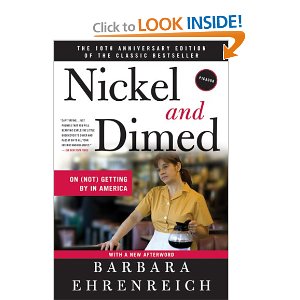
Book Review: Nickel and Dimed – On (Not) Getting By in America

Most of the books I review on Bankers Anonymous purport to give insight, for the non-financier, into how Wall Street works, a main theme for this site.  This book review, however, aims to give Wall Streeters insight into the life of the woman who cleans your house.

Barbara Ehrenreich engaged in stunt journalism in order to write Nickel and Dimed: On (Not) Getting By in America.  She temporarily shed her middle class, educated life in order to understand the working poor.  Over the course of six months, she worked minimum wage jobs and tried to pay for shelter, groceries and other expenses on only her monthly take home pay – an impossible task for her.

She apologizes upfront for the stunt by acknowledging the artificial short-term nature of the experiment as well as her advantages over the typical working poor in the United States.  She is white, native English-speaking, highly educated, in excellent health, and very motivated.  And yet the challenges she faces in paying for basic food and shelter would – if we are honest with ourselves – break most of us down.

Ehrenreich works for $2.43 an hour – plus tips – at her first job in Key West, FL at a hotel restaurant.   Next she moves to Portland, ME to juggle a maid job at $6.65 per hour with a similar low-paying job in a nursing home.  Later she works in the ladies clothing department at a Minneapolis Wal-Mart.  Typically, a single job leaves her short on rent and food money at the end of the month, although she lives in low-rent places such as a cramped, out-of-the-way cabin, a weekly-rate hotel, and a dingy, off-season trailer park.  Juggling two jobs, a theoretical solution, leaves her exhausted and physically unable to perform the first job.  It never quite works, and there’s seemingly no way to get ahead for the working poor.

Ehrenreich’s prose is funny[1] enough to lighten the burden she feels at the indignities of pee-testing, preposterous middle management patronizing, personality testing, and polyester uniforms.  She illustrates in specific ways[2] how the poor live in a parallel universe from you and me, even though they are stocking shelves or pouring coffee right next to us.

Ehrenreich’s writes about her experience during a boom time in America – 1998 – when unemployment reached a record low and corporate America complained about a dearth of workers.  This makes her narrative all the more compelling today, as in even the best of times the working poor have little chance to afford basic material necessities.

Although I read the book years ago when I worked on Wall Street, during the past few years of the Great Recession I’ve thought frequently about Nickel and Dimed.  We often hear a television commentator or political leader speak ruefully about the “middle class jobs lost,” as if that’s the national tragedy.[3]

It really gets up my nose, however, that we find tragedy in “educated, middle class people being out of work,” but we don’t focus on the persistent national tragedy of people who have been in recession all along.  Yes, the Great Recession threw a high number of white collar folks out of a job.  But the GR narrative stresses ‘white color’ jobs, by which I mean the image of ordinarily highly employable people suddenly struggling, rather than the large number of long-term working poor or under-employed people.

I really do not mean to sound indifferent about the tens of thousands of wonderful finance jobs lost in the Great Recession, or the millions of middle class folks who have struggled in recent years, but I do find the obsession with the middle class, rather than the working poor – the true underclasses in the United States – a curious omission in our American economic narrative.

The national unemployment rate rose from a low of 4.5% in 2007 just prior to the Great Recession to a current rate (in mid-2012) of 8.2%.  The African-American unemployment rate meanwhile has remained high at 8.3% and 14.4% respectively, nearly twice the national rate in 2007 and in 2012.

Are the 30% of Americans in a persistent state of underemployment, unemployment, and poverty invisible?  Yes, they are.  In this Great Recession, we just ignore them, because their situation is assumed to be unchangeable.

Both political parties shy away from acknowledging the working poor or people in chronic poverty. It seems only the “middle class jobs lost” are worth lamenting.

From the Obama “Jobs and Economy” page: “For years before the economic crisis, middle-class security had been slipping away. Wages stagnated while health care costs soared.”

From the Romney “Jobs and Economic Growth” page, we get a helpful “Middle-Class Promise Gap: Unemployment“ [LINK has been taken down with the end of the campaign.]

You will not find either candidate for President discussing the working poor or the persistent underclass in the United States.  I guess the working poor and unemployed don’t vote in sufficient numbers?  They certainly don’t donate enough to campaigns to matter.

The cone of silence increasingly ignores the American reality of wealth stratification.[4]

I currently live in the one of the poorest large cities in the United States, an urban environment with persistent poverty rates around 25% of the population.  For children under age 10, closer to 30% are growing up in households below the poverty line with a similar rate of undernourishment.  Their poverty was real before the Great Recession, it is real now, and because few leaders seem concerned about the issue, it will be true for the whole next generation to come.

In my hedge fund business, I invested extensively in municipal tax liens[5] in upstate New York.  Many upstate New York cities barely noticed the Great Recession.  Instead, decades prior to the recession, the regional Rustbelt deindustrialization kept them in a depression characterized by high rates of poverty, declining population, and falling real estate values.[6]

A permanent recession in some regions and in some population groups is the real story.  Nickel & Dimed is the real story.

My guess is anybody who reads this book review lives well ensconced in the middle class or above, and spends little time thinking on a daily basis about the working poor or the nation’s chronic underclass.  I’ll be the first to admit I certainly don’t.  Instead, my day – like yours – is full of what may be called ex-banker problems, and of course, cat videos.

Ehrenreich’s Nickel & Dimed gave me insight into the way millions of my fellow citizens live.   If more people should understand how high finance works, it’s even more essential that high finance folks understand how millions of their fellow citizens are getting by, or not, in America.

Please see related post: All Bankers Anonymous Book Reviews in one place.


[1] In writing this review I found myself struggling unsuccessfully to find something funny to say on the topic of the working poor and underclass in America.  Her specific experiment had light moments, but humor kind of eludes me on this one.

[2] Multiple restaurant co-workers live out of their cars because they can’t afford the rent anyplace near their place of employment.  Grocery shopping for healthy perishables proves impossible without a real refrigerator or kitchen.  Working slowly can be rational when you’re paid by the hour.  Neglecting antibiotics or doctor’s visits because of the cost can be devastating to your health and ability to work.

[3] It is certainly terrible to lose one’s job, and I do not mean to be callous about middle class folks who got laid off in the last few years.  The great risk for a middle class person who joins the unemployment ranks is really falling into the huge underclass, at which point he will be effectively forgotten in the national narrative.

[4] Which is why I was happy to interview a member of the 1% to speak candidly about his life here.

[5] As an investor, I purchased from municipalities a lien representing a senior claim on real estate for which the property owner had not paid City or County or School or Water taxes.  After the expiration of a statutory period of time, my firm had the right to foreclose on the real estate.  Many municipalities in upstate New York have a constant need to sell tax liens because of persistent tax delinquencies.  That of course reflects the relative poverty and declining real estate values in the cities and towns of the region.

[6] For investors who would like to know just how depressed the situation is in some upstate New York cities, perhaps my real world example will provide a point of comparison.  I sold a seven-unit residential building (acquired via tax lien foreclosure) in January 2011 for $75,000.  While two of the units needed a little improvement, three of the units had renters, providing cash flow on the building.  And I was happy to sell the building just to be rid of the risk.  That upstate New York city is not coming back any time soon.

Post read (5550) times.

Interview Part II: Greek Businessman On European Sovereign Power vs. Local Greek Power

Please click above to listen to full interview.

In the first podcast with Mihalis, we discussed the excessive size of the Greek government, and the challenges and opportunities of entrepreneurship during the Greek crisis.  During that same conversation Mihalis went on to discuss with me his solutions for Greece.  He envisions a radically strengthened European Union, in which the Greek state withers in favor of more unified control from a federal Europe.  Combined with that, ideally, he imagines local politics still under Greek control.  Finally, and interestingly to me, Mihalis spoke about his father, a prominent businessman who took over as mayor of Thesssalonika, Greece’s second largest city.

Mihalis: I have many radical views. I don’t want to, you know, take them public yet.

You know Greece can, as it did in the 18th century, the Greek ideal, the Greek nationalism. Greeks were used by the European nationalists in the 18th century to create the nation state.  In many ways you know the ideas of democracy, a nation that creates its own state, it was formed – it was inspired – by Greek ideals.  And now there’s a second opportunity in which Greece can become the, an example of deeper European integration.  With loss of sovereignty, national sovereignty.  Because at the end of the day the solution is very simple but no one wants to tell it like it is.  You have to sell assets.  And it’s not very easy to do. It’s not very easy, but it’s not too hard to do, if you want to do it.

Politicians are afraid that if anyone’s going to say that, they’re going to be blamed for being traitors or whatever.

Mike: have Greeks benefited from unification with the rest of Europe?

Mihalis: Of course!  That goes without saying.  Not only because of the level of standard of living, it’s also a question of giving us access to a much larger market.  It’s become a lot easier than before. It is made tourism a lot easier – more transparent, more efficient.  We think about Greece as basically three things to offer. Shipping, which is a main area of excellence in the world; Tourism – we have good real estate; and the products that this real estate produces: good wines, olive oil – good stuff to eat because it’s a blessed place.

And these things have become more accessible with the euro than before. Of course, they become more expensive as well because in Greece we didn’t have a good adaptation.  So when we did switch from the Drachma to the Euro, there was a hidden inflation that really ravaged society.

Mike: As you know, my parents vacation in Greece and they’re the classic tourist – for a month a year they spend their retirement money in Greece.  But it got about twice as expensive when they joined the Euro.  As my mom has worried to me about “what happens if they leave the euro?”  I said “that is something you should look forward to.  If they’re back in Drachma everything is half price again!”  Which is the way it was when they first were going to Greece.  From a balance of payments, or tourism perspective, shouldn’t they just leave the euro?

I know you disagree, but I’m trying to play devil’s advocate a bit.

Mihalis: I don’t disagree, it’s more a question of a better remedy.  It really depends on how you assess the symptoms.  If you have to amputate you have to amputate.  Leaving the euro for Greece would be tantamount to an amputation. It’s something that’s really wrong, if it’s the only way to save the patient is by cutting off his arm.  I still feel there are other remedies.  Although I’m a pessimist by nature I still hope that there are some healthy forces in Greece that can team up with more visionary – more powerful forces in Europe –  for deeper integration because there are more benefits than disadvantages to deeper integration overall, for the whole.

My radical view is that, if you had Greece lose part of its sovereignty so it could be the experiment of European integration.  It might be unrealistic or utopia what I’m saying but, I don’t see any other way out.  Because if you don’t create some radical changes, in the way the political system works and in the way culture affects self-government, it’s not going to work.  So you’re right.  There’s no reason to help, so kick them out.  Let them not be part of our problem. And whoever has connections to Greece… Maybe let the tourists go there, and find the Drachma was cheaper and that’s it.

But there are two forces inside Greece that are still fighting since the inception of the state in 1821.  It’s between

  1. Modernity and Westernization, versus
  2. Orientalism, and Backwardness, and no change.

It’s kind of like the Euro is a conviction, a belief, that we could be more modernized.  We can be more close to what Europeans and the West expect us to be.

The most admirable thing about the US – and that is why the US has become so strong – is that you have a local government which can take care of things efficiently, and then you have a federal government that deals with the outside and inside whole of the body. In Europe you could take that example. Greece could already have institutions to run regional governments that could fertilize or be pollinated by European experts, people who run things well abroad, take best practices. The problem is we don’t have the best practice rule; You call in someone who has made it in some way, who succeeded in doing something, and really try to make it work.  And then you have a blended society that has a common goal in mind which is to make it work.

MIHALIS ADVOCATES FOR RETAINING LOCAL GREEK CONTROL FOR CERTAIN THINGS LIKE CITIES, BUT CEDING SOVEREIGNTY TO THE EUROPEAN AUTHORITIES OVER BANKS, BUDGETS, AND BORDERS.  THE LOCAL CONTROL ISSUE IS PARTICULARLY INTERESTING WITH MIHALIS BECAUSE HIS FATHER GIANNIS, A WELL-KNOWN BUSINESSMAN, RECENTLY BECAME THE MAYOR OF THESSALONIKA, GREECE’S SECOND LARGEST CITY.  GIANNIS IS A KIND OF ANTI-POLITICIAN, WILLING TO SHAKE UP THE STATUS QUO TO CHANGE OLD BAD BEHAVIORS.  I ASKED MIHALIS IF HE THOUGHT HIS FATHER WOULD BE DRAFTED TO BECOME PRESIDENT OF GREECE.


Mihalis: There’s been a lot of talk about it in Greece.  Writers and journalists and many people have proposed, have just tossed his name as a potential independent guy that could come and sort of create a stable platform on which different forces can be synthesized. But I think he knows, he’s aware of his limitations and he always wants to focus on his scale.  And his scale is at the city level and I think he is committed to that.  You know he didn’t run into politics for the power trip.  I think he ran because he felt that he could offer and do and make a difference at the city level. I don’t think he could make that difference at the national level.

But I think he’s an example of what I’m talking about.  The global/local combination where you can have people like him who fight corruption who fight this venality built into the parliamentary system in Greece. Who have run successfully a business, who can fire people at the local level and hopefully improve things at the local level which are relevant to the people in their everyday life.   Then you can have people of much larger magnitude that can run the larger federal institutions of Europe.

For example the immigration problem is not a Greek problem, it’s a European problem.  Instead of sending an army to Afghanistan, why don’t we have an army that actually goes out to Greece’s frontiers because these are actually Europe’s frontiers.  Just an example.  Why have 6% of Greece’s GDP being squandered in armaments?  For God sakes! Who are we scared of anymore? Turkey? Why is Turkey going to invade in the Greek islands? Why are we afraid of the Russians anymore and we’re going to keep a big standing army in Greece which is useless anyway? It’s money used for corruption with German suppliers of arms and big politicians facilitating the sales.  We’ve seen it. Where the big money is it should be federal.  I’m not saying that you don’t have corruption at the large scale in the US or another federal system but I think you can put checks in place that are more transparent, and more rational, more systematic.

If European leadership could rely on people like my father at the local level to keep people happy in their everyday life, and they can then run macro-economics, to stabilize economies and create a little bit of a new a new growth model.

Mike: My impression is after reading New York Times profile of your father  that he’s the type of person that if he was in the United States and we were going through the crisis that Greece is going through, he would be immediately drafted as a leading contender to run the country.  At least the United States, everybody loves the anti-politician.  And the guy who just, practically, gets it done.  For 20 years that I’ve known you, I know your father’s never been involved in politics.  And yet here he suddenly shows up running the second largest city.  It’s fascinating to me.

Mihalis: Yeah but he was always, always involved in collective affairs.  He always cared about the collective.  He ran for the Communist Party eight years ago.  In the local politics. My mother had cancer, I had kicked him out from the office when I took over the business with my brother.  And he needed to do something.  So he said okay I’m going to offer what I have of my time to local politics.

He ran with the Communist Party because he didn’t believe in what the big parties were doing. Because the big parties were basically reshuffling the cards.  Exchanging votes for jobs.  And the Communists never had power.  So he wanted to, say, be clean. Of course he didn’t really share the dogma of Communism.  His ideology is basically “you care for the guy next to you.”

He always you know when he was a big businessman they used to call him the “Red Industrialist” because he was helping the suppliers or vineyard growers establish their own vineyards, estates, and wineries and brands.  So he basically undermined his own power.  But he knew that that was an evolutionary stage, that his road was to encourage, rather than be opposed to it.  He knew it was going to happen anyway.  I mean there were 50 wineries in Greece 30 years ago and now there are 500. And there might be even some more.  Small-scale mom-and-pop operations like in Italy and France. So Greece is becoming more Europeanized. It hasn’t been a straightforward road but it’s happening.

Mike: MIHALIS, MY PHILOSOPHER FRIEND, CONCLUDED OUR DISCUSSION BY TALKING ABOUT WHAT  GREECE MEANS TO EUROPE, AND WHAT EUROPE MEANS TO GREECE.

Mihalis:  I do think Greece has always played inspirational role.  Greece could become the model for the post-nation-state Europe.  If you think about it, since the imposition of the King in France until today we’ve run on the same model. Two world wars, European unification model, using the paradigm of the nation state.  And now we see the need for a more multilateral kind of model.  And Europe has a lot to learn I think both from China and the US as to how a more pluralistic federal system can be established. And Greece would be the hardest place to run it. If you can do it in Greece you can easily do it in any other country.  For the cultural reasons I mentioned, because Greece is also a very Oriental country deep down.  It’s not part of the homogeneous core group of Europe.

Yes, from an economic point of view, exiting the euro would be a short-term good solution to the crisis.  But it would signify, and it would imply, a sort of refutation of Europeanism and of what Greece could become in the future. So I would like to hope and insist and keep fighting for more European success on Greek soil.  Because Europe – what Europe stands for – is something I believe exemplifies the highest values of human societies today.  The combination of achievement in terms of social organization and balance between society and the individual is really coveted. It’s really envied by the rest of the world.  And I would hate to lose that.  I would want that for Greece.

But maybe it’s not meant to be.  Maybe Greece has to remain sort of an oddball.  It takes a little bit of social engineering to get there.  And right now I’m not occupied with this. I’m trying to sell some wine. That’s my contribution to the problem.

Post read (3587) times.

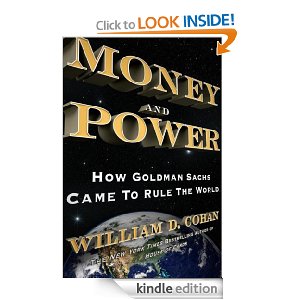
Book Review: Money and Power – How Goldman Sachs Came To Rule The World


The book cover – featuring a view of planet Earth presumably from a heavenly vantage point – offers the first hint that William D. Cohan’s plan here is not critical thinking but rather hyperbolic imagery.  Inside he writes a survey not of Goldman, Sachs & Co.’s overall history but rather of historical points selected for potential embarrassment to the firm.

As the consensus choice for the Wall Street firm that escaped the least scathed financially from the credit crunch, paradoxically, Goldman Sachs’ reputation became the most tarnished by its role throughout the 2007/2009 crisis and the years leading up to it.  After a calamity like the Great Credit Crunch, the general public and its commentators need a villain.  And it stands to reason, goes their thinking, that the Wall Street folks who broke even or came out ahead must have been the same ones who both caused the crisis and set themselves up ahead of time to benefit from it.

Cohan and his publisher clearly sought to benefit from this demand for a scapegoat.  Unfortunately Cohan seems determined to find a scapegoat more than he tries to put recent financial events into context that helps explain them.

If you’re looking to save time, skip to the final quarter of the book.  Cohan features Goldman’s mortgage department traders and some of their most successful trades in 2007 and 2008.  Cohan managed to get Josh Birnbaum, a key part of Goldman’s ‘Big Short’ trading team throughout 2007, to speak on the record and in depth about who did what, when, and to whom.  Now, it should be acknowledged here that Michael Lewis’ book about this period and the traders who got the The Big Short right is about five times more interesting than Money and Power, but crucially Lewis could not get Goldman’s employees to speak to him.  Lewis settled for a Deutche Bank trader and other more obscure hedge fund traders.  Cohan gets the journalistic prize of landing the insiders of Goldman, the firm that the public cares the most about.

The first three-quarters of Money and Power, however, did not need to be written, and certainly don’t have to be read.    The majority of Money and Power follows the rise and reign of Goldman’s leaders throughout its history.  He clearly interviewed a wide number of leaders and partners of the firm.  Less impressively, a majority of his chapters rely almost entirely on secondary sources such as earlier books, newspaper coverage of scandals, and feature pieces in industry magazines.  Lawsuits and SEC investigations provide the rare primary source document.

Cohan highlights a few gossipy items of interest, in particular clashes between the firm’s leaders throughout the years.  Given the recent collapse of MF Global, Jon Corzine’s massive risk appetite and his trading losses in 1994 seem particularly relevant.  Also relevant is Corzine’s long-time alliance with Chris Flowers, who installed him as head of MF Global, and earlier became an uncomfortable catalyst of conflict between Goldman’s leaders Corzine and Hank Paulson in the lead-up to the firm’s IPO in 1999.

Paulson clearly provided extraordinary access to Cohan and manages to come out looking the best among Goldman’s modern leaders, a trick Paulson also pulled off with journalist Andrew Ross Sorkin in Too Big to Fail.

If you need an illustration of how Cohan chose headlines over substance, look no further than his Prologue.

The Prologue describes in detail Senator Carl Levin’s (D-Michigan) cross-examination of executives in the Goldman mortgage department in front of his investigatory committee in 2010.  The hearing highlights Levin’s blustering unwillingness to listen to the testimony he’s asking for.  Levin repeatedly cuts off answers, refuses to acknowledge complexity, and grandstands for the cable news networks.

As Cohan tells it, Levin makes the point at the end of his Congressional cross-examination that as a lawyer, Levin knows not to represent both sides of a deal.  To do so, Levin lectures, would introduce undeniable conflicts of interest that would harm his client, his firm’s reputation, and the ethics of law practice.  Levin points out that as a broker working both sides of a CDO transaction, Goldman has badly served its clients and wrapped itself in a web rife with conflicts of interest.

It’s a fine-sounding point, and we can imagine a number of cable news hosts at the time pursing their lips in prim agreement with the venerable Senator’s analogy.

Levin clearly doesn’t get, however, or will not admit to getting, what a broker-dealer does all day.  By definition, a financial broker-client relationship is not an attorney-client relationship.  Attorneys always, or most properly, represent one side of a deal, but financial brokers do not.  There are almost always two sides to the client transaction, and the broker buys from one client and sells to the other client.  Cohan should know this, as does anyone who has ever worked in the securities business, but he doesn’t bother to point out the obvious flaw in Levin’s analogy.

Next Cohan describes the SEC actions against Goldman’s CDO structuring desk, built on the evidence of a pair of emails, one from a senior manager who describes relief at the end of a ‘a shitty deal’-  and the other in which a relatively junior CDO structurer worries to his girlfriend about the end of a financial window for selling his product.  The ‘smoking gun’ found by the SEC was only an empty water pistol, but that did not stop Cohan from describing the actions as if they are solid evidence of wrong-doing and moral breakdown.

Cohan concludes his Prologue with what’s meant to be a shocker about selling shares in Facebook in 2011.  For this, Cohan needs to be quoted in full:

“How could Goldman get comfortable, in January 2011, with offering its wealthy clients as much as $1.5 billion in illiquid stock of the privately held social-networking company Facebook – valued for the purpose at $50 billion – while at the same time telling them it might sell, or hedge, at any time its own $375 million stake without telling them that its own private-equity fund manager, Richard A. Friedman, had rejected the potential investment as too risky for the fund’s investors?”

Now here again, Cohan could prove that he knows how broker-dealers work – but he fails to give the obvious answers to his rhetorical question. First, the investment management arms of broker-dealers do not always, or even often, purchase the same investments as their clients.  Second, broker-dealers frequently have widely different valuations for assets than their clients.  Third, Goldman’s wealthy clients are allowed to, and often do, make purchases that differ, in important ways, from the purchases made by Richard A. Friedman for the firm.

I get the sense that Cohan did a Google search of Goldman just before sending his final book edits to his publisher in early 2011 and decided on one final zinger against the firm.  He should have restrained himself.  The Facebook example is the point where Cohan loses credibility as a financial journalist and becomes an author trying to capitalize on public anger by ignoring his own experience.  It’s too bad for Cohan that the point occurs in the Prologue.

How did Goldman Sachs come to “rule the world?”  It’s a great question, and a book that answered it would be a great book to read.  Unfortunately, Cohan provides almost no analysis to support his title.  Instead he presents Goldman’s history since at least 1929 as a series of scandals, bad behavior, and influence-peddling.

Is Goldman Sachs the real villain of the Credit Crunch?  Cohan effectively surveyed the popular mood and surfed the firm’s history for anecdotes to support this idea.  But there’s almost no comparative discussion in the book of Goldman’s role vs. the role of other Wall Street firms.  There’s also very little in the way of weighing evidence for Goldman’s centrality to the crisis vs. other important actors or explanations.  What we are left with instead is a survey of headlines throughout the firm’s history, and an unwillingness to explain what they mean.  The intelligent but non-insider audience will believe whatever they believed before picking up the book, and that’s a missed opportunity.

We need a book that leads the interested public through the complex issue of who is responsible for the Great Credit Crunch and the Great Recession, but Cohan’s Money and Power is not it.

Please see related post: All Bankers Anonymous Book Reviews in one place.


Post read (5030) times.

Life After Debt Part IV: Another Bizarro World Villain

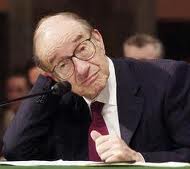
Continuing the theme of ironic historic statements in the light of present circumstances explored in Life After Debt Part I,[1] today’s bizarro world villain is Alan Greenspan.

No other financial celebrity (with the possible exception of Warren Buffet) carried more weight a decade ago than then-Federal Reserve Chairman Greenspan.  So when he said in 2001…

The most recent projections from OMB and CBO indicate that, if current policies remain in place, the total unified surplus will reach about $800 billion in fiscal year 2010, including an on-budget surplus of almost $500 billion. Moreover, the admittedly quite uncertain long-term budget exercises released by the CBO last October maintain an implicit on-budget surplus under baseline assumptions well past 2030… Indeed, in almost any credible baseline scenario, short of a major and prolonged economic contraction, the full benefits of debt reduction are now achieved well before the end of this decade — a prospect that did not seem reasonable only a year or even six months ago. Thus, the emerging key fiscal policy need is now to address the implications of maintaining surpluses beyond the point at which publicly held debt is effectively eliminated.[2]

… people listened.

And what they heard from Greenspan in 2001 was, “we deserve a tax break” given the impending massive federal surpluses.  Greenspan further went on to warn us of the problems of investing the federal surplus, just as the economists at Treasury had worried about in the ‘Life After Debt’ memo.

When I read this, even eleven years later, my face tightens up and my lips curl outward and my stomach gathers into a little tiny ball and I just start spitting f-bombs at Greenspan’s image on the computer screen.  The way he used his financial celebrity and political capital in 2001 drives me bonkers.

Now, I know the world is too complicated to blame all of our problems on the heads of a few individuals or institutions, and especially on the head of one person.  But, if I was forced to name the biggest enabler of our country’s shift in the past decade from surplus to deficit, from creditor to debtor, from strength to weakness, from leader to follower, I’d pick that guy.

If only he’d used his powers for good instead of evil.


[1] Also, please read related posts Life After Debt Part II and Life After Debt Part III

[2] If Greenspan’s bureaucraticoeconomicspeak needs translation, he’s saying something like: “The government’s statistics office says we’ll have a federal surplus by 2010, which will continue to grow, under reasonable assumptions, through 2030.  We just realized this 6 months ago.  Now the big issue to worry about is what to do with our surpluses.”

Post read (1426) times.

Interview Part I: Greek Businessman on the Government’s Bloat, and A Solution

Please click above to listen to full interview.

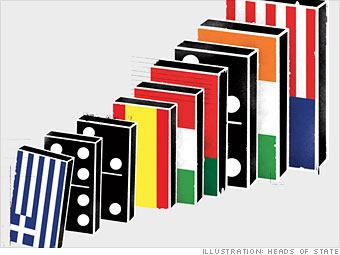
Part I – This conversation is not with a banker in recovery, but rather an old friend of mine named Mihalis who comes from a prominent Greek family.  Greek finance is the tail currently wagging the European dog, and Mihalis is one of the most insightful people I know.  I figured he could explain what’s going on.  I started by asking him about recent Greek Parliamentary elections.

Mihalis: Maybe it’s my personal bias but you know Parliament the way it works it’s really like the HR department of Greece Incorporated.

Mike: The HR department employs as many people as possible?

Mihalis: Yes, its votes in exchange for jobs and that’s the root of the problem.

Mike: you are saying the Greek Parliament is an HR system essentially for the country.

Mihalis: Yeah the whole public finance was used to give salaries to people.  If you looked at the workforce of Greece, basically you have 1 million employees directly or indirectly dependent on the state. You have 1 million self-employed people and 1 million people who work in companies as employees.  In Greece you have about 800,000 companies, so the average FTE – you know full-time equivalent – is something like 2 1/2. In Europe or America that’s like 100.

So essentially out of these 3 million you now about 1 million unemployed.  So the situation is really, really bad.

MIHALIS BEGAN TO EXPLAIN TO ME THE CORRUPTION AND BLOAT OF THE GREEK GOVERNMENT, AND THE  UNHOLY ALLIANCE BETWEEN POLITICIANS AND THEIR BANKING ENABLERS, AND THE CAPTURE OF THE POLITICAL SYSTEM BY BANKERS.

Mihalis: Half of the people… You know, you walk into a government building and you see half of the officials, they are honest people, they would like to work, they have some ideals they have some skills. But, they are completely demoralized, by the other half, which are jaded lazy, they bought their position because of a vote, and they pollute the whole system.  So, you can’t easily distinguish the two, so you’ve got to let a little bit of the forces to weed out the good from the bad.  And the only way to do that is to reset it.  They been trying to cut down the state, no one has really wanted to do it so they haven’t succeeded.  All they did was to displease the people.  Because they lowered their salaries, they’ve cut their benefits.  They started saving, doing a little bit more oversight on things. But all they’ve ended up doing is creating an even higher resistance to change.

Mihalis: The voters suddenly said well…So long.  We’re not going to vote for you anymore.  We’re going to vote for somebody who promises us even more jobs. The guy promised 100,000 more jobs after the election if he wins the election.  Crazy.  Right now the Greek government could function with 100,000 people. And it has 800,000 people.

In many ways, you know you have a few bankers, mostly of Greek origin, in the Greek desks of the big banks in Europe, maybe about 100 people, and they were just lending money to corrupt politicians. For nothing, just to cover up the problems of every year’s budget.  And this happened for like 15 years in a row at least. And then you had a collusion, with the politicians that want to appear you know with numbers that are smooth, attractive, and you start lying with statistics and blah blah blah and again Greece in the periphery was not a problem to worry about it was too small.  And that’s a recipe for disaster.

It’s a matter of popularity yes, in order to be a politician you need to be popular.  To be a good politician you need to actually make some wise decisions.  The problem is today politicians are neither wise nor make decisions.  They’re sort of dragged along by bankers.  The banking system is the backbone of the world, and they’re driving political decisions today. And it’s sort of putting the carriage before the horse, in many ways.

Mike: as an ex-banker myself I always, well, one main motto “Follow the money.”  Or if you’re wondering why the politicians are doing certain things, it’s generally wise to figure out what are the bankers asking them to do. It’s a good rule to follow. Wondering why people are acting like they’re acting, I find.

I ENJOYED HEARING MIHALIS, WHO I KNEW TO BE A PROGRESSIVE, LEFT-OF-CENTER GUY, SOUND LIKE WHAT WOULD BE IN THE AMERICAN CONTEXT A TEA-PARTY TYPE APPROACH –  RADICALLY SHRINKING WASTEFUL GOVERNMENT TO ONE EIGHTH OF ITS CURRENT SIZE.  I WANTED TO CHECK WHETHER HE HELD SIMILARLY RADICAL VIEWS ON THE IMPORTANCE OF ENTREPRENEURSHIP AND SMALL BUSINESS AND GETTING THE GOVERNMENT OUT OF THE WAY OF THE ENTREPRENEURIAL SPIRIT TO REVIVE THE GREEK ECONOMY.  IT TURNS OUT, IN A STRONG SENSE HE DOES.

Mihalis: You know, the Greek are realists.  With a built-in distrust for the state. Because the state treats you as a liar and as a thief and you treat the state back the same respect. You know I don’t respect you. I don’t expect that you give, that you will protect my wealth. I actually expect that you will take away my wealth because in Greece since the 1980s the whole notion of entrepreneurship has been demonized and we haven’t reached the point yet where we de-penalize entrepreneurs.

Mihalis: There was a model in the 1960s of entrepreneurs that were [taking advantage] of the laborers, and taking the money out, and not paying taxes. There were a few examples like this but they were ruined. This became one of the popular themes of the Socialist government that we don’t like business people, we don’t like capitalists. Because they keep all the wealth for themselves and keep everyone else unwealthy.  Again that was an abuse, that was Greek hyperbole. Deep down if you don’t have entrepreneurs you cannot have growth. And that has been part of the stifling of the Greek economy. Rather than boosting or helping entrepreneurs, it’s always there fighting against them. So you have then entrepreneurs fighting back. Evading taxes, trying to find any kind of way to protect themselves.

Because they know sooner or later that the state is going to go against them. Because it’s a small market as well, the scale is so small.  In the US if you’re an entrepreneur you have such a big market.  You don’t have to fight over the stakes.  Fighting is fierce when the stakes are low.  You fight over nonsense because there’s little to go around.

And we’re talking about the key problem.  Let the economy run. The Greeks can do very well in a very, very chaotic environment.  They don’t need a society. They don’t need the comfort of the state like the Germans do, or the Chinese do.  Greeks can survive no matter what. All you need to do is get the big state out of the way.  Because the Greeks were like, they chose the easy way.  The easy way which is o, the state can feed me and I can give my vote to it. And everything can’t be fine. But this doesn’t work and somebody has to publicly say that the people.  And if the money flow has to stop, it has to stop.

TO MY TEA PARTY FRIENDS WHO THINK AMERICAN FREEDOM UNIQUELY SUPPORTS AMERICAN ENTREPRENEURSHIP, MIHALIS SEES THAT GREEK ENTREPRENEURS HAVE A SIMILAR CULTURAL CALLING.

Mihalis: It’s a byproduct.  Freedom was born in Greece.  Greeks are free and I think that’s a byproduct.

MIHALIS AND I SPOKE EXTENSIVELY AFTER THIS ABOUT HIS OTHER SOLUTIONS TO THE GREEK CRISIS, EUROPEAN INTEGRATION, AS WELL AS THE ROLE HIS FATHER CURRENTLY PLAYS ON THE NATIONAL POLITICAL SCENE IN GREECE.  I’LL LEAVE THOSE FOR A FOLLOWUP PODCAST IN PART II.  IN THE MEANTIME, MIHALIS WOULD NOT LET ME PAINT HIM AS A RADICAL RIGHT WING GUY IN THE TEA PARTY MODE.

Mihalis: I mean you’re talking about an abuse of things. There’s been an abuse of the state.  Of the welfare state.  I’m definitely pro-welfare state, because I feel that the world is not perfect. The right wing guys are privileged, strong, they never had to suffer, and that’s why they see the world in their own eyes.  And the world is not like that. You need a welfare state.

There are ways and ways of funding it. In the Greek case it’s been abused.

In PART II of this conversation, Mihalis discusses further European integration, and his father’s role in Greek politics today.


Post read (2062) times.

UK’s FSA Gets It, Barclays Traders Did Not

It’s easy to pick on government regulators for not ‘getting it’ when it comes to finance, but I’m pleased to read the UK’s FSA report on Barclays’ actions and punishment related to LIBOR rigging.  The FSA gets it.

The traders, on the other hand, do not get it, which is hard to fathom.  Everybody I ever worked with on the trading floor knew different types of communication lend themselves to certain media.

A few select passages from the FSA report on electronic messages by Barclays traders:

“If you breathe a word of this I’m not telling you anything else”

“If you know how to keep a secret I’ll bring you in on it”

“We need a really low 3m[1] fix, it could potentially cost a fortune. Would really appreciate any help.”

Did nobody teach these guys?  Manipulation of this sort never gets written down.  Insidery gossip over the phone must be spoken in code.  If the information is particularly juicy, make the call on a personal cell, as all firm phone lines are taped.  This was very sloppy work by the Barclays guys.


[1] 3month LIBOR

Post read (4419) times.