What Is LIBOR Rigging? Why Should You Care?

What is LIBOR Rigging? 

LIBOR, which stands for London Interbank Offered Rate, is defined as the average benchmark interest rate at which the world’s 16 most important money-center banks willingly lend money to one other for a period of time, with the most frequently quoted time periods being 1 day, 1 month, 3months, or 6 months.  The British Bankers Association[1] determines LIBOR daily (and this is important for understanding the rigging process engaged in by Barclays traders) by surveying the Treasury departments of the world’s biggest banks about what rate they pay to borrow money from other banks, and then by taking an average of their answers.

LIBOR is the most important financial benchmark interest rate for trillions of dollars in lending.  While the US Federal Reserve sets an individual benchmark interest rate in the US through overnight lending to US Banks, the Fed cannot determine at what rate most of the world’s banks and largest companies lend to one another.  LIBOR sets the standard rate for that type of interbank lending, as well as the standard rates for swaps trading.    It’s a mostly invisible (to the average citizen) piece of financial architecture underlying, frankly, almost every major lending transaction in the world.  If you can effectively manipulate LIBOR, you can end up shifting billions of dollars from one bank to the other.[2]

Barclays got fined for evidence of LIBOR-rigging in the 2005 to 2007 time period, when the bank evidently submitted lower interest rate quotes than other surveyed banks.

Barclays paid their $453 million fine based on electronic message records evidence[3] that its Treasury officials cooperated with its trading desk in reporting a LIBOR rate lower than its actually borrowing rates between it and other banks.  While we do not know precisely the reason Barclay’s Treasury department cooperated in a scheme to report artificially lower borrowing rates to its trading department, the obvious presumption is that somebody’s profit and loss in the trading department was extremely vulnerable to a rise in LIBOR rates.  Trading desks with LIBOR-dependent positions could be caught wrong-footed in a fast-moving interest rate environment, and a little help in keeping LIBOR nice and low at a certain level for a certain amount of time until the desk could unwind its position could have meant saving someone’s career or annual bonus.[4]

LIBOR’s survey and averaging method for determining rates is meant to avoid rate-rigging like this.  The only way in which Barclay’s cheating could work systematically would be if the trading desk had access to people willing to cheat at other major banks.  Therefore the interesting question of the Barclays situation is if regulators can find evidence of widespread cooperation from other banks’ Treasury departments, which of course regulators are trying to do, with investigations ongoing at a dozen of the world’s largest banks.

In the larger sense LIBOR represented, up until recently, a successful self-regulating mechanism between banks.  Self-regulation only works if participants as well as regulators feel comfortable that the system works as advertised and cannot be captured by cheaters.

What’s really interesting and ironic about the Barclays situation is that by the time the Credit Crunch of 2008 got fully underway, Barclays reported higher rates than its peers, in what’s assumed to be an honest reflection of its actual borrowing costs, which should have been lower on average than its peers because of its relatively strong financial condition.  In other words, the other 15 LIBOR survey banks, on average, lied to appear more credit worthy than they really were.

In fact, Barclay’s head Bob Diamond complained in 2008 to the Bank of England that its competitors appeared to be reporting artificially low borrowing rates, which they likely would have done to mask the fact that they were having financial difficulties in borrowing from fellow banks.  A number of commentators pointed out (e.g. here  here and here) at the time that LIBOR had ceased working in 2008 as a reliable benchmark.  Barclays was one of the good guys at the time, while shakier banks ceased cooperating appropriately, ie. telling the truth.

Barclays’ outlier status in reporting higher than average rates attracted attention from Paul Tucker, a Bank of England official[5], who suggested directly to Bob Diamond’s deputy Jerry del Missier that the Bank of England would appreciate lower reported borrowing rates from Barclays.  Lower rates, presumably, would help signal financial calm, as well as keep costs low for financial institutions, during a time of crisis.

The problem with a nudge like that is that manipulation from the Bank of England is just like trading desk manipulation, and it undermines the financial architecture in just the same way.

Again I’m speculating a bit, but Diamond appears to have made sure that particular Bank of England nudge got released to the press in advance of his fall last week, possibly in a misguided attempt to show UK regulators that they were the ones complicit in the breakdown of LIBOR during the 2008 time period, not Barclays.  Regulators and central bank officials do not appreciate being exposed as manipulative liars, so expect the blame-Bob-Diamond excitement to get full-throated support from a number of UK central bank and regulator sources.

Market participants have long known that LIBOR manipulation was rampant in the lead-up and during the Credit Crunch of 2008.  Central bankers also knew.  The self-regulating process of LIBOR, indeed the entire money market system, ceased working in 2008.  One Federal Reserve friend of mine told me in late 2008 that the interbank borrowing market (of which LIBOR is a major part) was completely frozen, and that in the US, only the dramatic intervention of the Federal Reserve[6] kept up the illusion at that time that money could properly flow between financial institutions.

Only central bankers could keep the system afloat.  Some of this intervention, we sort of know from the Bob Diamond strategic release, took the form of subtly encouraging banks to lie on their LIBOR surveys.  Other interventions came in more straightforward ways such as the unprecedented financing by the Federal Reserve of dodgy collateral. [7]

What I mean by this last point is that the central banks and regulators of the US and the UK grossly manipulated money markets regularly to hide the true financial weakness of a number of financial institutions.  Bank of America and Citigroup, to take two easy examples, should have disappeared long ago if not for the money market sleight-of-hand via:

1. The Federal Reserve providing unlimited and nearly free funding to Too Big To Fail Banks.  This it continues to do.

2. Treasury providing equity capital unavailable from the market.  This has now been paid back by Citigroup and Bank of America, but they were the last ones to do so, of  the big US Banks.

3. Frequent waivers and special treatment in the past 4 years on unmet reserve requirements.

Why do I care when this happens?  I care because tens of thousands of private individuals reap the benefits of this thumb on the scale by regulators, while the public at large remained on the hook for the liabilities.  Just as a LIBOR manipulation shifts the economics of a swap from one counterparty to another, bank bailouts shift the economics of the banking sector from a one group of losers to another group of winners, and not necessarily in a fair or transparent way.

I really do not know what to make of the “LIBOR scandal,” except that I’m torn in a few directions.

On the one hand, clearly, lying and cheating on a key market survey is bad.  Especially by traders who need a lie to fix their Profit & Loss statements and save their bonus.  Barclays got punished, and their CEO resigned, as is just.

On the other hand, the hand-wringing and heavy sighing from regulators and commentators over the ‘Barclays LIBOR scandal’ misses the big picture about all the folks who manipulated money markets in the Credit Crunch of 2008, and when, and why.  When traders distort money markets, that’s manipulation.  When regulators and central banks distort money markets to pick winners and losers, that’s just good policy?  I don’t know.  It’s not so clear to me.


[1] This is a self-regulating trade association representing approximately 250 of the world’s largest banks.  It is most famous for organizing LIBOR, in cooperation with media company Thompson Reuters, but it also advocates on policy issues on behalf of its member banks.

[2] I’m sticking an example of why this is so in the footnotes as it can get a bit technical.  LIBOR gets quoted in % terms as an interest rate.  A simple interest rate swap could go as follows:  For a period of 10 years, Counterparty A agrees to pay Counterparty B a fixed rate of 3.25% of $1Billion, in exchange for Counterparty B agreeing to pay a variable rate of 6month LIBOR +0.25% (in my example, to keep the math simple, I’ll quote 6month LIBOR at 3% to start).  At the outset of the trade, each counterpart owes each other $3.25 million per year, so the trade is done ‘at the market.’  Over time, A will always owe $3.25MM per year, but B’s payment amount resets every 6 months, as 6month LIBOR will change over the course of 10 years.  Market conditions will ordinarily shift 6 month LIBOR over time, which makes the trade economically favorable for A or B over time.  If at some point, through manipulation, 6month LIBOR could be artificially lowered by, say, 0.05% for a year, then B would owe $500,000 less in that year.  When you consider the $ Trillions in notional interbank lending and derivatives trading, it’s clearer how small changes in LIBOR drastically alter the economics of trades for counterparts.  Market participants only agree to use a benchmark interest rate like LIBOR if they believe it is not open to systemic manipulation.

[3] Traders, seriously, why are you writing this down?  The first thing you’re taught in week one of trading class is to write down nothing of consequence.

[4] A typical trading desk could have hundreds, or in the case of a major broker-dealer like Barclays, thousands of LIBOR-dependent swap/derivative positions at any one time, many of which will be off-setting one another.  I’m in the realm of speculation now, but a trading desk with heavy exposure to a particular LIBOR reading (one that would involve asking for a little cheating help from one’s own Treasury dept) probably is not looking for a long period of market manipulation, but rather just a short-term fix until risk can be reduced, or an offsetting swap trade can be put on the books.  If Barclays’ trading desk felt overexposed by a lumpy $10 Billion trade and could get an improvement of just 0.01% in the LIBOR rate from its Treasury dept, that’s a million dollars saved right there.

[5] Up until recently thought to be next in line as the Head of the Bank of England

[6] in ways largely hidden from view

[7] As in the case of the Bear Stearns shotgun marriage to JP Morgan, the AIG bailout, and the Merrill Lynch shotgun marriage to Bank of America.  The Federal Reserve and the US Treasury took on extraordinary risk on behalf of the currency and US Taxpayer respectively in order to keep up an artificial illusion of bank financial health, similar to the LIBOR manipulation by the Bank of England.  When these financial institutions, surviving under essentially false pretenses, paid bonuses to their employees, no central bankers or regulator intervened.  I find this behavior unforgiveable.

Post read (18445) times.
Diamond Out. AKA Blaming the Wrong Guy Again

We here at Bankers Anonymous love ex-bankers[1] so it makes sense to throw our two cents in to the discussion on the departure of Bob Diamond from the head of Barclays PLC this week.

Journalists love to attach the word “scandal” to his departure, and indeed Barclays got hit last week by a combined $453 million fine from US & UK authorities for LIBOR rigging.  At the risk of alienating both my financial and non-financial readers, LIBOR rigging deserves some explanation, which I will do in the next post.  But first, Bob Diamond actually deserves an honorary slow clap as he exits the building.

A few points in his favor:

Diamond spends this week being grilled by members of the UK parliament, in a mock trial similar to our own Congress’ recent treatment of Jamie Dimon, except with more paddle than flatter.[2]  The parallels to Jamie Dimon include both of their relative successes as risk managers and opportunists throughout the 2008 debacle. [3]  In fact, Diamond should be remembered as one of the few prudent banking heads of the 2008 Credit Crunch.  To paraphrase Kipling’s If Poem, Diamond kept his head when all the other banking heads were losing theirs in the Fall of 2008.  He managed to acquire Lehman’s North American business for $1.75 Billion, which given Lehman’s control of $639 Billion in assets, meant Diamond’s Barclays bought one of the most valuable banking assets in the world, essentially for free.  Not a bad trick.

Second, Diamond gets grilled this week by UK parliamentarians and regulators extra hard for the sin of being a US citizen.[4]  Barclays’ relative success through the crisis, and its grafting of the Lehman franchise to an old-line UK banking franchise has made him in the UK a convenient short-hand for criticizing perceived American cultural traits and their inappropriateness in the UK financial context.[5]  Just as there’s an underlying anti-Semitism to some of the populist element hatred for Goldman Sachs,[6] there’s an underlying anti-Americanism to the piling on of Diamond’s leadership at Barclays.

Third, to extend both the Jamie Dimon and Goldman comparisons, the shadenfreude at Diamond’s fall represents the kind of ‘blame the winner’ mentality which muddles the narrative on the Credit Crunch.  Dimon’s JP Morgan, Blankfein’s Goldman, and Diamond’s Barclays are virtually the only success stories of major bank heads navigating the Credit Crunch.  Barclays did not need, nor did it receive, a bailout from the UK government, or the US government.  This is incredible, and you can’t say that about any other of the other major world banks in 2008.

Yes, it’s true that all major financial institutions benefitted from the explicit and implicit guarantees and bailouts handed out willy-nilly during the height of the crisis.  But Barclays did better than anyone.  Anyone!  And yes, you can’t say that Diamond deserves all the credit for this prudent risk management. But we should acknowledge the relatively outstanding performance if we want to go beyond the simple narrative of “Bankers = Bad.“

Political leaders enjoy giving current bankers the woodshed treatment because it’s more riveting than chastising unemployed super-wealthy, golden parachuted ex-CEOs.  But seriously, what about the ones who actually screwed up their banks and still got paid?  They’re the ones more deserving of public shaming.[7]

Speaking of getting paid for terrible performance, another point in Diamond’s favor is the fact that he and two deputies had already agreed to forgo their bonuses in 2012 as the LIBOR scandal hit the news, a symbolic gesture which has rarely been matched by other banking heads in the US.  I’m confident Diamond will not suffer overly much from this loss of income, but I admire the voluntary approach and wish more executives would take a similar approach when their firms suffer losses or scandals.

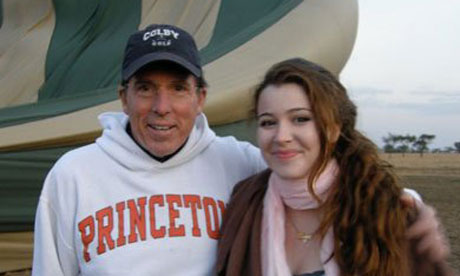
Finally, let’s a raise a toast to Bob Diamond’s newly famous daughter Nell, pictured with her dad at the top of this post, as a result of her politically incorrect tweets, and retweeting other people’s attacks on her dad, on her twitter feed.  She was mentioned in this book (page 363) when she was a sophomore at Princeton, urging her dad to try to purchase Lehman Brothers out of bankruptcy.  She graduated from Princeton in 2011, which is as good an excuse as I can come up with for linking to this awesome must-see video by a recently graduated Princeton woman.


[1] Bob, hit me up with a DM, let’s do a podcast…

[2] That “more paddle than flatter” phrase makes more sense if you read the previous Dimon post, which you should do right now.

[3]Also, even their names are pronounced similarly!  What’s up with that?

[4] Which, just after July 4th makes me need to watch this video:  America! F Yeah!

[5] The British are more subtle than us Yanks.  An MP named Teresa Pearce tweeted her views of his American-ness in the following way: “Really annoying that Mr Diamond is using our first names. so rude.”  Way to stick it to the Colonies, Teresa!

[6] I mean in particular the famous Matt Taibbi description of Goldman Sachs as the “great vampire squid wrapped around the face of humanity, relentlessly jamming its blood funnel into anything that smells like money.”  It’s hard to escape the suspicion that the blood sucking image taps into an underlying mistrust of Jews.

[7] I named all these in an earlier post, but they deserve all the rotten tomatoes we can muster: Ken Lewis at Bank of America, Sandy Weill and Vikram Pandit at Citigroup, Stanley O’Neal at Merrill Lynch, Franklin Raines at Fannie Mae, Joe Cassano at AIG, and Angelo Mozilo at Countrywide

Post read (3125) times.

Life After Debt Part III – Check out the “Where Are They Now?” File

After discussing in Part I the Bizarro World of government debt and the Part II Weapons of Mass Financial Destruction, in Part III we check in on the people currently residing in the “Where Are They Now” file.

One through-the-looking glass aspect of the never-published ‘Life After Debt’ Treasury Memo is the cast of Treasury department characters copied on it and expected to weigh in on the impending problem of Treasury surplus.  The key players today have really not changed since the end of the Clinton administration.  To wit:

Larry Summers – Was Secretary of the Treasury under Clinton in 2000.  Most recently served as and then stepped down from the post of White House Director of the National Economic Council under President Obama.

Doug Elmendorf – Was Deputy Assistant Secretary for Economic Policy under Clinton in 2000.  Currently head of the Congressional Budget Office during the Obama administration, the non-partisan office responsible for producing all Federal fiscal and financial projections, upon which deficit and budget planning is made.

Gary Gensler – Was Undersecretary for Domestic Finance in the Clinton administration in 2000.  Currently the Chair of the Commodities Futures Trading Commission (CFTC) the primary regulator of commodities trading.  (The same CFTC that recently slapped Barclays with $200 million worth of the total $453 million fine for Libor rigging)

Lee Sachs – Was Assistant Secretary to the Treasury for Financial Markets.  Counselor to Treasury Secretary Geithner in 2009 and 2010, now resigned from that post.

Martin N. Baily – Now is a Senior Fellow at the Brookings Institute, and author with Doug Elmendorf of an explanation of the 2008 credit crunch titled “The Great Credit Squeeze.”

What does it mean that the same team under Clinton immediately went to work for the Obama administration?

On the one hand we can take comfort in the idea of expertise and experience in wielding economic power, influence, and decision making.  Twelve years after serving under Clinton, the band is largely back together and continuing to guide the economic ship.  This is not surprising and in fact has been a hallmark of Obama’s economic and financial policy.  While he occasionally nods to his base with a reference to greedy bankers or sympathizes with the concerns of ‘Occupy Wall Street,’ Obama’s actions — caution and continuity with both the Clinton and the W. Bush administrations — speak loudest.

On the other hand, I get the awful feeling, and I’m not the only one, that keeping intact the same team from twelve years ago almost ensures that we will not get a critical review or substantive critique of what went on before.

Let’s be real here: From the surpluses predicted as far as the eye can see in 2000, to the deficits as far as the eye can see in 2011, big fiscal mistakes have been made.  Financial opportunities were blown.  Debts have ballooned for which future generations will be paying taxes.  Very few of us actually made those decisions that led to the national debts.  This happened under Clinton, W. Bush, and Obama.  Changing an administration periodically offers our system a chance to respond to mistakes, to reach new conclusions based on new data.  But if you bring substantially the same people back, you might not only make the same mistakes, you’ll likely get a high degree of ass-covering that impedes progress.

Summers gets blamed publically, probably rightly, for making too many choices to protect his legacy of economic leadership.  But it is worth noting that the ‘Where are they now” file is full of the same people now in the Obama White House with their fingerprints on this Clinton era Treasury memo.

The memo offers a pointed reminder that we almost had it made in 2000 but circumstances, and yes, people, failed to protect our national credit.  But since we’ve got the same people still in charge, can we expect better decisions and better results in the future?


See Next Post “Life After Debt IV: Another Bizarro World Villain

Post read (1342) times.

Life After Debt, Part II – Weapons Of Mass Destruction

In Part I, I discussed an internal Clinton-era memo in which US Treasury department officials considered the consequences of paying off our national debt, by 2012.

The most frightening ironies of the ‘Life After Debt’ memo are the alternative vehicles the author proposed to replace US Treasuries.

As a finance professional, reading the memo carefully, I almost chocked on my morning coffee at the proposals coming from the bowels of Treasury.  It was like reading a 1930s memo proposing the invention of a nuclear bomb, as that would ensure the end of all future wars.

First, the author considers FNMA and FHLMC (more commonly known as Fannie Mae and Freddie Mac) agency debt as securities for the conduct of monetary policy instead of US Treasury debt.  Since the companies were AAA-rated, fast-growing and as rock-solid as the US housing market (!), this was not an entirely crazy idea at the end of 2000.  Obviously, with the receivership of Fannie Mae and Freddie Mac in 2008, we know in hindsight that a Federal Reserve balance sheet filled with agency debt would have meant a complete catastrophe wrapped in a shit sandwich.  Although it had become an increasingly important staple of Wall Street bond issuance for the prior decade, agency debt from Fannie and Freddie became deeply distressed in the Summer of 2008, and would have ripped a limitless black hole in the Federal Reserve balance sheet.  Needless to say it’s a good thing that did not happen.

But the second suggested vehicle for absorbing impending federal surpluses is the real problem.  The author introduces “[N]ew, very low-risk securities constructed from a pool of private debt securities.”

Knowing what we know now, we should be thankful this idea never took off.  I’ll quote the memo for a fuller description and then explain what the author was getting at:

 Such securities would be packaged in a way similar to mortgage-based securities currently issued by Government Sponsored Enterprises like Freddie Mac and Fannie Mae, but would not be as liquidity constrained and would be better diversified against certain market risks.  To package the new instrument, a financial institution could buy a set of high-quality corporate bonds.  It would then offer to sell a coupon bond called the Triple-A Plus bond that pays a fixed annual interest rate for the life of the bond.  The Triple-A Plus Fund would put up its equity capital and take on the default risk of the underlying corporate bonds.  Although not completely risk-free, bonds like the Triple-A Plus bond would entail very little credit risk and would be close substitutes for Treasury securities.  With the advent of such an instrument, liquid and transparent markets should develop, given the value of just such a low-risk security to both private markets and the Fed.

Now, I take great interest in the author’s plan, because it is both prescient, up-to-date for its time, and in hindsight, incredibly stupid.  This theoretical super AAA bond was in the process of being perfected by Wall Street at the time of his writing.  It would have been constructed by pooling a diversified portfolio of high quality corporate bonds, and then offering a fixed rate to the holder who takes on the very-low probability of default.  My sense is the author must have heard of this financial innovation through a conversation with Wall Street structuring professionals, and he then attempted to apply it to solving the problem of what instrument the Fed could use for investments instead of US Treasurys.


The author is right that there was no liquidity constraint on this type of instrument, which is another way of saying, Wall Street could make in infinite amount of it.  The author also correctly notes that “the value of such a low-risk[1] security to both private markets and the Fed” would lead to the creation of extraordinary amounts of this debt instrument.  Finally, and most importantly, the author was also right that the assets were “not completely risk-free,” although plenty of quantitatively sophistical investors believed them to be risk-free up until the period of 2007 and 2008, when they were shown to be financial “weapons of mass destruction.”  The “Super-senior” AAA CDO, comprised of a portfolio of low-risk corporate bonds, was a particular innovation of Goldman Sachs’ mortgage desk where I worked in the years following this memo.


AIG Financial Products (AIG FP) considered the “Super-senior AAA CDO assets riskless, and the income derived from it to be free money.  It was precisely these instruments, described by the author at the Treasury department, perfected in the following years by Goldman Sachs to the specifications of its client AIG FP, that sent AIG into government receivership in 2008.  We can be thankful again that the Federal Reserve didn’t buy these products from Wall Street, as attractive as they sounded in the memo.


Up Next: Life After Debt Part III – Check out the “Where Are They Now?” file


[1] !!!!

Post read (2312) times.

Life After Debt, Part I – Bizarro World Debt Crisis

Join me, if you will, in examining a time capsule from November 2000.  A junior economist, burrowed deep in the cubicles of the US Treasury Department, wrote a never-published memo to his bosses about a major problem facing the financial markets titled, ‘Life After Debt.’  How would markets react to the imminent pay down of all our Treasury debt?  Projections at the time showed the stock of US Treasury bonds would be completely paid off by 2012.[1]

Meaning, no more government debt.  Federal government debt, totally paid off.

Produced in the final weeks of the Clinton administration, the paper never got published.  No problem a little more than a decade later, as we know, since this alternative reality never came true.  Not even close.

National Public Radio’s Planet Money Program made the unpublished memo available a while ago, but it deserves further study.  To read it today opens up the Bizarro World of US national debt, a world a decade ago when our biggest problem seemed to be the issue of disappearing federal deficits and the problem of parking future federal surpluses.  Our US Treasury officials lay awake wondering at night – how will we ever invest our untold billions of surplus future tax receipts?  How can we avoid dismantling Wall Street’s bond market infrastructure?  How can we not crowd out private investments with excess government surpluses?

This is Bizarro World indeed, given the downgrade of United States sovereign debt risk by S&P, the seeming impossibility of producing an annual balanced budget, and the ever-increasing load of national debt.

If September 11, 2001 marked a new era in the United States’ relationship with national security and existential threats, the end of 2000 marked a turning point in our relationship with fiscal responsibility.  Concerns before then strike us now as oddly naïve, as if from a different generation from our own, despite their proximity to today.  Reading this memo with our present day lens is funny, but not in the ‘ha-ha’ way.  More like the laugh-instead-of-crying kind of way.

The Treasury department author worried about three negative consequences of buying back all US Treasuries, specifically the elimination of

a) A risk-free benchmark for pricing risky assets,

b) A fully articulated yield curve for market signaling, and

c) A key instrument of the Federal Reserve for conducting Monetary Policy

As a bond guy by training I will acknowledge that US Treasuries fulfill these roles very nicely, and the author conscientiously consids how to address changes over time in these three key areas.  Markets would indeed have to adjust to a new regime if US Treasuries slowly disappeared.  I can’t fault the economist for considering the important consequences of such a big changes in US markets.

In addition, as you read the memo carefully and the side notes by the author and editor, you see that they understood that overall reducing or eliminating the Federal Debt was a good thing, but that the risks and costs of doing so should be anticipated, understood, and debated.  This understanding works fine as a theoretical exercise deep in the heart of the Treasury Department cubicles.  But one does get the decidedly uncomfortable feeling that concern for structurally important institutions such as US Treasury dealers and bond investors would take precedence over the general welfare improvement inherent in paying down indebtedness.  This preference isn’t spelled out, but it is implicit.

I do not mean to imply the author is complicit in defending Wall Street bond dealers and their investors, per se.  But I do read the memo and want to violently reach back in time and throttle anyone who gave up our best, once-in-a-generation opportunity, at national solvency.  We seem so far from it now that the detached consideration of the ‘pros and cons’ of paying off the national debt reads as cruel historic irony.

As a country we’re the Megaball Multi-State winner from 2000 who, ten years later, declared bankruptcy.  We took the lump sum lottery that we won and blew it on a speculative Las Vegas condo investment, flashy speedboats, and a few too many wars of choice in the Middle East.

Instead of building national wealth, we now we have deficits as far as the eye can see, to pay off the wars, as well as social safety net programs that are, demographically speaking, unsustainable.

But I digress.  It’s worth reading the memo to check out the choices under consideration in 2000 for parking our impending windfall of federal surpluses.  The details are funny, but again, not in the ha-ha way.


Up Next…Part II – Weapons of Financial Mass Destruction


[1] Back in 2000, I fully expected to be writing this blog in 2012 from my hovercraft.  Life is cruel sometimes.

Post read (6029) times.

Now, Alanis, For Something Really Ironic

There’s comedy, there’s high comedy, and then there’s Wall Street Journal Op-Eds.  Phil Purcell writes this morning about the opportunity to cure “Too Big To Fail.”  He urges shareholders to split our mega-banks into smaller, more manageable entities.

Since I happen to agree strongly with that goal, I naturally sat up straighter at the breakfast table, ignored the screaming two-year-old[1] and gripped my cereal spoon a little tighter, all the better to pay attention to Purcell’s piece.

But Purcell crusades Wall Street Journal style, so I should have been prepared for his giant helping of unreflective Jell-O.  He served up a plate of 1950s thoughts, masquerading as a new idea.[2]

Ah, where to begin?  Let’s start with the fact that Purcell himself created one of the Too Big To Fail behemoths, leading Dean Witter’s acquisition of Morgan Stanley in 1997.  He then headed the combined firm before being pushed out in 2005.  All the ‘synergies,’ all the ‘costs savings,’ all the ‘shareholder value’ he made happen with that exciting merger?  He’s awfully quiet about that now.  I’m not saying he’s apologetic, as he mostly certainly is not.  Just quiet.

At the point in his Op-Ed where he notes that Morgan Stanley Dean Witter had to be bailed out by taxpayers in 2008, Purcell ought to contritely note his part in the creation of a massive Too Big To Fail bank.[3]  But he’s not about to apologize for the unholy mess that he engineered, to his personal benefit, capped off at the end by a $113.7 million[4] exit package.[5]  The fact that he brought a perfectly nice retail brokerage (Dean Witter) under the same roof as an M&A and trading powerhouse (Morgan Stanley) resulted in an opportunity for private gain for him by the time he left in 2005, and public liabilities for us taxpayers in 2008, just three years later.  But that’s not his concern, and that obviously goes unmentioned.

What he is very concerned with, however, is shareholder value.  Purcell rightly points out that investors discount the share prices of firms that could not survive the 2008 crisis without a taxpayer bailout.  Shareholder value, I agree, is a worthwhile concern.  Not the primary concern when it comes to TBTF, but still, a valid concern.

Purcell proposes that shareholders advocate a break-up of the giant banks.  Nevermind the fact that shareholders have close to zero effectiveness [6] [7] when it comes to managing big governance issues of publicly owned corporations.  The only folks who have the power to choose to break up their own big public firms are the ones in the CEO seat.  Few CEOs willingly shrink their own kingdoms.  It just doesn’t happen that way.[8]

Purcell’s main recommendation is to split the TBTF banks into smaller entities, so that client-oriented firms “should be spun off to give the value to shareholders,” while high growth financial-service companies should be owned privately.  You know, by private equity companies.  And here’s the weird thing you’ll be shocked by:  Purcell, strangely enough, runs a private equity firm that purchases high growth financial service companies!  What a happy coincidence!  He’s just here to help.

So, to sum up:  We should combine financial firms into Too Big To Fail banks from 1998 to 2008, as it will greatly enhance the probability of extraordinary CEO pay from a shareholder-owned company, and never mind the taxpayer bailout to follow.  In 2012, we should break up these same banks to sell them to your private equity business?  Again, you don’t even mention the taxpayer bailout or the policy implications of the government welfare underlying your fortune?

Thanks for your thought leadership through the years, Mr. Purcell.  My two year-old is more selfless than you.  Now why is she crying again?


[1] My wife made me include that detail.  Not sure why.  Wives work in mysterious ways.

[2] “Mr. Romney!  Mr. Romney!    A Telex just came in for you, and I had the secretary make you a carbon copy!  Mr. Purcell accepts your offer of Treasury Secretary in the new administration!”

[3] Is it too much to ask that we get a little Japanese-style begging of forgiveness from guys like Purcell?  Just a deep bow and a contrite apology – I really think it would go a long way.

[4] Read about it here.  There’s a great passage at the end of the NY Times coverage, in which Purcell’s departure and golden parachute kicks off a competitive feeding frenzy of private enrichment at the top of Morgan Stanley, headed then by John Mack.  A compensation consultant calls it “an ‘ice cream war’ between children, where one wants as much as the other. ‘Except that, in this case,’ he said, ‘somebody seems to have got the whole ice cream factory.’”  Oh, the good old days.

[5] If you have a strong appetite for self-serving crap, can I interest you in Phil Purcell’s Wikipedia entry?  Which he clearly wrote himself?  He’s not well-known enough to have anybody come in and edit his entry and add a dose of realism, although Wikipedia notes that the page probably needs some editing.  (Meaning, there’s only been one author of the post, Purcell himself.)

[6] The “Shareholder Democracy” aka “Say on Pay” Movements exist in the minds of a few business school professors.  But they’ve had no noticeable effect on the business world.

[7] The exception to the rule being a few well-known hedge fund agitators like Daniel Loeb, Bill Ackman, or the wily veteran Carl Icahn.

[8] Mubarak, Saleh, Gaddafi, and Assad used to get together at pool parties and laugh at the relative accountability and haplessness of American financial CEOs Pandit, Moynahan, Dimon, and Blankfein.  Now Blankfein’s all like, “Shoe’s on the other foot now, bitch!  They can’t make me leave!”

Post read (4346) times.