End This Pain

The Federal Trade Commission recently sued the largest anesthesia-provider in Texas and its private equity owners. 

As the dominant provider in Houston and Dallas, ten-times larger by revenue than its nearest competitor in Texas, US Anesthesia Partners Inc is accused by the FTC of reducing competition and unfairly raising prices. 

According to the FTC complaint, private equity firm Welsh Carlson Anderson & Stowe noticed a fragmented market 11 years ago. They began a process of “rolling-up” anesthesia practices in Texas cities Houston, Dallas, Austin, San Antonio, Tyler, and Amarillo, until they’d built a behemoth involving 1,000 doctors, 750 nurses and over a dozen practices. 

US_Anesthesia_partners

As a result of its dominant position in its major markets, the FTC claims, the firm controls 60 percent of hospital-only anesthesia costs statewise, and 43 percent of cases. With that, the firm has been able to raise prices significantly, with reimbursement rates twice the median of other providers in Texas. The FTC quotes an email from a member of the anesthesia firm who wrote “Cha-ching” after completing another anesthesia practice acquisition, on the expectation that they would be able to extract monopolistic profits from their dominant position.

I have three reasons for mentioning this lawsuit against the anesthesiologist private-equity roll-up.

The first, most trivial point, is about the dangers of email in business.

You guys, this is in no way legal or financial advice but seriously, avoid writing “Cha-ching” in a celebratory email if you work for a private equity firm. Sure, you can think it, you might even say it to your buddy over post-acquisition drinks, but just please don’t write it down. That email could cost you and your partners a lot of money. 

The second, more profound point, is that this case gives us a sense of an important federal government and national business trend in 2023.

We are in year 3 of a significant shift to a much more activist antitrust phase of the federal government in its enforcement of market competition. Lina Khan, the FTC commissioner, embodies this shift. She established herself as a leading scholar rethinking antitrust rules with respect to technology giants such as Amazon, with a highly influential article entitled “Amazon’s Antitrust Paradox” written while she was still a law student at Yale University.

Lina_khan
Lina Khan, FTC Char

Most of the attention toward the FTC’s actions in recent years – with Khan as chairwoman – has focused on how the commission might target tech industry giants, such as Amazon, Alphabet (Google), Microsoft, and Apple for anti-competitive practices. 

This anesthesia roll-up case in Texas is an example outside of the technology industry of the FTC’s more activist stance. Traditionally the FTC focused on correcting situations where a monopolistic business might unfairly raise prices because of an absence of competition. But watch the tech space over the next year as the FTC is expected to bring more aggressive enforcement there on anti-trust theories beyond “monopolies lead to higher prices for consumers.” 

For its part, US Anesthesia rejects the FTC’s case and says it is based on “flawed legal theories and a lack of medical understanding about anesthesia.”

My third reason for bringing this up is personal. This is a follow-up to an earlier post I wrote in which I mentioned an anesthesia-billing problem that I found absolutely egregious.

I got an in-network preventive colonoscopy in June 2022 (to celebrate turning 50), covered by my insurance company Blue Cross Blue Shield of Texas. This procedure included anesthesia (because duh), but I learned 11 months later, in May 2023, that the anesthesiologist Alamo Sedation Associates was not considered in-network for my insurance at the time. I had first met the anesthesiologist who did the procedure approximately 90 seconds before going under, while gowned and sideways on a gurney. It had never occurred to me to look over my shoulder and ask at that special moment, “Hey, are you in-network with Blue Cross Blue Shield?” 

In May 2023, Alamo Sedation Associates sent me an invoice of $1,920 for their service. A month later this bill was reduced to $1,785.82 when BCBS paid $134.18 as an in-network payment. Over the course of the next 4 months I refused to pay the $1,785.82 balance.

Alamo_sedation_associates
A Very Bad Experience

Astute readers wrote to me in August that a federal law passed January 2022 made this kind of ‘surprise bill’ illegal. Blue Cross Blue Shield representatives, when presented with this situation by me over at least a half-dozen phone calls, claimed this law only applied to emergency-room bills. Most times I called them they claimed “oh, it should be resolved at some point, but we can’t promise it will be.” Four months later it wasn’t resolved.

Meanwhile, collection agency Quantified Management Services, hired by Alamo Sedation Associates, began to threaten my credit for non-payment of $1,785.82, via letters and phone texts in late August.

From the Alamo Sedation Associates PLLC website: “We accept any insurance that the facility where you are having the service accepts. Because we are an ancillary provider, we typically do not need to contract separately with your insurance to be processed in-network (several BCBS plans are the exception).” The first two sentences simply aren’t true, and the parenthetical phrase at the end is what drove me crazy, for months. Alamo Sedation Associates did not have a live person who would answer any of my phone calls, only an automated voicemail system and recorded messages about where to pay their invoice. Although I don’t think they are part of US Anesthesia Partners, the vibe the Alamo Sedation Associates PLLC website gives is that they are owned by a for-profit company based 3,000 miles away and unreachable on any day ending in the letter Y.

Blue Cross Blue Shield failed to resolve the bill after 6 months and countless phone calls. I imagine this same scenario being played out among tens of thousands of patients, most of whom would either pay the bill or have their credit wrecked. The experience was awful, predatory, and I think, illegal.  

Charles Riley of Riley and Riley, Attorneys at Law in San Antonio, who represents patients in disputes with health care providers and insurance companies, disagreed with BCBS.

Once I signed on with Riley, he wrote a letter letting them know he represented me and disputed the charge. The bill was zeroed out by BCBS, the anesthesia provider, and the collection agency. I found out about Riley’s success with my situation last week.

Charles_Riley_attorney_san_antonio
Charles Riley and firm

In terms of consumer and patient harm, ignoring the federal surprise billing law, threatening my credit, and refusing to honor the in-network claim, I believe and my attorney believe that both Alamo Sedation Associates and Blue Cross Blue Shield were in dangerous potential class-action lawsuit territory for them. By zeroing out my bill, they avoided us finding out for sure. But if you are stuck in a similar situation, I’d recommend you find an attorney like the one who represented me. 

There’s nothing wrong with the practice of anesthesiology. This is essential medicine! But the part of the business that involves surprise billing, jacking up prices in Texas, being jerked around by your insurance company for six months, and ignoring consumer protection laws isn’t great. 

Post read (122) times.

Improve The Higher Ed Scholarship Application ROI

Higher education costs too much, that’s a given.

The preferred solution to the problem of paying for the extraordinary cost of higher education is scholarships. Because free money is the best kind of money. 

The central problem with scholarships, however, is maximizing your return on investment. Investment of your time, and investment of your effort. 

Sallie Mae, the national private student loan company, recently purchased scholarship search-engine Scholly specifically to address the problem of improving families’ return on investment of time and effort.

As Brian Babineau, Chief Brand Officer for Sallie Mae told me, “We found that efficiency is the problem. The biggest barrier to applying (for scholarships) is that kids don’t think they can win, so they might believe the ROI of their time is terrible. We want to make it easier for them to win, and also make them feel like winning is a possibility.”

Houston

At the Greater Houston Community Foundation website, high schoolers and their parents can efficiently seek opportunities that may be available specifically for them. 

Courtney Grymonprez, Scholarship Manager at the GHCF, points me to the 48 listed scholarships on their site. 

Most are narrowly focused on children of certain employers, or from a particular school or community, or who suffered from a medical condition, or who seek to pursue a specific course of study. That specificity means that for those students who qualify, the scholarships themselves may not be overly competitive to win. 

“There are years when certain scholarships are not awarded, because nobody applied. 

Sometimes there are scholarships for one particular high school. Local scholarships are the best way of having really good chances,” she says. High school guidance counselors, she says, are a good resource for finding these types of scholarships.

Outside of the GHCF scholarships she oversees, she recommends all Texans look at the Houston Livestock and Rodeo site, where funds raised from the event are available for higher education. 

Grymonprez is quick to point out that not all scholarships there are targeted to agriculture or “rodeo themed” in any way. 

San Antonio

Meanwhile, the San Antonio Area Foundation offers over 120 scholarships totaling $9 million for local students. 

Their flagship opportunity, called “Legacy Scholarship,” is merit-based and worth $40,000 over 4 years, for 80 students from Bexar County planning to attend public or private university in Texas. That application is due during junior year. 

Between December first and February 24th this year, however, is the most efficient way for current seniors in the San Antonio area to apply for scholarships from the SAAF. Through a single application, prospective students can make themselves eligible for dozens of scholarships. Actually, at SAAF, there are currently two applications.

According to Jennifer Ballesteros, the Executive Director of Scholarship and Relief programs at SAAF, students can submit both a “universal” and a “common” application through the SAAF. Some scholarships are administered solely by SAAF staff, while other scholarships are awarded in consultation with outside committees, which explains the difference between the two categories of awards. But students should absolutely apply via both methods to increase their odds of landing money. Just two applications, to put oneself in the running for over a hundred scholarships, seems efficient to me.

As with the Greater Houston Community Foundation, many scholarships through the SAAF are highly targeted to a student’s family background, choice of major, intended career, or a specific campus. As a result of this narrow targeting, some scholarships are less competitive and more easily won. Every year, Ballesteros says, “There is money left on the table, and we do want that money to be spent.” Bellesteros mentioned money for archeology majors, to cite one example, has gone unclaimed in the past. In terms of ROI, an uncompetitive scholarship is the best kind of scholarship!

Over at the scholarship search engine Scholly, sponsored by Sallie Mae, Babineau echoed this same theme. Some money is just out there waiting to be claimed. 

“We want to change the narrative that scholarships are only for students with a 4.0 GPA and 1600 SATs,” says Babineau. “There are scholarships available for the person you are, the things you want to be and do, your hobbies. There are local scholarships available in your town. We are trying to create awareness around that.” 

Accessing regional foundations, plus a scholarship search engine, feels like an important way to increase your student’s return on investment of time and effort. 

I spent 6 minutes to create a profile on Scholly as a parent, after which the app returned with $131,250 in 11 “potential scholarships” for my child. After I inputted some more data – another 5 minutes – based on my oldest daughter’s extracurricular activities, academic interest and personal background, the app upped the amount to $151,750 in potential scholarships. 

Scholly is just one of a number of scholarship search engines that parents and students could use to quickly identify plausible scholarships. While the “best” search engines may change over time, a Google search will quickly give your student a few places to begin.

$100 million unclaimed scholarships!

The National Scholarship Providers Association, an advocacy group, claims that $100 million in college scholarships goes unclaimed each year. 

Maybe this opens up the concept to a college junior or senior that hustling to apply for college scholarships is a very worthwhile use of time. Can 30 minutes of online work qualify them for $500? Can 2 hours of essay writing and filling out forms get you $2,000? A high schooler is unlikely to earn that much on a per hour basis in any other (legal) activity they could engage in.

A version of this post previously ran in the San Antonio Express News and Houston Chronicle.

Please see related posts:

San Antonio student who figured out the scholarship game

Post read (109) times.

Troubled Bank in Texas – Part II

The private $4.7 billion Industry Bancshares Inc. in rural Texas made the dramatic step in early November of asking for a meeting in December 2023 to solicit shareholder permission to issue additional ordinary shares and preferred shares. It’s unclear at this point whether they will get this permission or be able to raise additional capital. What is clear is that existing shareholders of Industry Bancshares are unlikely to end 2023 happy, no matter what happens next.

Industry_bancshares

There’s a straight through-line narrative from the rapid interest-rate hikes by the Federal Reserve in 2022, to a number of large bank failures this Spring in New York and California, to Industry Bancshares recently seeking permission to raise more capital. Rate hikes have caused a slow-moving banking crisis nationwide throughout 2023. This crisis has now come home to rural, central Texas.

Other banks and bond portfolio losses

Plenty of other better-known banks have suffered this year from their bond portfolio losses, with the same root cause of aggressive Fed hikes in 2022.

Silicon Valley Bank, which in March 2023 suffered the third-largest bank failure in US history, had almost exactly the same problem as Industry Bancshares, but on a larger scale. Like Industry Bancshares, it owned many ultra-safe long-maturity US Treasury bonds which dropped in value when interest rates rose. The differences in customer profiles, however, could not be starker. Whereas Silicon Valley’s Twitter-networked high net-worth depositors yanked their money quickly and brought down the bank in the course of a week, Industry Bancshares customers appear to move at a different speed. The key difference – and this has been an advantage so far for the Texas bank – is the slow pace of deposit banking among its customers.

SVB
They owned super-safe long-dated Treasurys

Bank of America, to name another well-known bank, has a huge bond portfolio-loss problem that has been a headache for national regulators ever since the beginning of 2023. In October 2023 Bank of America reported $131 billion in unrealized bond portfolio losses. Unlike Industry Bancshares, however, Bank of America has a highly positive net worth overall of $229 billion, on a traditional GAAP accounting basis, as of September 2023.

San Antonio-based USAA, the largest Texas-based bank, had a $10.4 billion loss on its bond portfolio in 2022 and reported its first negative earnings year in its 100-year history. USAA also had a substantial positive net worth at over $27 billion at the end of last year on a traditional GAAP accounting basis.

2022 was USAA’s worst year ever

So Industry Bancshares has plenty of company among the misery of banks whose bond portfolios got hurt by the rapid rate hikes of 2022. It stands uniquely apart, however, in its dropping into negative net worth territory throughout all of 2023, a valuation place no financial institution wants to be.

Illiquidity versus insolvency

In the normal model of banks at risk, we worry about a run on a bank because of illiquidity. Illiquidity arises because banks generally only keep a fraction of their total assets in cash or highly liquid equivalents. This is usually fine because they generally assume customers will not all demand their cash back at the same time. If customers did suddenly withdraw their deposits – as you probably watched in the fictional small-town bank run depicted in the Christmas classic “It’s A Wonderful Life” – no bank generally holds sufficient cash on hand. In a traditional liquidity crisis we understand that the problem is one of timing. Meaning, if you give the bank enough time to sell off its assets to raise cash, everything will be fine. The bank ultimately holds plenty of valuable assets well above the money owed to depositors and lenders. It’s illiquid, but not insolvent. Every modern bank worries about illiquidity risk because it can happen to any bank. FDIC insurance is a great solution for illiquidity risk, because it eliminates the need for smaller depositors – anyone below $250 thousand at the bank – to demand their money back quickly out of fear of a bank run.

its_a_wonderful_life
Our image of a bank run from the movies

In the more extreme model of banks at risk, however, we worry about a bank run due to insolvency. That could happen if a bank has a negative net worth – owing more money than it actually owns in assets. This is rare. Normally insolvency could be due to unexpectedly high losses on a bank’s real estate or business loan portfolio. Or as happened this past year, it could be because of an extreme drop in the value of a bank’s bond portfolio. The problem and the solution is not a matter of needing more time to sell assets – it’s a matter of the bank literally doesn’t have enough valuable assets to cover its liabilities, and then depositors realizing the risk they face in that situation.

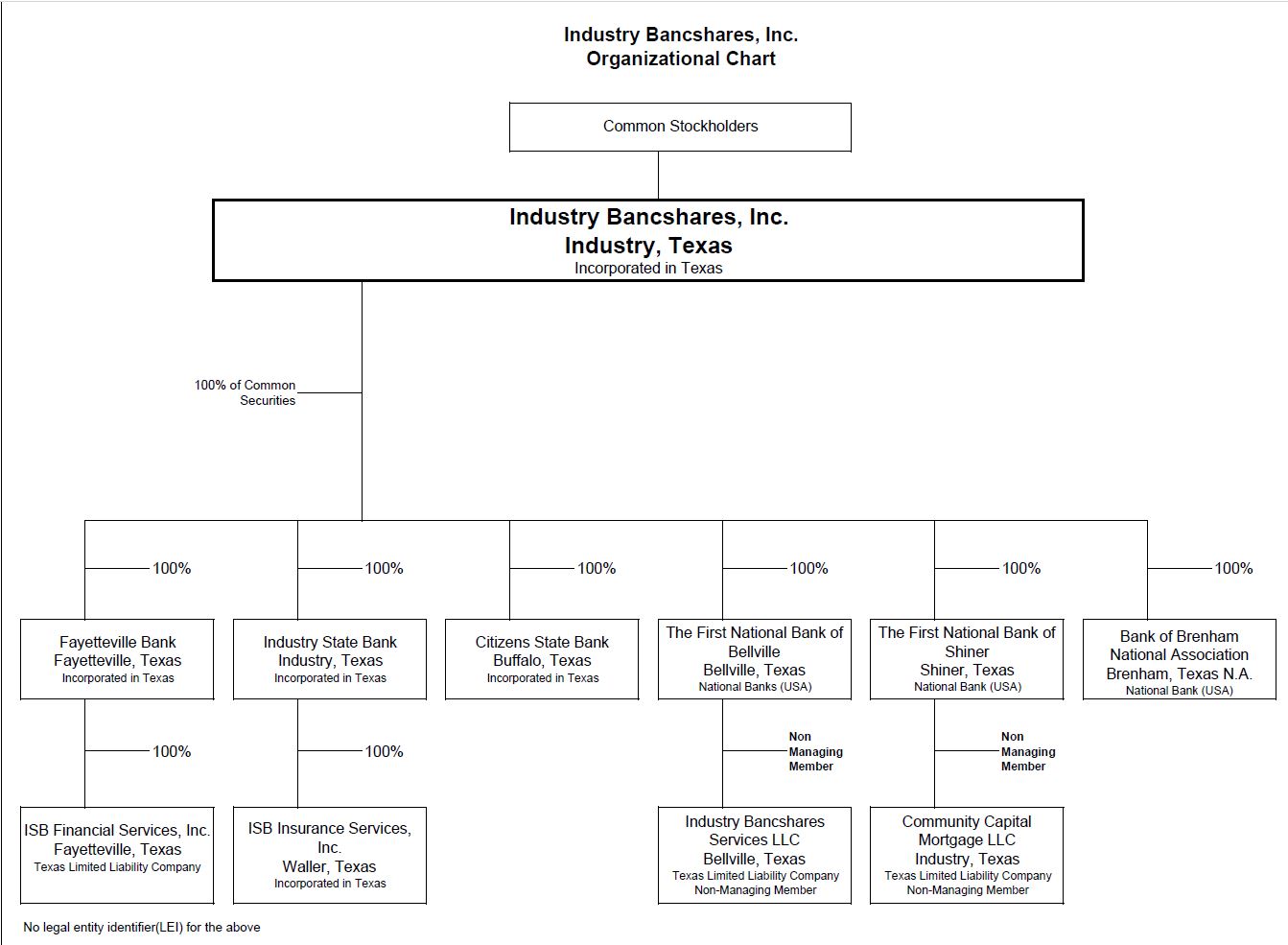
Weirdly, as I wrote about a few months ago, just 15 out of 4,697 banks in the United States reported a negative net worth mid-way through 2023, putting them at risk of insolvency if too many depositors and lenders decided to ask for their money back. Even more weirdly, 6 of those 15 negative net worth banks are actually part of the same bank, the bank holding company Industry Bancshares. This holding company is made up of 6 small Texas banks with 27 branches located in rural counties between Houston, San Antonio, and Austin: Citizens State Bank of Buffalo, Bank of Brenham National Association, Fayetteville Bank, First National Bank of Bellville, First National Bank of Shiner, and Industry State Bank.

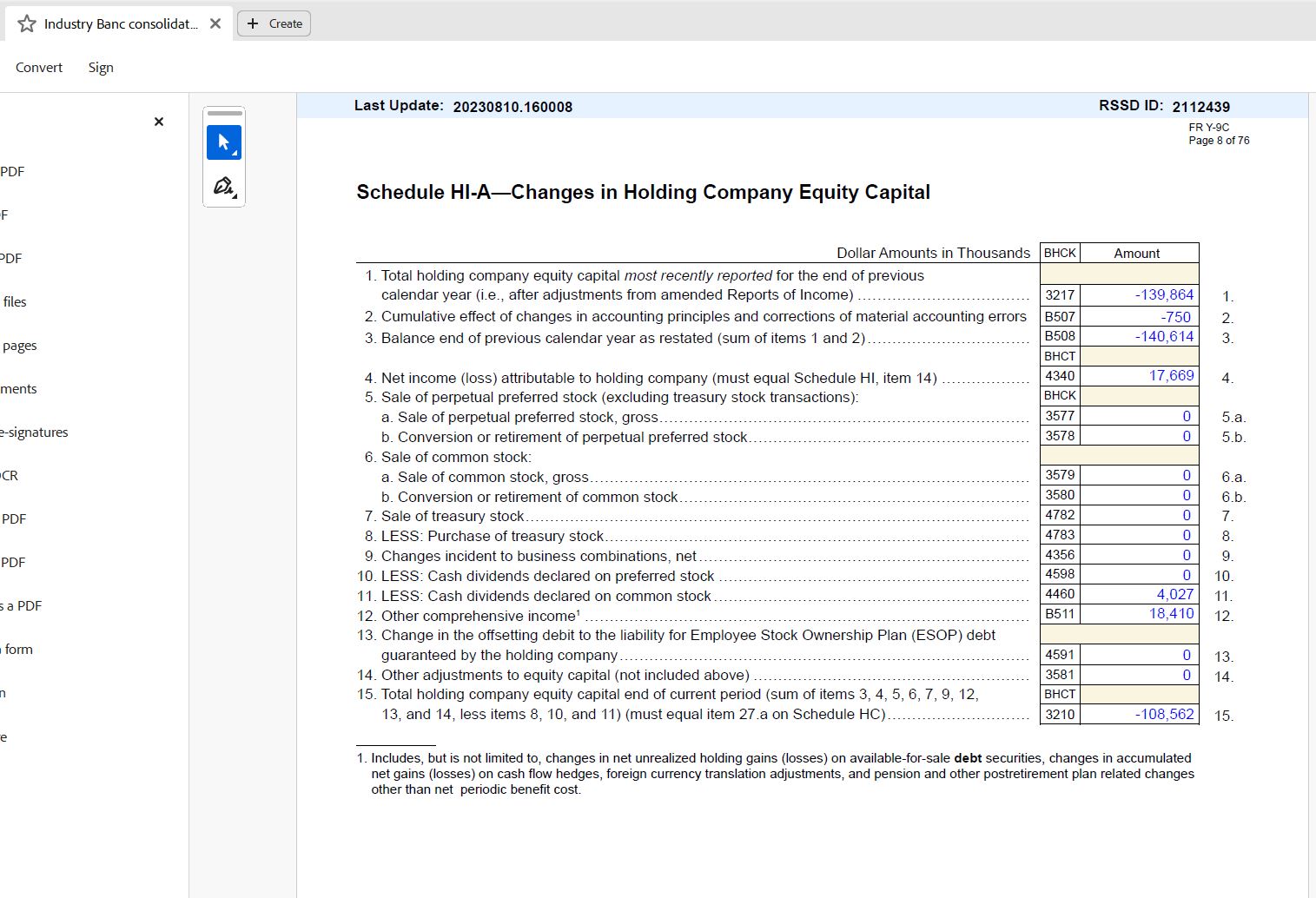
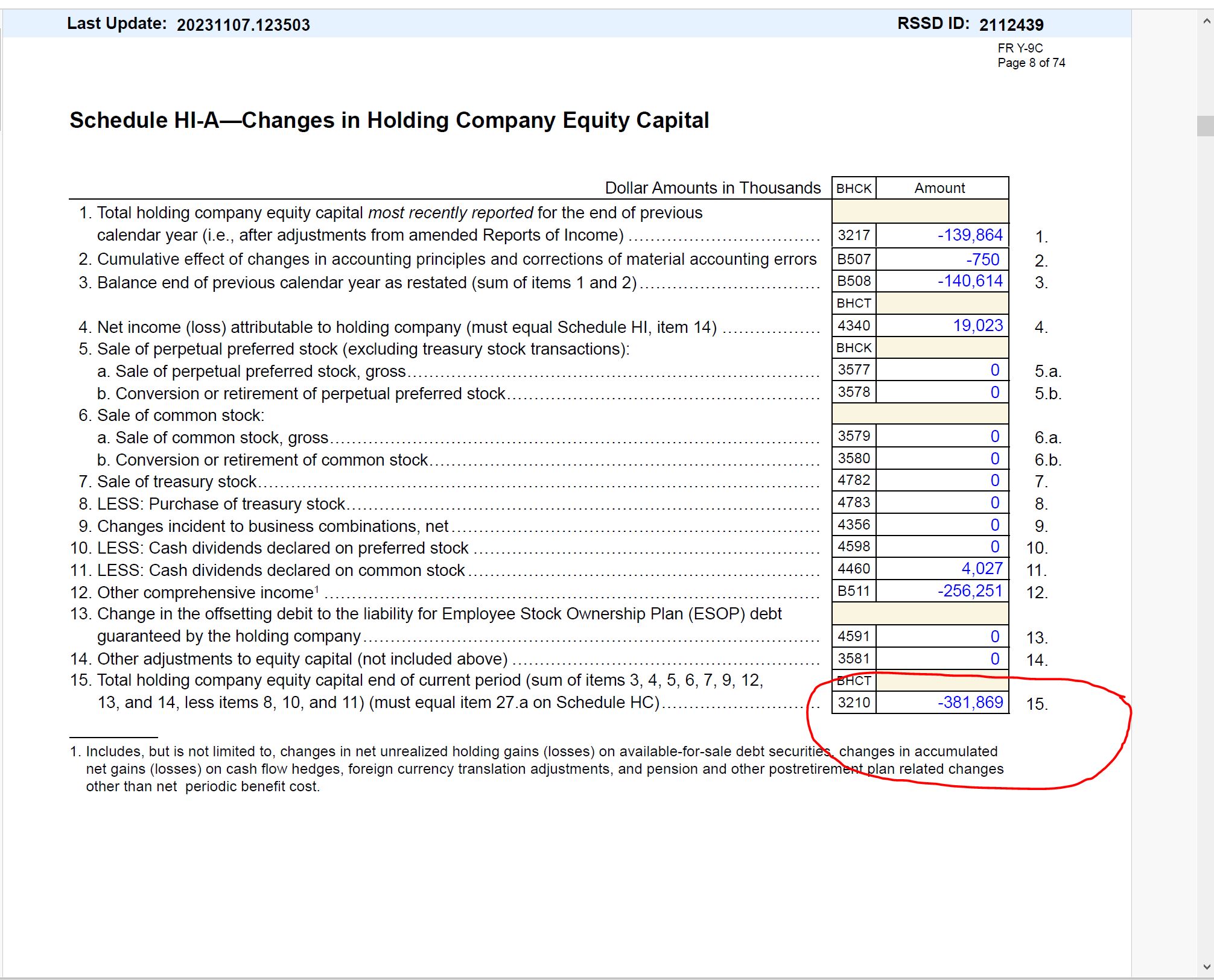
When I first wrote about the bank, each one of the six individual banks had a negative net worth. In total the six were collectively in the hole for $128 million, or $108 million at the bank holding company level. That value was based on public filings from the end of June 2023. Unfortunately, due to further interest rate rises and bond portfolio losses, each of the six individual banks now has a significantly larger, that is to say worse, negative net worth. Collectively that balance sheet hole ballooned to $401.4 million by September 30 2023, or $381.9 million at the bank holding company level.

$108 million reported negative equity in June 2023 for Industry Bancshares. Line 15 is the key. Line 3 is as of year-end December 2022. Bank management reported this position to regulators since at least late 2022.

The solutions

The last time I wrote about Industry Bancshares, I mentioned possible solutions management could pursue were to: 

1. Try to sell to a larger, better-capitalized, bank 

2. Raise new investor capital 

3. Do nothing, and hope to earn their way over time out of their negative equity position, or

4. Do nothing, and hope for bond portfolio values to improve.  

I don’t know if they are trying option 1. They reported to shareholders that they hired a financial advisor known as Hovde Group to seek strategic financial solutions. The December 2023 shareholder meeting is a necessary step in the direction of option 2. Option 3 is a longer-term strategy which requires patience on the part of regulators and depositors to overlook their negative net worth for a few years in the hopes that consistent profitability solves the problem. Industry Bancshares reported $19 million in net income through September 2023, so this is possible, but it would take a while. Option 4, which they elected to do by default, appears to have exacerbated the situation. 

Further bond portfolio losses led to negative $381.9 million equity capital position by September 2023. Line 12 is how much worse the bond portfolio got in Q3 2023 alone, as interest rates rose.

Interest rates jumped again in the 3rd quarter of 2023, and losses deepened. Option 4, doing nothing with the bond portfolio, has made their negative equity position 3 times larger than was previously reported, halfway through the year.

Bank Accounting v. GAAP Accounting

Because of a quirk in the way banks are regulated, banks can choose to have their portfolio losses on “available for sale” bonds ignored by regulators, when regulators look to see if a bank is solvent or has sufficient capital. Only when bonds are sold – and Industry Bancshares has not sold theirs – are the losses counted. And bonds don’t have to be sold, as long as depositors or other lenders do not request their money back. As a result, Industry Bancshares can state with a straight face that they meet regulatory standards for “well capitalized.” At the same time, in ordinary business terms and according to common sense, they have a deeply negative net worth.

An October letter to shareholders from management included this message: 

“You may have seen an article or two about the Company that have not been very favorable and have been very misleading in many respects. The articles have painted our Company and the banks in an unnecessarily poor light due to an accounting concept that requires banks to report unrealized losses and gains on a certain portion of their securities portfolios.”

I would posit that my article in September was not “very misleading in many respects” at all, although readers can render their own judgment on that. Bankers – who literally evaluate corporate solvency and business valuations for a living – understand very well what the difference is between positive and negative net worth, despite what regulators permit them to report and claim.

Dividends, valuations, and at-risk people and groups

It is notable that the bank paid $4.027 million in dividends via two payments to shareholders in April 2023 and July 2023, even though the bank as a going concern was worth less than zero dollars in the ordinary sense of a business enterprise.

Industry_bancshares_org_chart
Industry Bancshares Org Chart as of 2019

In January 2023, bank management communicated to shareholders that bank shares were worth an estimated $37.25 per share, down from approximately $44 per share in 2022. This despite a December 31 2022 equity capital position of negative $159.7 million across all six banks combined. Management has suggested that a new share offering after December 2023 would be in the range of $1.5 to $2.5 per share. Even before the issuance of new shares, existing shareholders are facing a 95% loss in value over the past year.

The owners of the more than $2 billion in more than 3,100 deposit accounts with balances above $250 thousand, employees who may have their net worth tied up in an Employee Stock Ownership Plan (ESOP), and ordinary shareholders should seek to more fully understand their situation at Industry Bancshares.

A version of this post ran in the San Antonio Express News and Houston Chronicle.

Please see related posts

A Troubled Texas Bank, Part I

USAA had a very bad, no good year in 2022

It’s A Wonderful Life, a failed banker origin story

Post read (1091) times.

Book Review: The Counting House by Gary Sernovitz

My favorite finance novel of the past few years was released today, November 14, 2023.

The central character of The Counting House, identified throughout the novel as “the CIO,” is in a mid-to-late personal and career crisis, as the manager of a University endowment. 

Once upon a time, the Chief Investment Officer managed to beat the market for a few years. In addition to securing his comfortable pay package he got a hagiographic New York Times write-up as his reward. Unhappily ever after, however, he has languished in financial-performance mediocrity. Lately he has underperformed. That is his perseverative fear.

I met The Counting House author Gary Sernovitz in person a few years ago when he visited San Antonio to make a presentation on the oil and gas industry. In his day job he is a managing director of Houston-based private equity firm Lime Rock Partners. I read an advance copy of The Counting House this past summer.

Was This Written Just For Me?

While I recommend The Counting House to anyone interested in the overlapping themes of a finance guy’s mid-life crisis and competing philosophies of investment management, I have one big fear about this novel: Was this written specifically for me? In the most micro-niche targeted way? Like, possibly I might enjoy and relate to this book more than anyone else on the planet.

First, there’s the level of specificity of the years 2000 to 2023-era hedge fund, private equity, quant fund, and asset allocation characters. Sernovitz name-drops everybody who was anybody during this period. We meet, as the CIO meets, representatives of practically every institutional investment strategy of the past 25 years. Via the CIO’s jaundiced viewpoint, we get Sernovitz’s most skeptical view of each of these. Which are all skeptical views very much worth reading because they are funny, insightful, and multi-layered. 

Although an asset manager himself, the CIO stands at a critical distance from these giants of investment management. He doubts everything about their strategies. He allows for the possibility of genius but assumes that luck and timing play a greater role than genius in raising their reputations.

The central question of the CIO’s inner monologue – to what do we attribute above-market returns? – is the defining finance debate of our times. The protagonist is an asset allocator – he picks the managers who implement the strategies – but he’s deeply skeptical of even that role. Is he exercising a skill? What is that skill, exactly? For people like me, who find markets exciting – yet who have read the research on efficient markets and find most investing strategies absurd – this debate is everything. Everything!

In this particular way the philosophical market question underlying The Counting House seems micro-targeted to me. People who love the markets, but also understand that most of what we humans do to “invest” is a kind of hocus pocus that mesmerizes and entertains but ultimately offers worse risk-adjusted returns than do pure stock index funds.

Are there a few tens of thousands of people who are similarly obsessed with this question? I hope so, which would give this novel the broad audience it deserves. 

The protagonist’s fear, of underperforming or actually losing money, further makes this book particularly appealing to me. 

It is difficult to explain to people who haven’t been fiduciaries for other people’s money, just why this is particularly torturous. From the outside, it probably looks like a highly “First World” problem: When you lose money for wealthy people, institutions and for yourself well, “Boo hoo. So sad.” But, like, did anybody die? No.

Gary_Sernovitz
Author Gary Sernovitz

The CIO is tortured. I have been similarly tortured. 

You feel like a failure. You question whether you have any skill at all. Was past success just an illusion? Were your assumptions made about skill mere self-deception? Investors are not generally naive. Being naive or self-deceived is the worst character flaw for an investor to admit it to. Was I unlucky, did I have bad timing, or was I the dumb money in the situation? Is attempting to achieve risk-adjusted returns, better than an index fund, ultimately a fool’s game? 

Certainly I have concluded (in good company with my main man Warren Buffett) that the vast majority of people – and institutions – shouldn’t be trying to beat the market. They do not have an edge. That’s always my advice, now that I’m on the merely-advice-giving side of things, rather than the fiduciary side. 

The CIO and his Oz

The novel builds to the CIO’s meeting with an Oz-like character. A billionaire wizard of the markets, who does have an edge. He consistently wins. And he prefers to interact with nobody.

He has a lizard-like personality, devoid of warmth. Just pure market-genius. His energy derives from the screens of his Bloomberg terminal. He has no time for human interactions. He is in Sernovitz’s depiction a horror in a human shape, practically oozing a sulfurous smell. Devoid of every human weakness or human vulnerability. He cares nothing for the uses of money – either consumption or philanthropy. He is a pure market creature.

I appreciate Sernovitz’s thought experiment. What lies at the very center of everything? What is the purest expression of capitalism? Sernovitz is a capitalist. I know this not only from his day job but from his earlier book which celebrates the fracking revolution, called The Complete Story of the Shale Revolution, The Fight Over Fracking, and the Energy Revolution, which I also highly recommend.

He also clearly enjoys these contradictions. Can you be an investor but acknowledge the absurdity of it all? Can you be a capitalist but acknowledge an inhumane lizard-brain as the clearest expression of the philosophy? Can you find something worthy of a lifetime’s effort, but constantly critique it?

These are questions possibly better addressed through fiction than philosophy. 

A version of this book review ran in the San Antonio Express News and Houston Chronicle.

See related post:

Book Review: The Green and The Black by Gary Sernovitz

Post read (1234) times.

A Troubled Bank in Texas – Part I

Editor’s Note: A version of this story ran in the San Antonio Express News and Houston Chronicle on September 17 2023. Since this is an ongoing (and soon to be updated story) I figured Part 1, although a few months late, needed to be posted here.

Following the 2nd, 3rd, and 4th largest bank failures in US history – that all occurred in Spring 2023 – a natural question is: What happens next? 

I’ve never thought it likely that only failed banks First Republic, Silicon Valley, and Signature made major errors last year when the Fed aggressively hiked rates, while the other 4,697 banks in the country did not. Only one other tiny bank in Kansas has failed since then. It’s the dog that, eerily, hasn’t barked in the night.

Industry Bancshares Inc is made up of 6 smaller banks in rural Texas counties

Industry Bancshares Inc, has 6 subsidiary banks and 27 branches just a few hours’ drive from each other in the rural counties between the Texas triangle formed by Houston, Dallas, and San Antonio.

The six subsidiary banks of Industry Bancshares, Inc are Citizens State Bank of Buffalo, TX, Bank of Brenham NA, Fayetteville Bank, First National Bank of Bellville, First National Bank of Shiner, and Industry State Bank of Industry TX.

Industry Bancshares Inc Org Chart, as of 2019

Since at least December 2022, and including through their latest public filing of financial data in June 2023, all six of the banks that together make up Industry Bancshares has reported a significant negative net worth, using traditional accounting standards.

Bank Solvency

I don’t mean to be alarmist. Like shouting “fire” in a crowded theater, shouting “insolvent!” in a crowded bank lobby is neither kind nor prudent. Hopefully you watched the movies “Mary Poppins” and “It’s a Wonderful Life” so you have an intuitive sense for the fragility of all banks, especially to the extent that the FDIC only guarantees deposits up to a certain point. 

its_a_wonderful_life
From: “It’s a Wonderful Life”

The people who should be alerted to the financial stats I’m citing, however, are the 3,216 depositors at these 6 banks who have a reported $2.2 billion in accounts over the $250 thousand FDIC guaranteed limit, as of June 2023. This post is aimed specifically at those folks with billions of dollars in under-insured deposit accounts. Shareholders and board members of course should stay alert as well.

A spokesperson for Industry Bancshares Inc responded to a series of my questions, “Industry Bancshares, Inc. and our six chartered banks have capital levels that significantly exceed the required regulatory minimums, are financially strong and well positioned in the current environment to continue to serve our customers throughout the communities we operate in Texas.”

Not credit mistakes, but interest rate mistakes

Unlike past banking crises, the banking crisis of 2023 is not about losses in credit portfolios, meaning loans banks made to businesses or real estate that went sour. Industry Bancshares in fact has a pristine loan portfolio, with each subsidiary reporting less than 0.25 percent of non-performing assets at the end of 2022. This is very clean.

Instead, banks are showing losses on their bond portfolios. Most banks hold lots of bonds, and most bonds lost money in 2022, when interest rates went up quickly. So most banks have losses to report this past year on their bond portfolios. Banks publicly report, every quarter, how much they’ve lost (or gained) on bonds that they hold. 

Says the bank’s spokesperson, “Over the past 30 years, our bond portfolio strategy has enabled us to maintain strong earnings and bolster our capital position. The bond portfolio is comprised of high-quality, performing investments such as U.S. government treasuries and agencies and highly rated Texas municipal securities. The current unrealized losses in our bond portfolio are just that – unrealized. Our high credit quality, highly rated bonds continue to perform as agreed.”

Federal Reserve of Dallas overseas bank holding companies

The bank declined to respond to my question about what changes if any have occurred in the bond portfolio, or the value of the portfolio, or hedging strategy, or interest rate posture since the bank last publicly reported numbers on June 30, 2023.

An outlier in AOCI

The losses that banks have on many of their bonds classified as “available for sale” are reported as an accounting line item called “Accumulated Other Comprehensive Income” (AOCI). In plain language this means “how much are our bonds worth today, if we were forced to sell them, compared to when we bought them?” If they are worth less today, then AOCI is a negative number.

Two other important accounting line items matter to this story, before I explain how much of an outlier Industry Bancshares is among US banks. 

First, banks calculate and report their net worth in two different ways. One is called “Total Equity Capital” and is calculated according to regular business accounting standards (aka generally accepted accounting principles, or GAAP.) You could think of this as the difference between what they own, and what they owe. Standard stuff for how we would calculate the net worth of any business.

A different calculation is called “Common Equity Tier 1 Capital” (aka CET1) which follows specific bank regulatory rules, and it basically allows banks (and their regulators) to more or less ignore bond portfolio losses, in most cases. When a regulator looks at CET1 instead of GAAP results, a bank will look fine, even as it reports extraordinarily negative AOCI numbers.

Here’s where Industrial Bancshares’ quarterly reports from June 2023 are very interesting. (What I mean is now is the point to unglaze your eyes from my accounting lesson, and sit up straight in your chair.)

Industry Bancshares’ Unusual Situation

Using data from official bank accounting reports, just a mere 15 banks in the entire country had a negative “Total Equity Capital” number at the end of June 2023. Interestingly, the top 5 worst banks on the list, or in other words the banks with the lowest net worth on the list of 4,697 banks in the country are actually part of the same bank holding company. Number 7 on this ignominious list is also part of the same holding company. Yes, you guessed it, they are the 6 banking subsidiaries of Industry Bancshares Inc of Texas. All 6 subsidiaries have a negative net worth, and as a result so does the consolidated bank holding company. All-in, Industry Bancshares is currently supporting $5.8 billion in assets but has a combined “Total Equity Capital” of negative $128 million, as of its June 2023 report, or $108 million at the holding company level.

Line 15 from June 30 2023 FR Y-9C for Industry Bancshares Inc shows negative $108 million net worth on a GAAP accounting basis

In the plainest language, what does negative total equity capital mean? It’s not just an accounting problem. If depositors and lenders to the bank all wanted their money back tomorrow, and if the bank managed to sell all of their assets (including their bonds) to give that money back, negative equity simply means there wouldn’t be enough money. In simplest terms, they’d be short $128 million. At current prices, their bonds lost so much value last year that there isn’t enough to cover depositors and lenders to the banks. And the bonds didn’t recover enough in the six months from December 2022 to June 2023. They reported negative $159.7 million total equity capital in December 2022.

The fact that there are only 15 banks out of 4,697 in the country with a negative net worth, but 6 of those banks are actually the same bank holding company, makes Industry Bancshares a strong outlier on this measure, according to publicly reported data in June 2023.

And look, I’m not your licensed financial advisor, and your mileage may vary, but personally I like to bank with an institution that has a positive net worth. Actually I’d be fine because, sadly for me, I don’t have balances over $250 thousand at my bank, but you know what I mean.

In response to my query about their $2.2 billion in 3,216 underinsured deposit accounts as of June 2023, the spokesperson for the bank replied “We have a growing, diverse, stable, and loyal deposit base. Our team of bankers use their experience and industry best practices to counsel our customers on how to safeguard their large cash balances…With six chartered banks we can increase FDIC insurance for customers across our affiliates. In addition, we utilize IntraFi Network, a solution that helps bank depositors access FDIC insurance above $250 thousand, to ensure our customers have access to FDIC insurance coverage.”

Another independent ranking

Bauer Financial, a bank rating group, assigns ratings every quarter to banks based on their financial strength.

In their June 2023 ranking, five out of 487 of banks in Texas merited 2 out of 5 stars, indicating a rating of “problematic.” Twenty-three banks out of 487 got 3 stars, indicating “fair” financial health. All 6 subsidiary banks of Industry Bancshares received 3 out 5 stars in June 2023. That’s a rating on par with San Antonio-based insurance and banking giant USAA. Although Bauer is indicating some cause for concern, they are not highlighting Industry Bancshares as an outlier the way the AOCI measurement I cited does.

Bank ranking company

So why haven’t regulators shut them down?

So if these banks are such outliers, when considering their bond portfolio losses and their overall business value, and this information is known and public, why do regulators allow them to be in business? 

I mean, one would assume and hope regulators are paying attention. The Dallas Federal Reserve would have responsibility for the bank holding company. In response to my query, the Texas Department of Banking replied formulaically that they could not comment, among other things, on “information related to a regulated entity’s financial condition or business affairs.” 

So I’ll speculate instead. The answer is likely a combination of: 

1. A bank accounting technicality,

2. A purposefully gentle treatment of bond portfolio losses by regulators, and 

3. Depositors over $250 thousand being blissfully unaware of the risks they currently run.

The bank accounting technicality issue is that regulators essentially have turned a blind eye to AOCI losses, and instead use the special banking health measure – CET1 – that ignores it. The thought process I guess is that as long as banks don’t have to sell their bonds at current market prices, they do not have to lock in their losses. And if depositors don’t flee, and the bank doesn’t sell the bonds at a loss, and other problems don’t crop up like credit losses, everything is fine in the long run. 

The regulatory treatment of CET1, which ignores bond losses, allows the spokesperson for the bank to truthfully say in response to my query: “We have increased our Tier 1 leverage capital levels in each of the last 15 years, and in 2023 those levels have continued to increase. As of July 31, 2023, Industry Bancshares, Inc.’s Tier 1 leverage capital is 11.7% and total risk-based capital is 29.7%, which is in the 99th percentile of our peer group and is well above the regulatory definitions of well capitalized.” The bank, like regulators, focuses on CET1.

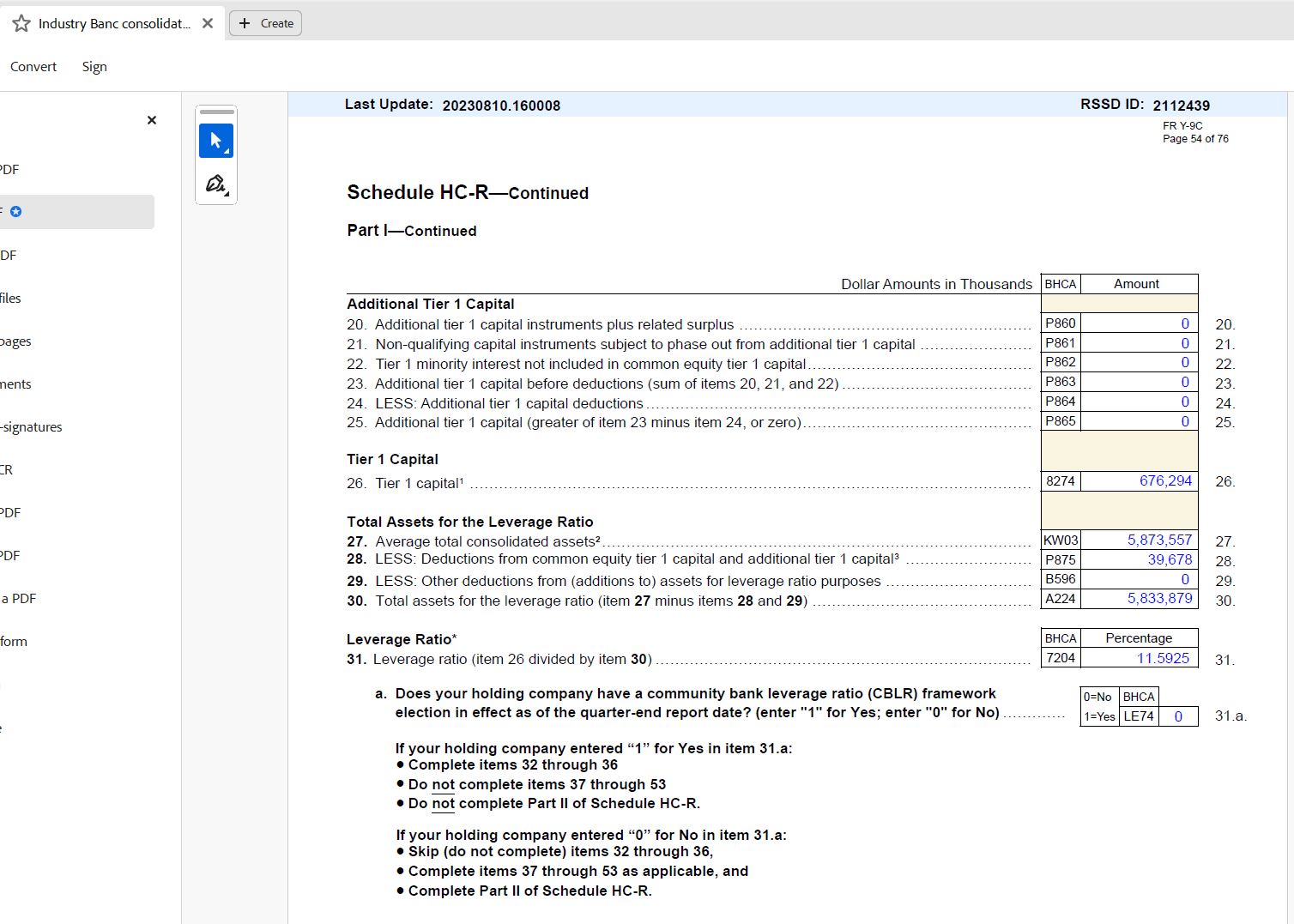
Page 54 of June FR Y-9C. Showing positive CET1 capital of $676 million and healthy 11.5925% leverage ratio. This is likely why regulators have given Industry Bancshares a pass in 2023, as CET1 ignores bond losses.

In fact a special program called the Bank Term Funding Program was created in March 2023 in the wake of the Silicon Valley and Signature failures – failures due to their bond portfolio losses and subsequently depositors fleeing! – to save banks from having to abruptly sell their bonds if they started to lose depositors or needed liquidity for any other reason. It’s a program put in place on an emergency basis that shields banks from the consequences of their losses on their bonds. In plain language, under this program, banks can borrow from the Fed against their bonds in amounts just as if they haven’t had any losses. In the banking world there’s a concept called “extend and pretend” that banks sometimes offer to their borrowing customers who have trouble paying back their debts. This program is a bit like the Federal Reserve offering “extend and pretend,” but for banks with bond portfolio losses.

The positive case for Industry Bancshares

What could a bank like Industry Bancshares, Inc and its subsidiaries do in this scenario to improve their lot and protect their uninsured depositors? The prudent short-run solution is to either merge with a stronger bank or sell to a stronger bank. Were I the acquiring bank, I would look very closely at the negative net worth and bid accordingly. Acquiring banks understand bank accounting very well.

Another short-term fix is to raise more capital from investors, which can then be used as a cushion against losses or fleeing deposits. Industry Bancshares last raised equity capital in 2017, according to SEC filings. Were I a current or prospective investor, I’d want to know their current position, but maybe they already do? The bank declined to respond to my question of whether it had sought to raise additional capital to bolster its negative net worth.

Were I an uninsured depositor with a commitment to sticking with one of these banks, additional capital would be the main thing I’d demand. The bank did not to respond to my question of whether the bank had paid investors dividends in 2022 or 2023. Documents I reviewed showed the bank did pay dividends to investors at least from 2014 to 2019. 

The long-term fix, or no fix at all, is to wait. Given enough time, a successful bank franchise can earn money and climb its way out of a financial hole. Not counting their bond losses, the combined banks earned $76 million in 2022. At this pace of earnings, and assuming no change in their bond portfolio, they could climb back to a roughly breakeven, a zero net worth, in about two years.

Their bond portfolio may recover in time. As long as depositors do not flee and regulators give them time, these banks may eventually survive and thrive. But for anyone with more than $250 thousand in your account, you’ve been warned.

Please see related posts:

USAA Bank reports 2022 results – Not Great

Post read (4666) times.

Ask An Ex-Banker – Future Mortgage Rates

Q: We moved away from San Antonio last summer. Our prior APR, with 11 years left on our mortgage, was 3.25 percent. The interest rate for our new house was 5.25 percent.  We took out a 30-year loan with plans to refinance it into a 15-year when interest rates go down.  Now I’m not sure when they will ever go down. Or, when they start to go down, how long do we wait?  Our old 3.25 percent seems like a dream now. If it gets to 4 should we jump on that? Will it get to 4 in the next year?

-Jeff J, Nashville, TN

A:

You have many high-salience mortgage questions in a very short note! I’ll address each one. 

One of my rules is to not forecast markets. Neither stock markets nor interest rates markets. Partly that’s because I will always be wrong and I don’t like being wrong. Partly it’s because it really bothers me when finance media people pretend they can predict the future. In reality, that specific habit of forecasting by otherwise supposedly serious finance media people should earn them a fortune-teller’s cap (with all the stars and lightning bolts) to signal their likely accuracy. 

Having said all that, I still have some guideposts for you to watch for the future.

The Federal Reserve last raised the benchmark fed funds interest rate on July 26, completing its eleventh hike after more than a year of very aggressive interest rate rises. National mortgage rates changed a lot in the last 16 months as a result. While the Fed does not directly control mortgage rates, the benchmark fed funds rate plays an important anchoring role in setting 15-year and 30-year mortgage rates. All that means is that while future interest rate predictions are impossible to make, the first thing that would have to happen for mortgage rates to come down dramatically is the Federal Reserve signaling they are done raising rates. They have not yet signaled that. So you have a ways to wait still for the first guidepost. 

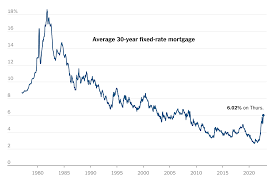
30-year-mortgage-rates

The next guidepost would be that the Fed intends to actually lower rates. Usually that happens because a recession has begun or some other shock to the system forces the Fed to lower rates. That hasn’t happened yet either. Once the Fed signals an intention to lower rates – or actually starts to do it – then you can sharpen your pencil to pick a target for refinancing your mortgage.

Mortgage rates as of this writing (with “no points”) are above 6 percent for 15 years and above 7 percent for 30 years, making your current 5.25 percent 30 year mortgage comparatively attractive right now. You are very much not incentivized to refinance at current rates.

“How much would interest rates have to drop to make it worthwhile to refinance?” is the logical and popular follow-up question. Mortgage lenders, because they earn fees every time you refinance, would have you refinance with a 1 percent improvement in your interest rate. To answer one of your questions directly, I probably wouldn’t bother refinancing into a 4 percent mortgage rate. Reasonable people can differ on this but for myself, I probably wouldn’t do it until I could drop my interest rate by 2 percent points from my current mortgage. There are just too many fees, “points,” and closing costs to make it financially worthwhile to refinance for a minor improvement in rates.

If you have the extra monthly cash flow required, and you prefer to be in a 15-year mortgage, I’d still look for a 2 percent interest rate improvement over your existing 30-year mortgage to make that change. In your case therefore I’d personally wait until the 15-year mortgage rate hit 3.25 to do it. That’s pretty far away from here and it seems unlikely – barring an emergency crisis or recession – that interest rates will get that low next year.

One other semi-tangential thought for you to watch over the next few years, while waiting for lower interest rates.

In the olden days of the late ‘90s and early 2000s, mortgage rates were roughly around current levels and many people found it advantageous to use floating rate mortgages – known as Adjustable Rate Mortgages (ARMs). 

ARMs got a bad name following the 2008 mortgage crisis, mostly because sub-prime ARMs were a particularly painful product that caused a lot of misery. ARMs would start out for 3 years or 5 years at an affordable fixed rate – 4 or 5 or 6 percent for example – but then adjust upward at the end up the time period into a much higher floating rate with 25 or 27 years remaining on the mortgage. For sub-prime borrowers, the rates adjusted upwards into usurious rates like 12 to 14 percent at the end of the fixed rate period. People lost their homes as a result.

But for prime borrowers, ARMs were not inherently terrible, just somewhat risky. I purchased homes with an ARM (twice!) without doing myself harm. I mention this not because you should necessarily refinance into an ARM, but rather to just remind you that these products exist, they are not inherently evil, and there could come a time when it would make sense to consider refinancing into an ARM. 

But not yet. Not to get too technical on the shape of the interest rate curve, but ARMs are generally attractive when short-term interest rates are much lower than medium to long-term interest rates. As of this writing, short-term interest rates in the US are remarkably and unusually flat-to-inverted, meaning short term interest rates are actually higher than long term rates. This makes ARMs particularly unattractive right now. So they are definitely not a solution to your problem today. 

It’s not impossible, however, that ARMs rates could become attractive before traditional 15 or 30 year mortgages do. Just something to watch out for in the next few years while you hope for improved rates for refinancing your mortgage.

A version of this ran in the San Antonio Express News and Houston Chronicle.

Post read (164) times.